 VIPSolutions
give answer in 2 step with explanation at the end of each step and final answer at the end:Ex 16.6.1 Describe or sketch the surface with the given vector function. a.r(u,v) = (u+v,3 —v,1+ 4u +50) b. r(u,v) = (2sinu,3 cos u,v) c. x(s,t) = (s5,t,8% — 5%) d. r(s,t) = (ssin2t, s% s cos 2t) Ex 16.6.2 Find a vector function r(u,v) for the surface. a. The plane that passes through the point (1,2, —3) and is parallel to the vectors (1,1,—1) and (1,—1,1). b. The lower half of the ellipsoid 222 + 4y? + 22 = 1. c. The part of the sphere of radius 4 centered at the origin that lies between the planes z=-2andz=2.
Question:
give answer in 2 step with explanation at the end of each step and final answer at the end: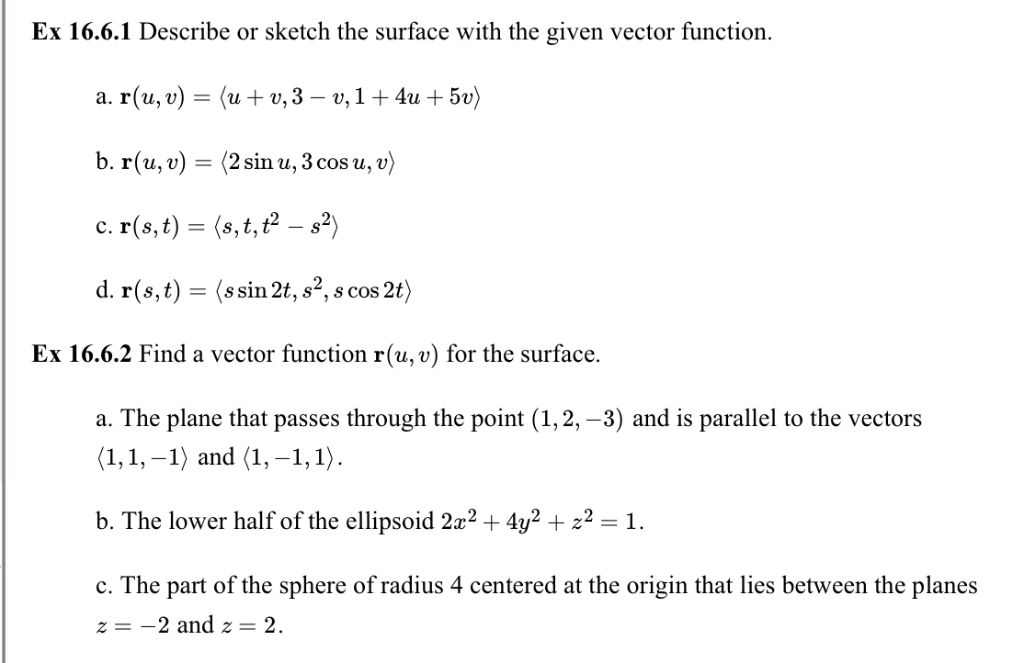 Ex 16.6.1 Describe or sketch the surface with the given vector function.
a.r(u,v) = (u+v,3 —v,1+ 4u +50)
b. r(u,v) = (2sinu,3 cos u,v)
c. x(s,t) = (s5,t,8% — 5%)
d. r(s,t) = (ssin2t, s% s cos 2t)
Ex 16.6.2 Find a vector function r(u,v) for the surface.
a. The plane that passes through the point (1,2, —3) and is parallel to the vectors
(1,1,—1) and (1,—1,1).
b. The lower half of the ellipsoid 222 + 4y? + 22 = 1.
c. The part of the sphere of radius 4 centered at the origin that lies between the planes
z=-2andz=2.
This is AI generated Response.
Asked by: Rahul
Created at: 2025-11-21 03:27:15
Asked by: Rahul
Created at: 2025-11-21 03:27:15
Final Answer:
Rendered
Raw Text
Did you like this answer?
Let's solve **Ex 16.6.2(a)** as requested, in **2 steps** with explanations after each.
---
## Ex 16.6.2(a)
### **Step 1: Write the General Form of the Plane**
A plane that passes through a point \( \mathbf{r}_ = (x_, y_, z_) \) and is parallel to vectors \( \mathbf{a} \) and \( \mathbf{b} \) can be parameterized as:
\[
\mathbf{r}(u, v) = \mathbf{r}_ + u\mathbf{a} + v\mathbf{b}
\]
**Explanation:**
This formula gives all points on the plane by starting at the point \(\mathbf{r}_\) and moving along the directions given by the vectors \(\mathbf{a}\) and \(\mathbf{b}\), scaled by parameters \(u\) and \(v\).
---
### **Step 2: Plug in the Given Values**
- Point: \( (1, 2, -3) \)
- Vectors: \( \langle 1, 1, -1 \rangle \) and \( \langle 1, -1, 1 \rangle \)
So,
\[
\mathbf{r}(u, v) = \langle 1, 2, -3 \rangle + u \langle 1, 1, -1 \rangle + v \langle 1, -1, 1 \rangle
\]
\[
= \langle 1 + u + v,\; 2 + u - v,\; -3 - u + v \rangle
\]
**Explanation:**
We added \(u\) times the first vector and \(v\) times the second vector to the initial point, and combined components.
---
## **Final Answer**
\[
\boxed{
\mathbf{r}(u, v) = \langle 1 + u + v,\; 2 + u - v,\; -3 - u + v \rangle
}
\]
📢 Instructions:
- Ask anything relatd to above question only.
- For new Question goto :