 VIPSolutions
give answer in 2 step with explanation at the end of each step and final answer at the end:What is the magnitude of the net force on the second wire in (Figure 1)? Express your answer in newtons. F=[ov Request Answer Part C What is the magnitude of the net force on the third wire in (Eigure. 1)? Express your answer in newtons. 10A 2 20cm 20cm 3 10A DE ———————— 50cm What is tho mag of the nat ce on the second wre in (Eke 17 Express your answer in newton. mE. c= y Fa 5 |x pa— ~ pac Wht he mage of he ne force on the Pwd wee n (Ex. 1)7 Express your answer in newtons.
Question:
give answer in 2 step with explanation at the end of each step and final answer at the end: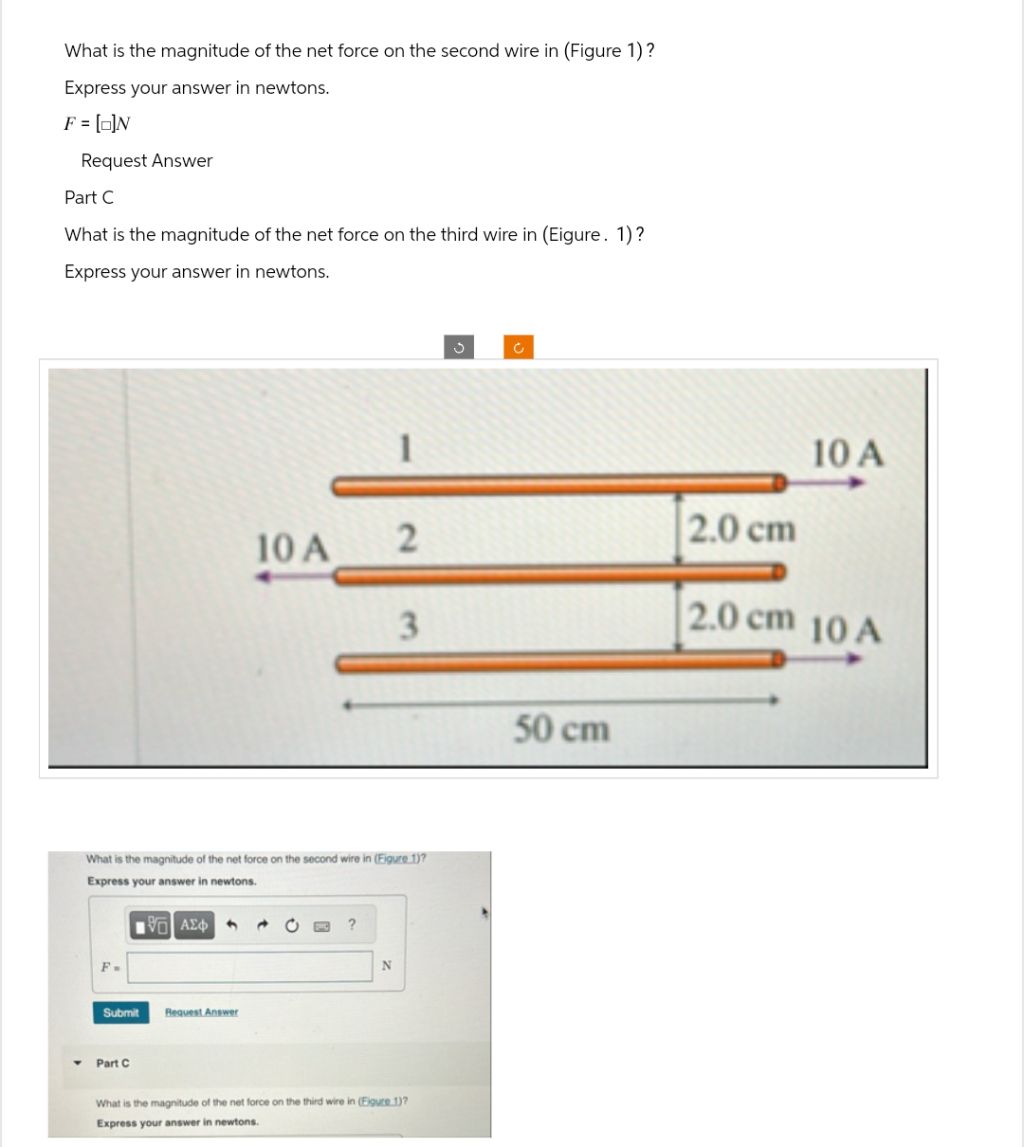 What is the magnitude of the net force on the second wire in (Figure 1)?
Express your answer in newtons.
F=[ov
Request Answer
Part C
What is the magnitude of the net force on the third wire in (Eigure. 1)?
Express your answer in newtons.
10A 2 20cm
20cm
3 10A
DE ————————
50cm
What is tho mag of the nat ce on the second wre in (Eke 17
Express your answer in newton.
mE. c= y
Fa 5 |x
pa—
~ pac
Wht he mage of he ne force on the Pwd wee n (Ex. 1)7
Express your answer in newtons.
This is AI generated Response.
Asked by: Rahul
Created at: 2025-11-21 03:19:40
Asked by: Rahul
Created at: 2025-11-21 03:19:40
Final Answer:
Rendered
Raw Text
Did you like this answer?
Let's solve the problem step by step:
---
## **Step 1: Find the force per unit length between two parallel wires**
The magnetic force per unit length between two parallel wires carrying currents \( I_1 \) and \( I_2 \), separated by distance \( r \), is given by:
\[
\frac{F}{L} = \frac{\mu_}{2\pi} \frac{I_1 I_2}{r}
\]
where
- \( \mu_ = 4\pi \times 10^{-7} \, \text{T}\cdot\text{m}/\text{A} \)
- \( I_1 = I_2 = 10\,\text{A} \)
- \( r = .02\,\text{m} \) (since 2. cm = .02 m)
**Explanation:**
This equation tells us how much force each meter of one wire experiences due to the other, depending on their currents and separation.
---
## **Step 2: Calculate net force on the second wire**
The second wire (middle) is affected by both the top and bottom wires:
- **Wire 1 (top):** Current is to the right; distance = .02 m above wire 2.
- **Wire 3 (bottom):** Current is to the right; distance = .02 m below wire 2.
Since the currents in wire 1 and wire 3 are both to the right, and wire 2 is to the left:
- The force from each is **attractive** (opposite current directions), so both forces act in the **same direction** (toward the other wires).
Calculate force from one wire:
\[
F_{12} = \left(\frac{\mu_}{2\pi}\right) \frac{I_1 I_2}{r} \cdot L = \left(\frac{4\pi \times 10^{-7}}{2\pi}\right) \frac{10 \times 10}{.02} \cdot .5
\]
\[
= (2 \times 10^{-7}) \frac{100}{.02} \cdot .5
\]
\[
= (2 \times 10^{-7}) \times 500 \times .5
\]
\[
= (2 \times 10^{-7}) \times 250
\]
\[
= 5 \times 10^{-4}\ \text{N}
\]
Since both wires exert the same magnitude of force on wire 2 and in the same direction:
\[
F_{net} = 2 \times 5 \times 10^{-4} = 1 \times 10^{-3}\ \text{N}
\]
**Explanation:**
Both adjacent wires pull wire 2 with equal force, so the total magnitude is double the single-wire value.
---
## **Final Answer**
**The magnitude of the net force on the second wire is:**
\[
\boxed{1 \times 10^{-3}\ \text{N}}
\]
---
If you also need the answer for the third wire, let me know! The process is almost identical.
📢 Instructions:
- Ask anything relatd to above question only.
- For new Question goto :