This is AI generated Response.
Asked by: Rahul
Created at: 2025-11-20 03:03:51
Final Answer:
RenderedRaw Text
Did you like this answer?
Let's solve the first **two steps** with explanations:
---
## **Step 1: Kirchhoff’s Junction Rule**
**Apply the Junction Rule at point B:**
Let:
- \( I_1 \) be the current through \( P \)
- \( I_2 \) be the current through \( Q \)
- \( I_3 \) be the current through \( R \)
- \( I_4 \) be the current through \( S \)
- \( I_G \) be the current through the galvanometer (between B and D)
**At point B:**
\[ I_1 = I_2 + I_G \]
**At point D:**
\[ I_3 + I_G = I_4 \]
**Balanced condition:**
When the galvanometer shows zero current, \( I_G = \).
So, the relationships become:
- \( I_1 = I_2 \)
- \( I_3 = I_4 \)
**Explanation:**
At the balanced condition (no current through the galvanometer), the current entering node B equals the current leaving through Q, and the current entering node D equals that leaving through S. This is Kirchhoff's Junction Rule (conservation of charge).
---
## **Step 2: Kirchhoff’s Loop Rule**
**Apply the Loop Rule to two loops:**
- **Loop 1: A-B-D-A** (Left loop)
- **Loop 2: B-C-D-B** (Right loop)
Let's write the voltage equations (clockwise):
### **Loop A-B-D-A:**
\[
\text{Voltage drop across } P + \text{Voltage drop across } R =
\]
\[
I_1 P - I_3 R =
\]
But since \( I_1 = I_3 \) (from Step 1, at balance), this simplifies to:
\[
I_1 P = I_1 R \implies P = R
\]
But let's keep it general for now.
### **Loop B-C-D-B:**
\[
\text{Voltage drop across } Q + \text{Voltage drop across } S =
\]
\[
I_2 Q - I_4 S =
\]
Again, since \( I_2 = I_4 \) (from Step 1, at balance), this simplifies to:
\[
I_2 Q = I_2 S \implies Q = S
\]
But generally, we write:
\[
I_2 Q = I_4 S
\]
**Explanation:**
Kirchhoff’s Loop Rule states that the sum of potential differences (voltage) around any closed loop is zero. At balance, the voltage drop from A to B equals that from A to D, and similarly, from B to C equals from D to C.
---
## **Summary of Steps So Far:**
- **Step 1:** At balanced condition, \( I_1 = I_2 \) and \( I_3 = I_4 \).
- **Step 2:** The voltage drops across \( P \) and \( R \) are equal for their respective branch currents, as are the drops across \( Q \) and \( S \).
---
## **Final Answer (for Steps 1 & 2):**
- **Step 1:** At balance, \( I_1 = I_2 \), \( I_3 = I_4 \) (by Junction Rule).
- **Step 2:** For the loops, \( I_1 P = I_3 R \) and \( I_2 Q = I_4 S \) (by Loop Rule). At balance, these simplify further as the currents in each branch are equal.
---
Let me know if you'd like to proceed with Steps 3 and 4!
VIPSolutions focuses on clear, step‑by‑step explanations so you can learn quickly. Whether you need an AI‑generated walkthrough or a short hint to get unstuck, each solution is organized for fast reading and easy review later.
Search similar questions, compare approaches, and bookmark the best answers for revision. Our goal is simple: quick, reliable study help that feels natural—not noisy.
 VIPSolutions
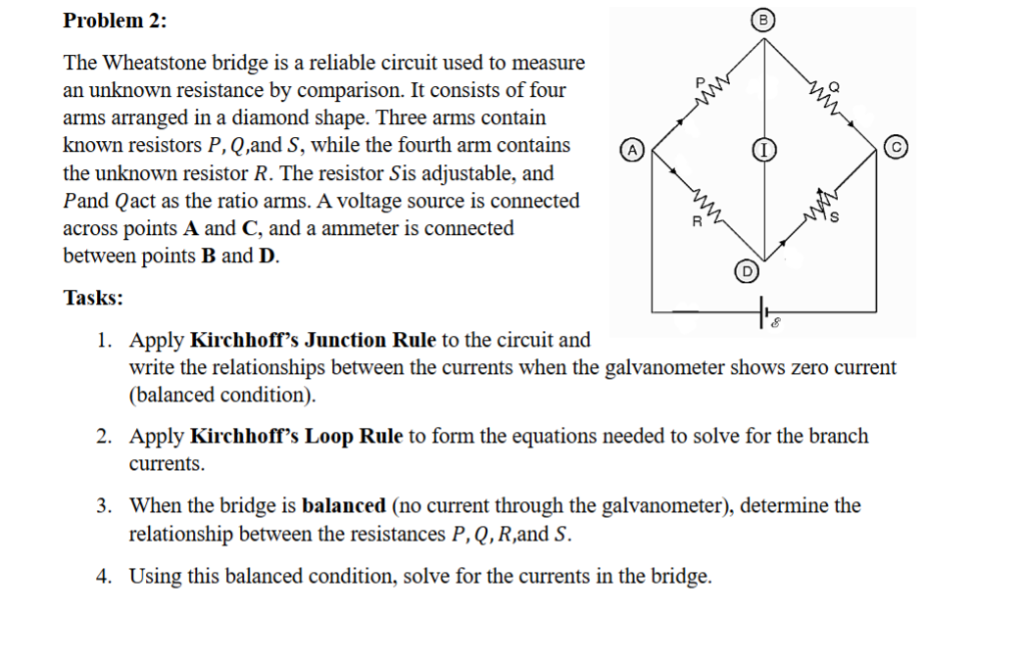 Problem 2:
The Wheatstone bridge is a reliable circuit used to measure
an unknown resistance by comparison. It consists of four R Q
arms arranged in a diamond shape. Three arms contain
known resistors P, Q,and S, while the fourth arm contains ® ©
the unknown resistor R. The resistor Sis adjustable, and
Pand Qact as the ratio arms. A voltage source is connected
across points A and C, and a ammeter is connected G s
between points B and D. ®
Tasks:
&
1. Apply Kirchhoff’s Junction Rule to the circuit and
write the relationships between the currents when the galvanometer shows zero current
(balanced condition).
2. Apply Kirchhoff’s Loop Rule to form the equations needed to solve for the branch
currents.
3. When the bridge is balanced (no current through the galvanometer), determine the
relationship between the resistances P,Q, R,and S.
4. Using this balanced condition, solve for the currents in the bridge.