 VIPSolutions
give answer in 2 step with explanation at the end of each step and final answer at the end:Predict the major product obtained from each of the following reactions and show the stereochemistry where pertinent c-g | |
Question:
give answer in 2 step with explanation at the end of each step and final answer at the end: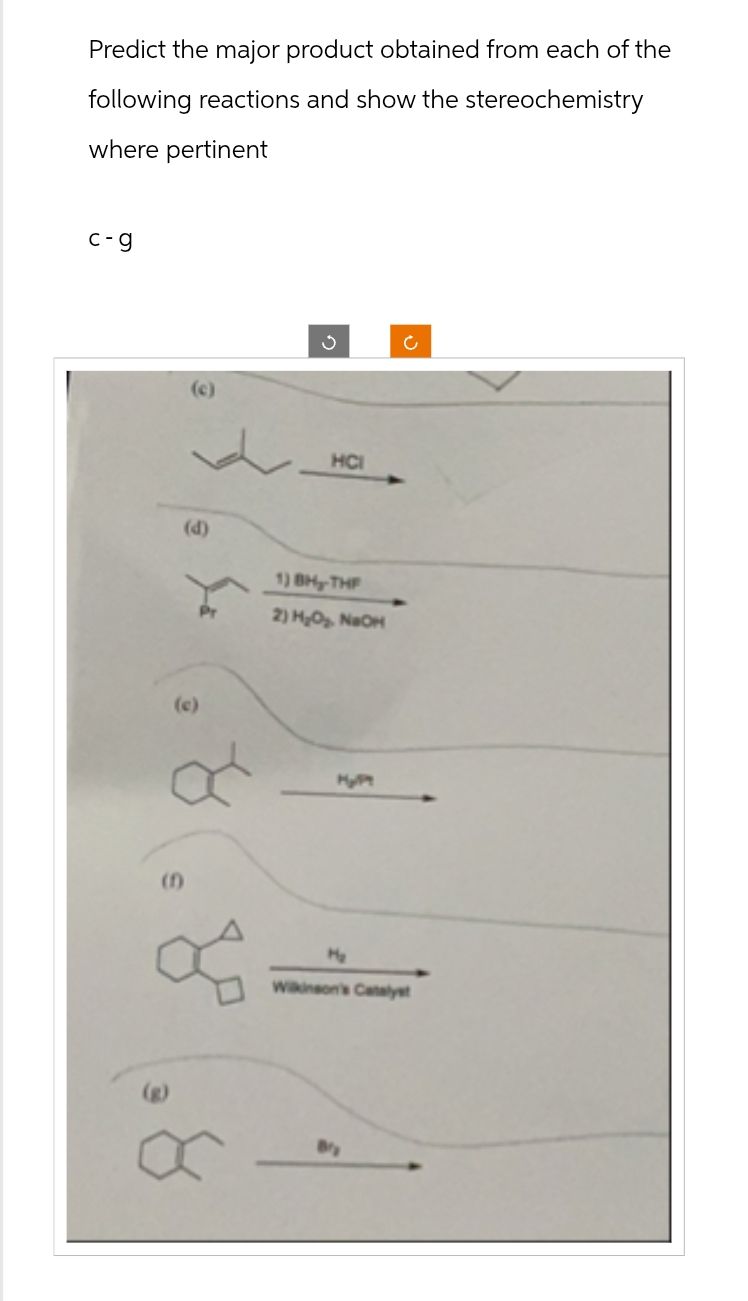 Predict the major product obtained from each of the
following reactions and show the stereochemistry
where pertinent
c-g
| |
This is AI generated Response.
Asked by: Rahul
Created at: 2025-11-19 19:18:41
Asked by: Rahul
Created at: 2025-11-19 19:18:41
Final Answer:
Rendered
Raw Text
Did you like this answer?
Let's solve each reaction stepwise, with explanations:
---
## (c) Addition of HCl to an Alkene
**Step 1**:
Identify the reaction as a **Markovnikov addition** of HCl to an alkene.
- The double bond will react with HCl.
- The H will add to the carbon with more hydrogens (least substituted).
- The Cl will add to the more substituted carbon.
**Step 2**:
Draw the product:
- The double bond is between the second and third carbon.
- H adds to the terminal carbon, and Cl adds to the middle one.
**Major Product:**
2-chloro-2-methylbutane
```
CH3
|
CH3—C—CH2—CH3
|
Cl
```
---
## (d) Hydroboration-Oxidation
**Step 1**:
This is an **anti-Markovnikov** addition of water across the double bond (BH₃/THF, then H₂O₂/NaOH).
- The OH group will attach to the less substituted carbon.
**Step 2**:
- Starting with 1-propyl-propene, the OH adds to the terminal carbon.
- Syn addition (same side), but since the group is on a terminal carbon, stereochemistry is not relevant.
**Major Product:**
1-propylpropan-1-ol (or, more simply, 1-pentanol)
---
## (e) Catalytic Hydrogenation (H₂/Pt)
**Step 1**:
This is a **syn addition** of H₂ to a cyclohexene ring.
- All double bonds will be reduced (alkene to alkane).
**Step 2**:
- The product is a fully saturated ring (cyclohexane), with the isopropyl substituent intact.
**Major Product:**
Isopropylcyclohexane
---
## (f) Hydrogenation with Wilkinson’s Catalyst
**Step 1**:
Wilkinson’s catalyst selectively hydrogenates alkenes, not cyclopropanes.
- Only the alkene gets reduced.
**Step 2**:
- The ring system retains the cyclopropyl group; only the double bond is reduced.
**Major Product:**
Cyclohexyl group with cyclopropyl and ethyl substituents (no double bonds).
---
## (g) Addition of Br₂ to an Alkene
**Step 1**:
Br₂ adds **anti** across the double bond (vicinal dibromide formation).
- Stereochemistry: Br atoms add on opposite sides (trans).
**Step 2**:
- The cyclohexene ring will have two Br’s on adjacent carbons, trans to each other.
**Major Product:**
Trans-1,2-dibromocyclohexane (with the ethyl group on C1 or C2, depending on numbering).
---
# **Summary Table**
| Reaction | Major Product | Stereochemistry |
|----------|--------------|-----------------|
| (c) | 2-chloro-2-methylbutane | — |
| (d) | 1-pentanol (anti-Markovnikov) | — |
| (e) | isopropylcyclohexane | — |
| (f) | cyclohexylcyclopropane (alkane) | — |
| (g) | trans-1,2-dibromocyclohexane | trans/anti |
Let me know if you need structures or further clarification!
📢 Instructions:
- Ask anything relatd to above question only.
- For new Question goto :