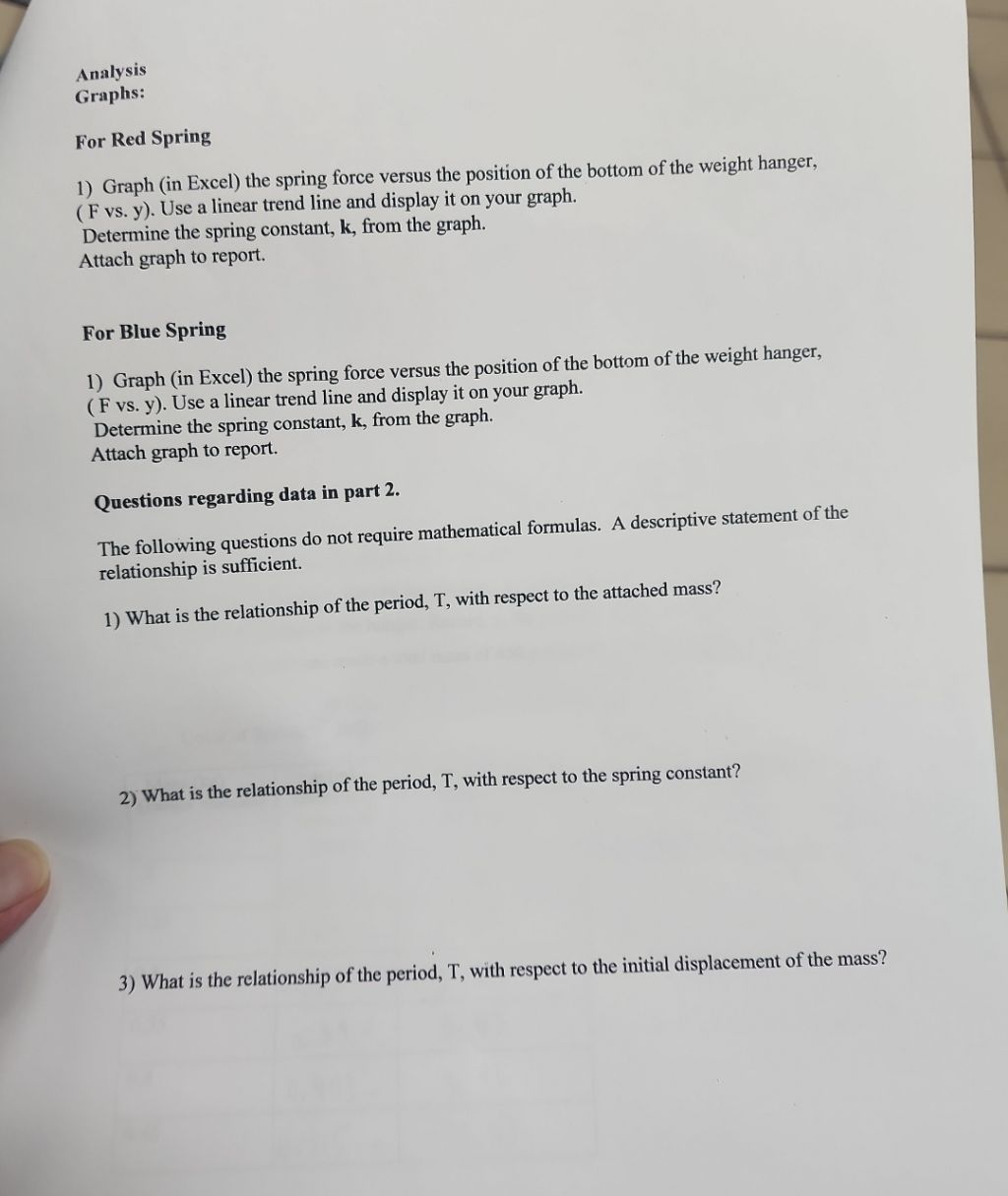
give answer in 2 step with explanation at the end of each step and final answer at the end:/ Analysis
Graphs:
For Red Spring
1) Graph (in Excel) the spring force versus the position of the bottom of the weight hanger,
(F vs. y). Use a linear trend line and display it on your graph.
Determine the spring constant, k, from the graph.
Attach graph to report.
For Blue Spring
1) Graph (in Excel) the spring force versus the position of the bottom of the weight hanger,
(F vs. y). Use a linear trend line and display it on your graph.
Determine the spring constant, k, from the graph.
Attach graph to report.
Questions regarding data in part 2.
The following questions do not require mathematical formulas. A descriptive statement of the
relationship is sufficient.
1) What is the relationship of the period, T, with respect to the attached mass?
2) What is the relationship of the period, T, with respect to the spring constant?
3) What is the relationship of the period, T, with respect to the initial displacement of the mass?
Question:
give answer in 2 step with explanation at the end of each step and final answer at the end:/ Analysis
Graphs:
For Red Spring
1) Graph (in Excel) the spring force versus the position of the bottom of the weight hanger,
(F vs. y). Use a linear trend line and display it on your graph.
Determine the spring constant, k, from the graph.
Attach graph to report.
For Blue Spring
1) Graph (in Excel) the spring force versus the position of the bottom of the weight hanger,
(F vs. y). Use a linear trend line and display it on your graph.
Determine the spring constant, k, from the graph.
Attach graph to report.
Questions regarding data in part 2.
The following questions do not require mathematical formulas. A descriptive statement of the
relationship is sufficient.
1) What is the relationship of the period, T, with respect to the attached mass?
2) What is the relationship of the period, T, with respect to the spring constant?
3) What is the relationship of the period, T, with respect to the initial displacement of the mass?
This is AI generated Response.
Asked by: Rahul
Created at: 2025-11-19 07:42:29
Final Answer:
RenderedRaw Text
Did you like this answer?
Certainly! Here are the step-by-step answers with explanations for the three questions regarding the period \( T \):
---
### 1) What is the relationship of the period, T, with respect to the attached mass?
#### Step 1: Understanding the relationship
The period \( T \) of a mass-spring system depends on the mass attached to the spring. As the mass increases, the period increases.
**Explanation:**
A heavier mass takes more time to complete one oscillation because it has greater inertia, which slows down the system's response.
#### Step 2: Describing the relationship
The period \( T \) increases as the attached mass increases.
---
### 2) What is the relationship of the period, T, with respect to the spring constant?
#### Step 1: Understanding the relationship
The period \( T \) of a mass-spring system depends inversely on the spring constant \( k \). As the spring constant increases, the period decreases.
**Explanation:**
A stiffer spring (higher \( k \)) pulls the mass back more strongly, resulting in faster oscillations and a shorter period.
#### Step 2: Describing the relationship
The period \( T \) decreases as the spring constant increases.
---
### 3) What is the relationship of the period, T, with respect to the initial displacement of the mass?
#### Step 1: Understanding the relationship
For a simple mass-spring system undergoing **simple harmonic motion**, the period \( T \) does **not** depend on the initial displacement.
**Explanation:**
The period is determined only by the mass and the spring constant, not by how far the mass is pulled or pushed from equilibrium (as long as the system remains within the elastic limit and simple harmonic motion applies).
#### Step 2: Describing the relationship
The period \( T \) does not change as the initial displacement changes.
---
## Final Answers
1. **The period \( T \) increases as the attached mass increases.**
2. **The period \( T \) decreases as the spring constant increases.**
3. **The period \( T \) does not depend on the initial displacement of the mass.**
VIPSolutions focuses on clear, step‑by‑step explanations so you can learn quickly. Whether you need an AI‑generated walkthrough or a short hint to get unstuck, each solution is organized for fast reading and easy review later.
Search similar questions, compare approaches, and bookmark the best answers for revision. Our goal is simple: quick, reliable study help that feels natural—not noisy.
 VIPSolutions
 / Analysis
Graphs:
For Red Spring
1) Graph (in Excel) the spring force versus the position of the bottom of the weight hanger,
(F vs. y). Use a linear trend line and display it on your graph.
Determine the spring constant, k, from the graph.
Attach graph to report.
For Blue Spring
1) Graph (in Excel) the spring force versus the position of the bottom of the weight hanger,
(F vs. y). Use a linear trend line and display it on your graph.
Determine the spring constant, k, from the graph.
Attach graph to report.
Questions regarding data in part 2.
The following questions do not require mathematical formulas. A descriptive statement of the
relationship is sufficient.
1) What is the relationship of the period, T, with respect to the attached mass?
2) What is the relationship of the period, T, with respect to the spring constant?
3) What is the relationship of the period, T, with respect to the initial displacement of the mass?