 VIPSolutions
give answer in 2 step with explanation at the end of each step and final answer at the end:1. What is the spring constant of a spring that starts 10.0 cm long and extends to 11.4 cm with a 300 g mass hanging from it? 2. List three places besides in springs where Hooke's law applies. 3. Show that (t) = A cos(wt) + Bsin(wt) is a solution to the differential equation of the mass/spring system. 4. Does the period of simple harmonic motion depend on amplitude? 5.0n what does the period of a mass on a spring depend? 6.Is the true pendulum an example of SHM? Explain. 7.What is the point of using a Taylor series in the context of the pendulum differential equation? 8. What period do you expect to find for small amplitude swinging motion of a rock tied to a 1.0 m long string? 9. Using the animated slider in the book, estimate the period of the same rack caused to swing at a 90 degree angle from vertical. NOTE: Itis possible to drag and zoom the plot in the book to get a precise answer. 10. Why does the actual pendulum'’s plot of angle vs time flatten out at very large swing angles? Give a clear physical explanation 11. At what point in SHM is the velocity maximum? Displacement maximum? 12. What could we conclude if a system has a phase trajectory that sweeps out larger and larger area as time goes by? 13. What does a repetitive phase trajectory indicate about a system? 14. What does each point in phase space represent? 15. Given an oscillator of mass 2.0kg and spring constant of 180N/m, what is the period without damping? Use numerical methods to model this oscillator with an additional friction force equal to Fiamping = —cu where cis a positive damping constant. Using c=5.0, what is the new period of oscillation. What about for c=10? Assume initial position is 0.2m and initial velocity is zero. Please find the period using the position versus time plot and use the first full cycle of the motion. 16. Critical damping is the case where the mass never actually crosses over equilibrium position, but reaches equilibrium as fast as possible. Experiment with changing cto find the critical damping constant. Use the same initial conditions as in the last problem. Zoom in a bit to make sure you don't allow any oscillations to take place - even small ones. 17. Shocks on cars are usually designed to achieve critical damping of the suspension system when the car is loaded with maximum number of passengers and cargo. With only a driver and minimum cargo, is the car over-damped or under-damped? Over-damped means even more damping than the critical amount and under means the opposite. 18. A 2.0kg mass on a spring with elastic constant 32 N/m starts at a position of x=0.3m away from equilibrium with a velocity of 0.4 m/s. What will its maximum displacement be? Maximum velocity? Maximum acceleration? What will those three values be at t=5.05? 19. A pendulum length is doubled. What happens to its period? 20. A mass hanging from a pendulum is doubled. What happens to the period?
Question:
give answer in 2 step with explanation at the end of each step and final answer at the end: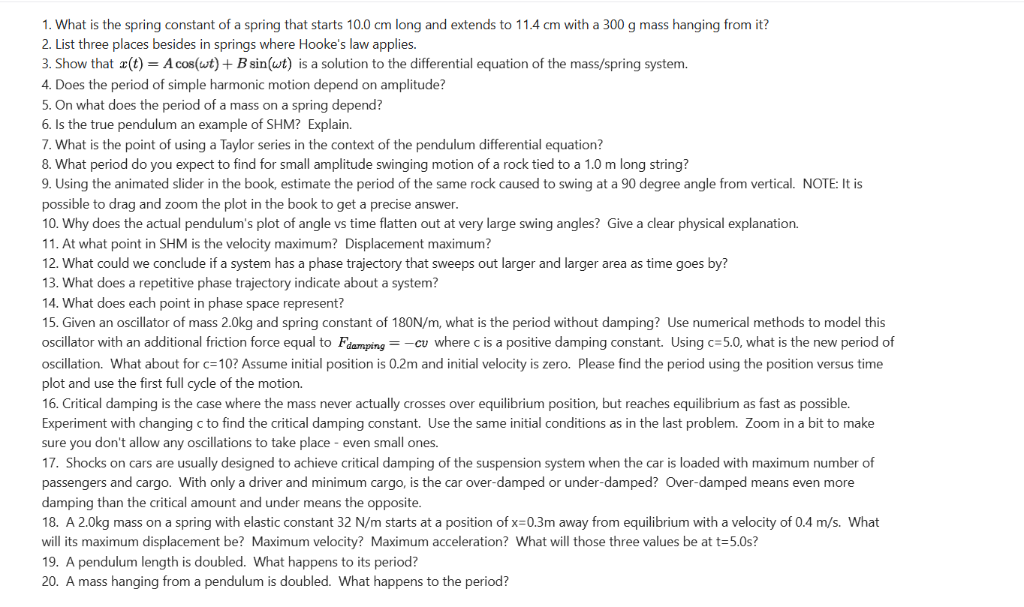 1. What is the spring constant of a spring that starts 10.0 cm long and extends to 11.4 cm with a 300 g mass hanging from it?
2. List three places besides in springs where Hooke's law applies.
3. Show that (t) = A cos(wt) + Bsin(wt) is a solution to the differential equation of the mass/spring system.
4. Does the period of simple harmonic motion depend on amplitude?
5.0n what does the period of a mass on a spring depend?
6.Is the true pendulum an example of SHM? Explain.
7.What is the point of using a Taylor series in the context of the pendulum differential equation?
8. What period do you expect to find for small amplitude swinging motion of a rock tied to a 1.0 m long string?
9. Using the animated slider in the book, estimate the period of the same rack caused to swing at a 90 degree angle from vertical. NOTE: Itis
possible to drag and zoom the plot in the book to get a precise answer.
10. Why does the actual pendulum'’s plot of angle vs time flatten out at very large swing angles? Give a clear physical explanation
11. At what point in SHM is the velocity maximum? Displacement maximum?
12. What could we conclude if a system has a phase trajectory that sweeps out larger and larger area as time goes by?
13. What does a repetitive phase trajectory indicate about a system?
14. What does each point in phase space represent?
15. Given an oscillator of mass 2.0kg and spring constant of 180N/m, what is the period without damping? Use numerical methods to model this
oscillator with an additional friction force equal to Fiamping = —cu where cis a positive damping constant. Using c=5.0, what is the new period of
oscillation. What about for c=10? Assume initial position is 0.2m and initial velocity is zero. Please find the period using the position versus time
plot and use the first full cycle of the motion.
16. Critical damping is the case where the mass never actually crosses over equilibrium position, but reaches equilibrium as fast as possible.
Experiment with changing cto find the critical damping constant. Use the same initial conditions as in the last problem. Zoom in a bit to make
sure you don't allow any oscillations to take place - even small ones.
17. Shocks on cars are usually designed to achieve critical damping of the suspension system when the car is loaded with maximum number of
passengers and cargo. With only a driver and minimum cargo, is the car over-damped or under-damped? Over-damped means even more
damping than the critical amount and under means the opposite.
18. A 2.0kg mass on a spring with elastic constant 32 N/m starts at a position of x=0.3m away from equilibrium with a velocity of 0.4 m/s. What
will its maximum displacement be? Maximum velocity? Maximum acceleration? What will those three values be at t=5.05?
19. A pendulum length is doubled. What happens to its period?
20. A mass hanging from a pendulum is doubled. What happens to the period?
Asked by: Rahul
Created at: 2025-11-19 05:04:51
Final Answer:
📢 Instructions:
- Ask anything relatd to above question only.
- For new Question goto :