 VIPSolutions
give answer in 2 step with explanation at the end of each step and final answer at the end:SRR SRREREYS Lwwwowm EERE ee Fears
Question:
give answer in 2 step with explanation at the end of each step and final answer at the end: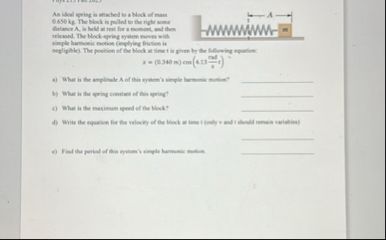 SRR
SRREREYS Lwwwowm
EERE ee
Fears
This is AI generated Response.
Asked by: Rahul
Created at: 2025-11-19 04:24:07
Asked by: Rahul
Created at: 2025-11-19 04:24:07
Final Answer:
Rendered
Raw Text
Did you like this answer?
Let's work through each question step by step, as requested.
---
### (a) What is the amplitude \( A \) of this system’s simple harmonic motion?
**Step 1:**
Identify the equation of motion given:
\( x = (.384\, \text{m}) \cos \left[ (4.72\, \text{s}^{-1})t \right] \)
**Step 2:**
The amplitude is the coefficient in front of the cosine function.
**Explanation:**
In the equation \( x = A \cos(\omega t) \), the value \( A \) is the amplitude.
**Final Answer:**
**Amplitude, \( A = .384\, \text{m} \)**
---
### (b) What is the spring constant of this spring?
**Step 1:**
The angular frequency \( \omega = 4.72\, \text{s}^{-1} \) is given.
For a mass-spring system, \( \omega = \sqrt{\dfrac{k}{m}} \).
**Step 2:**
Rearrange to solve for \( k \):
\( k = m\omega^2 = (.650\, \text{kg}) \times (4.72\, \text{s}^{-1})^2 \)
\( k = .650 \times 22.2784 = 14.48196\, \text{N/m} \)
**Explanation:**
The spring constant \( k \) relates to the mass and angular frequency by the above formula.
**Final Answer:**
**Spring constant, \( k = 14.5\, \text{N/m} \) (rounded to 3 sig figs)**
---
### (c) What is the maximum speed of the block?
**Step 1:**
Maximum speed \( v_{\text{max}} = \omega A \).
**Step 2:**
\( v_{\text{max}} = 4.72\, \text{s}^{-1} \times .384\, \text{m} = 1.81248\, \text{m/s} \)
**Explanation:**
Maximum speed in SHM is the product of angular frequency and amplitude.
**Final Answer:**
**Maximum speed, \( v_{\text{max}} = 1.81\, \text{m/s} \) (rounded to 3 sig figs)**
---
### (d) Write the equation for the velocity of the block at time \( t \) only.
**Step 1:**
The general velocity equation for SHM:
\( v(t) = -A\omega \sin(\omega t) \)
**Step 2:**
Substitute the values:
\( v(t) = -.384\, \text{m} \times 4.72\, \text{s}^{-1} \sin(4.72t) \)
\( v(t) = -1.81 \sin(4.72t) \) m/s
**Explanation:**
Velocity is the derivative of the position function with respect to time.
**Final Answer:**
**\( v(t) = -1.81 \sin(4.72t) \) m/s**
---
### (e) Find the period of this system’s simple harmonic motion.
**Step 1:**
The period \( T = \dfrac{2\pi}{\omega} \).
**Step 2:**
\( T = \dfrac{2\pi}{4.72} = 1.332 \, \text{s} \)
**Explanation:**
The period is the reciprocal of the frequency, which is related to angular frequency.
**Final Answer:**
**Period, \( T = 1.33\, \text{s} \) (rounded to 3 sig figs)**
---
Let me know if you want further clarification on any step!
📢 Instructions:
- Ask anything relatd to above question only.
- For new Question goto :