 VIPSolutions
give answer in 2 step with explanation at the end of each step and final answer at the end:1213 Feng Seavoer Desalionion Sys has cash: Tish 3 capital vest i of SSO0000 fe next year fo projects ht age prone recovery of bighly back gsvandwatr. Al procts have yar le and the MARR ix 10% pr yes on Seect any rato the project. (5) Projet Zs ovr of Mi. Feng. Determioe the mimo NCE ccesary o make Z the ccomomically bes Project (1 Us 3 spesdshct 1 answer te wo. por shove. in Weta savage Prot _imenmene sim Sher ibors Yocum woo ow 2 sam soo om
Question:
give answer in 2 step with explanation at the end of each step and final answer at the end: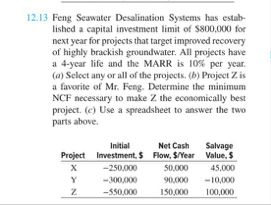 1213 Feng Seavoer Desalionion Sys has cash:
Tish 3 capital vest i of SSO0000 fe
next year fo projects ht age prone recovery
of bighly back gsvandwatr. Al procts have
yar le and the MARR ix 10% pr yes
on Seect any rato the project. (5) Projet Zs
ovr of Mi. Feng. Determioe the mimo
NCE ccesary o make Z the ccomomically bes
Project (1 Us 3 spesdshct 1 answer te wo.
por shove.
in Weta savage
Prot _imenmene sim Sher ibors
Yocum woo ow
2 sam soo om
This is AI generated Response.
Asked by: Rahul
Created at: 2025-11-19 04:12:28
Asked by: Rahul
Created at: 2025-11-19 04:12:28
Final Answer:
Rendered
Raw Text
Did you like this answer?
## Step 1: Net Present Worth (NPW) Calculation
Let's calculate the Net Present Worth (NPW) of each project using the following formula:
\[
NPW = - \text{Initial Investment} + \sum_{t=1}^{n} \frac{\text{Net Cash Flow}}{(1+i)^t} + \frac{\text{Salvage Value}}{(1+i)^n}
\]
Where:
- \( n = 4 \) years
- \( i = 10\% \) or .10
Let's compute the Present Worth (PW) factors:
- \( P/A, i, n = P/A, 10\%, 4 \)
- \( (P/A, 10\%, 4) = \frac{1 - (1 + .10)^{-4}}{.10} \approx 3.170 \)
- \( (P/F, 10\%, 4) = (1 + .10)^{-4} \approx .683 \)
Now, for each project:
### Project X
\[
NPW_X = -250{,}000 + 90{,}000 \times 3.170 + 45{,}000 \times .683
\]
\[
NPW_X = -250,000 + 285,300 + 30,735 = \$66,035
\]
### Project Y
\[
NPW_Y = -300{,}000 + 100{,}000 \times 3.170 + 10{,}000 \times .683
\]
\[
NPW_Y = -300,000 + 317,000 + 6,830 = \$23,830
\]
### Project Z
\[
NPW_Z = -550{,}000 + 150{,}000 \times 3.170 + 100{,}000 \times .683
\]
\[
NPW_Z = -550,000 + 475,500 + 68,300 = -\$6,200
\]
**Explanation:**
We have calculated the NPW for each project at a 10% MARR over 4 years. Projects X and Y have positive NPWs, while Project Z has a small negative NPW.
---
## Step 2: Project Selection and Minimum NCF for Project Z
### (a) Select any or all of the projects (Budget = $800,000)
- Project X: $250,000
- Project Y: $300,000
- Project Z: $550,000
Possible combinations under $800,000:
- X + Y = $550,000 (NPW = $66,035 + $23,830 = $89,865)
- X + Z = $800,000 (NPW = $66,035 + (-$6,200) = $59,835)
- Y + Z = $850,000 (Over budget)
- X only = $250,000 (NPW = $66,035)
- Y only = $300,000 (NPW = $23,830)
- Z only = $550,000 (NPW = -$6,200)
**Explanation:**
The best combination within the $800,000 limit is Projects X + Y (NPW = $89,865).
---
### (b) Minimum NCF for Project Z to be best option
Let the required annual NCF be \( N \) for Project Z.
Set NPW of Z = NPW of (X + Y):
\[
-550,000 + N \times 3.170 + 100,000 \times .683 = 89,865
\]
\[
-550,000 + 3.170N + 68,300 = 89,865
\]
\[
3.170N = 89,865 + 550,000 - 68,300
\]
\[
3.170N = 571,565
\]
\[
N = \frac{571,565}{3.170} \approx \$180,386 \text{ per year}
\]
**Explanation:**
Project Z needs a minimum annual net cash flow of **$180,386** to be preferred over the next best alternative (X + Y).
---
## Final Answer
- **Best project selection:** Projects X and Y together, with a total NPW of $89,865 and within the $800,000 budget.
- **Minimum NCF for Project Z:** $180,386 per year for 4 years (with $100,000 salvage value), to make it economically the best choice.
📢 Instructions:
- Ask anything relatd to above question only.
- For new Question goto :