 VIPSolutions
give answer in 2 step with explanation at the end of each step and final answer at the end:aay fphere of radius 1 meter cacrion 8 charge of 5 C. The sphere is surrounded by & crocs meal se, ns Fin tm, sd Se tem § 2 Thr eh cao che Se fg above (9) Find the hic 8k E a regions 4,5, ud 1. (0) Find the surface char dy oa ade dace 1,3. sed (6) Fi th peal at the spbr's cote, vn tha he peti st oo (4) Next, imagine tht th cuter mtce (of he utr ha) rod which ower
Question:
give answer in 2 step with explanation at the end of each step and final answer at the end: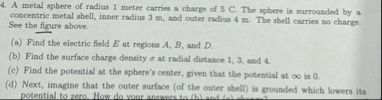 aay fphere of radius 1 meter cacrion 8 charge of 5 C. The sphere is surrounded by &
crocs meal se, ns Fin tm, sd Se tem § 2 Thr eh cao che
Se fg above
(9) Find the hic 8k E a regions 4,5, ud 1.
(0) Find the surface char dy oa ade dace 1,3. sed
(6) Fi th peal at the spbr's cote, vn tha he peti st oo
(4) Next, imagine tht th cuter mtce (of he utr ha) rod which ower
This is AI generated Response.
Asked by: Rahul
Created at: 2025-11-19 03:54:42
Asked by: Rahul
Created at: 2025-11-19 03:54:42
Final Answer:
Rendered
Raw Text
Did you like this answer?
Let's solve each part step by step.
Given:
- Metal sphere of radius \(1\, \text{m}\), charge \(+5\, \text{C}\)
- Concentric metal shell: inner radius \(3\, \text{m}\), outer radius \(4\, \text{m}\)
- Shell carries **no net charge**
### (a) Find the electric field **E** at regions **A, B, and D**.
Let:
- **Region A:** \(r < 1\, \text{m}\) (inside the metal sphere)
- **Region B:** \(1 < r < 3\, \text{m}\) (between sphere and shell)
- **Region D:** \(r > 4\, \text{m}\) (outside the shell)
#### **Step 1: Use Gauss’s Law for each region**
- **Region A** (\(r < 1\, \text{m}\), inside the conductor):
**Explanation:** In electrostatic equilibrium, the electric field inside a conductor is **zero**.
\[
E_{\text{A}} =
\]
- **Region B** (\(1 < r < 3\, \text{m}\), between sphere and shell):
**Explanation:** The total charge enclosed by a Gaussian surface of radius \(r\) is \(5\, \text{C}\).
By Gauss’s Law:
\[
\oint \vec{E} \cdot d\vec{A} = \frac{q_{\text{enc}}}{\epsilon_} \implies E \cdot 4\pi r^2 = \frac{5}{\epsilon_}
\]
\[
E_{\text{B}} = \frac{1}{4\pi \epsilon_} \frac{5}{r^2}
\]
#### **Step 2: Continue for Region D**
- **Region D** (\(r > 4\, \text{m}\), outside the shell):
**Explanation:** The shell carries no net charge, so the total enclosed charge is still \(5\, \text{C}\).
By Gauss’s Law (same as above):
\[
E_{\text{D}} = \frac{1}{4\pi \epsilon_} \frac{5}{r^2}
\]
---
### **Final Answers (a):**
- **Region A:** \(E = \)
- **Region B:** \(E = \frac{1}{4\pi \epsilon_} \frac{5}{r^2}\)
- **Region D:** \(E = \frac{1}{4\pi \epsilon_} \frac{5}{r^2}\)
---
Would you like to proceed to part (b)?
Question:
All parts solved
This is AI generated Response.
Asked by: Rahul
Created at: 2025-11-19 03:55:17
Asked by: Rahul
Created at: 2025-11-19 03:55:17
Final Answer:
Rendered
Raw Text
Did you like this answer?
## Electric Field Analysis of a Charged Sphere
Given:
- Metal sphere of radius \(1\, \text{m}\), charge \(+5\, \text{C}\)
- Concentric metal shell with inner radius \(3\, \text{m}\) and outer radius \(4\, \text{m}\)
- Shell carries no net charge
### (a) Find the Electric Field **E** at Regions **A**, **B**, and **D**.
#### **Step 1: Calculate Electric Field in Regions A and B**
- **Region A** (\(r < 1\, \text{m}\)):
**Explanation:** Inside a conductor, the electric field is zero due to the redistribution of charges.
\[
E_{\text{A}} = 0
\]
- **Region B** (\(1 < r < 3\, \text{m}\)):
**Explanation:** The electric field can be determined using Gauss's Law, where the charge enclosed is \(+5\, \text{C}\).
The integral form of Gauss's Law is:
\[
\oint \vec{E} \cdot d\vec{A} = \frac{q_{\text{enc}}}{\epsilon_0}
\]
For a spherical surface of radius \(r\):
\[
E \cdot 4\pi r^2 = \frac{5}{\epsilon_0} \implies E_{\text{B}} = \frac{5}{4\pi \epsilon_0 r^2}
\]
#### **Step 2: Calculate Electric Field in Region D**
- **Region D** (\(r > 4\, \text{m}\)):
**Explanation:** Outside the shell, the charge enclosed remains \(+5\, \text{C}\), thus the electric field behaves similarly to that in Region B.
Using Gauss's Law:
\[
E_{\text{D}} = \frac{5}{4\pi \epsilon_0 r^2}
\]
### **Final Answers (a):**
- **Region A:** \(E_{\text{A}} = 0\)
- **Region B:** \(E_{\text{B}} = \frac{5}{4\pi \epsilon_0 r^2}\)
- **Region D:** \(E_{\text{D}} = \frac{5}{4\pi \epsilon_0 r^2}\)
---
### (b) Find the Surface Charge Density on the Inner and Outer Surfaces
#### **Step 1: Calculate Surface Charge Density on Inner Surface**
- **Inner surface (at \(r = 3\, \text{m}\))**:
**Explanation:** The inner surface of the shell will have an induced charge of \(-5\, \text{C}\) to maintain electrostatic equilibrium (screening the inner charge).
The area of the inner surface:
\[
A_{\text{inner}} = 4\pi (3\, \text{m})^2 = 36\pi\, \text{m}^2
\]
The surface charge density (\(\sigma_{\text{inner}}\)) is:
\[
\sigma_{\text{inner}} = \frac{-5\, \text{C}}{36\pi\, \text{m}^2}
\]
#### **Step 2: Calculate Surface Charge Density on Outer Surface**
- **Outer surface (at \(r = 4\, \text{m}\))**:
**Explanation:** The outer surface will have a charge of \(0\, \text{C}\) since the shell has no net charge. Thus:
\[
\sigma_{\text{outer}} = 0
\]
### **Final Answers (b):**
- **Inner Surface Charge Density:** \(\sigma_{\text{inner}} = \frac{-5}{36\pi}\, \text{C/m}^2\)
- **Outer Surface Charge Density:** \(\sigma_{\text{outer}} = 0\, \text{C/m}^2\)
---
### (c) Find the Potential at the Sphere's Center
#### **Step 1: Determine the Electric Potential**
- **At the center (Region A)**:
**Explanation:** The potential inside a conductor is constant and equals the potential at the surface of the conductor. The potential \(V\) at the surface (\(r = 1\, \text{m}\)) can be calculated using:
\[
V = k \cdot \frac{q}{r} = \frac{1}{4\pi \epsilon_0} \cdot \frac{5}{1} = \frac{5}{4\pi \epsilon_0}
\]
### **Final Answer (c):**
- **Potential at the Sphere's Center:** \(V = \frac{5}{4\pi \epsilon_0}\)
---
Would you like further assistance with any other part of this problem?
📢 Instructions:
- Ask anything relatd to above question only.
- For new Question goto :