 VIPSolutions
give answer in 2 step with explanation at the end of each step and final answer at the end:A massless roc of bngth # sks an rictionidss lable (the ry plane). Looking down me ett ek 4 ho Ae mg be re TL oT i se prc ol Rg er Sun Tih pile coef soft dt at lle, od whey
Question:
give answer in 2 step with explanation at the end of each step and final answer at the end: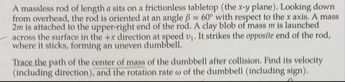 A massless roc of bngth # sks an rictionidss lable (the ry plane). Looking down
me ett ek 4 ho Ae
mg be re TL
oT i se prc ol
Rg er Sun
Tih pile coef soft dt at lle, od whey
This is AI generated Response.
Asked by: Rahul
Created at: 2025-11-19 03:46:13
Asked by: Rahul
Created at: 2025-11-19 03:46:13
Final Answer:
Rendered
Raw Text
Did you like this answer?
## Step 1: Find the Velocity of the Center of Mass After Collision
**Conservation of Linear Momentum:**
Since the collision happens on a frictionless table and the clay sticks to the rod, we use conservation of linear momentum in the \(x\)-direction (since the clay only moves in the \(x\)-direction before the collision).
- **Initial total momentum (in x):**
- Rod and attached mass are at rest: \(\)
- Clay: \(m v_1\)
\[
p_{x,\text{initial}} = m v_1
\]
- **Total mass after collision:**
- Mass at end of rod: \(2m\)
- Clay: \(m\)
- Total: \(3m\)
Let \(V_{\text{cm}}\) be the velocity of the center of mass after collision.
\[
m v_1 = (3m) V_{\text{cm},x}
\implies V_{\text{cm},x} = \frac{v_1}{3}
\]
**Explanation:**
The clay hits and sticks, so the total linear momentum is shared among all masses, resulting in a lower center-of-mass velocity.
---
## Step 2: Find the Angular (Rotation) Rate After Collision
**Conservation of Angular Momentum:**
Angular momentum is conserved about the center of mass of the system since no external torques act.
- **Let the rod have length \(L\).**
- The mass \(2m\) is at one end, clay \(m\) at the other.
### Find Initial Angular Momentum (about the center of mass after collision)
- **Location of center of mass (CM) after collision:**
- Place origin at the rod's center for calculation.
- Let the rod be oriented at \(60^\circ\) to the \(x\)-axis.
- The two masses are at ends, a distance \(L\) apart.
Let’s call the two ends \(A\) (with mass \(2m\)) and \(B\) (clay, mass \(m\)).
- Coordinates of \(A\): \((,)\)
- Coordinates of \(B\): \((L\cos\beta, L\sin\beta)\), where \(\beta = 60^\circ\).
**Center of mass:**
\[
x_\text{CM} = \frac{2m \times + m \times L\cos\beta}{3m} = \frac{L\cos\beta}{3}
\]
\[
y_\text{CM} = \frac{2m \times + m \times L\sin\beta}{3m} = \frac{L\sin\beta}{3}
\]
- **Initial angular momentum (about CM):**
- Only the clay has initial momentum: \(m v_1\).
- Its position vector from CM: \(\vec{r}_B - \vec{r}_{CM}\).
- Its velocity: \(v_1\) in \(+\hat{x}\).
The angular momentum is \(L = \vec{r} \times m\vec{v}\).
\[
\vec{r}_B - \vec{r}_{CM} = (L\cos\beta - \frac{L\cos\beta}{3},\ L\sin\beta - \frac{L\sin\beta}{3}) = (\frac{2L\cos\beta}{3}, \frac{2L\sin\beta}{3})
\]
The cross product for angular momentum (z-component):
\[
L_{z,\text{initial}} = m \left[
\frac{2L\cos\beta}{3} \cdot - \frac{2L\sin\beta}{3} \cdot v_1
\right] = -\frac{2mL\sin\beta}{3} v_1
\]
- **After collision:**
All mass rotates about CM. Let \(\omega\) be the angular velocity after collision.
The moment of inertia about CM:
- For \(2m\) at distance \(d_1\): \(d_1 = |\vec{r}_{CM}|\)
- For \(m\) at distance \(d_2\): \(d_2 = |\vec{r}_B - \vec{r}_{CM}|\)
Both are \(r = \sqrt{(2L\cos\beta/3)^2 + (2L\sin\beta/3)^2} = \frac{2L}{3}\).
\[
I_{CM} = 2m \left(\frac{L}{3}\right)^2 + m \left(\frac{2L}{3}\right)^2
= 2m \frac{L^2}{9} + m \frac{4L^2}{9} = \left( \frac{2mL^2}{9} + \frac{4mL^2}{9} \right) = \frac{6mL^2}{9} = \frac{2mL^2}{3}
\]
**Setting angular momenta equal:**
\[
-\frac{2mL\sin\beta}{3} v_1 = I_{CM} \omega
\implies \omega = -\frac{2mL\sin\beta v_1}{3 \cdot \frac{2mL^2}{3}} = -\frac{\sin\beta v_1}{L}
\]
For \(\beta = 60^\circ\), \(\sin 60^\circ = \frac{\sqrt{3}}{2}\):
\[
\omega = -\frac{\sqrt{3}}{2} \frac{v_1}{L}
\]
**Explanation:**
The negative sign shows the direction of rotation (using the right-hand rule, consistent with the clay's impact direction).
---
## **Final Answers**
### **Path of Center of Mass**
- **Moves in \(+\hat{x}\) direction** with velocity \(V_{\text{cm},x} = \frac{v_1}{3}\).
### **Velocity (including direction)**
- \[
\boxed{V_{\text{cm}} = \frac{v_1}{3}~\hat{x}}
\]
### **Rotation Rate of the Dumbbell**
- \[
\boxed{\omega = -\frac{\sqrt{3}}{2} \frac{v_1}{L}}
\]
(Negative sign indicates rotation direction according to the right-hand rule.)
📢 Instructions:
- Ask anything relatd to above question only.
- For new Question goto :