 VIPSolutions
give answer in 2 step with explanation at the end of each step and final answer at the end:J Gi ap ™ x0 Ad tom ms mrs i er Ja ber ee STE ren i mo CROSS EE SE el a a ct et rm a ee © Wt it i Lo nn y ii J i
Question:
give answer in 2 step with explanation at the end of each step and final answer at the end: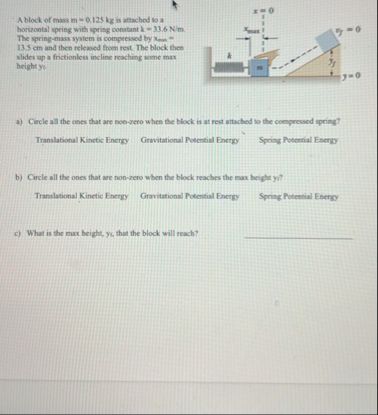 J Gi ap ™ x0
Ad tom ms mrs i
er Ja ber
ee STE
ren
i mo
CROSS EE SE
el a
a ct et rm
a ee
© Wt it i
Lo
nn
y ii
J i
This is AI generated Response.
Asked by: Rahul
Created at: 2025-11-19 03:41:13
Asked by: Rahul
Created at: 2025-11-19 03:41:13
Final Answer:
Rendered
Raw Text
Did you like this answer?
Let's break this problem into two steps for each part, with explanations and a final answer at the end.
---
## Part (a): **Circle all the ones that are non-zero when the block is at rest attached to the compressed spring**
### Step 1: Identify Energies at Rest with Compressed Spring
- The block is **at rest** and **attached to the compressed spring**.
- **Translational Kinetic Energy:** The block is **at rest**, so kinetic energy is **zero**.
- **Gravitational Potential Energy:** The block is not at a height above the reference point (y = ), so gravitational potential energy can be **zero or a reference value**.
- **Spring Potential Energy:** The spring is **compressed**, so there is **spring potential energy stored**.
**Explanation:**
Only the spring potential energy is non-zero because the block is at rest and at the reference height.
#### **Final Answer for (a):**
- **Spring Potential Energy**
---
## Part (b): **Circle all the ones that are non-zero when the block reaches the max height \( y_1 \)**
### Step 2: Identify Energies at Max Height \( y_1 \)
- The block **reaches its max height** and comes to rest momentarily.
- **Translational Kinetic Energy:** The block comes to rest at the max height, so kinetic energy is **zero**.
- **Gravitational Potential Energy:** The block is at height \( y_1 \), so gravitational potential energy is **non-zero**.
- **Spring Potential Energy:** The spring is no longer compressed or stretched (block is no longer attached), so spring potential energy is **zero**.
**Explanation:**
At max height, all the energy is gravitational potential energy since the block is momentarily at rest and the spring is not stretched/compressed.
#### **Final Answer for (b):**
- **Gravitational Potential Energy**
---
## Part (c): **What is the max height, \( y_1 \), that the block will reach?**
### Step 1: Find Initial Energy (when block is at rest with compressed spring)
- **Spring Potential Energy:**
\[
E_\text{spring, initial} = \frac{1}{2} k x^2
\]
Where \( k = 33.6\, \text{N/m} \), \( x = .135\, \text{m} \).
\[
E_\text{spring, initial} = \frac{1}{2} (33.6)(.135)^2 = \frac{1}{2} \times 33.6 \times .018225 = .306\, \text{J}
\]
**Explanation:**
All energy starts as spring potential energy when the block is at rest and the spring is compressed.
### Step 2: Set Final Energy (at max height, all energy is gravitational potential)
- **Gravitational Potential Energy at max height:**
\[
E_\text{grav, final} = mgy_1
\]
Where \( m = .125\, \text{kg} \), \( g = 9.8\, \text{m/s}^2 \).
Set \( E_\text{spring, initial} = E_\text{grav, final} \):
\[
.306 = .125 \cdot 9.8 \cdot y_1
\]
\[
y_1 = \frac{.306}{.125 \times 9.8} = \frac{.306}{1.225} \approx .25\, \text{m}
\]
**Explanation:**
All initial spring energy converts to gravitational potential at the max height.
#### **Final Answer for (c):**
- **The max height, \( y_1 \), is \( \boxed{.25\, \text{m}} \).**
📢 Instructions:
- Ask anything relatd to above question only.
- For new Question goto :