 VIPSolutions
give answer in 2 step with explanation at the end of each step and final answer at the end:2. (20 points) Let M be the locus: of a system of equations axz+yiHyityi=—h er 43z=-2 i.e. when embedded in R*, x pxzeyteyieyi=—hl m={ly|: and CRE z e’+3z=-2 (a) (1 point) Geometrically, the set M is © asmooth curve. © asmooth surface. O asmooth solid. (b) (9 points) Justify your answer in Part (a). Hint. You can show that at every point on M, locally M is a graph of some (implicit) function. (c) (10 points) Find the affine subspace of maximal dimension (which is the same dimension as M) that is tangent 2 to the smooth manifold M at the point | 0 |. =1
Question:
give answer in 2 step with explanation at the end of each step and final answer at the end: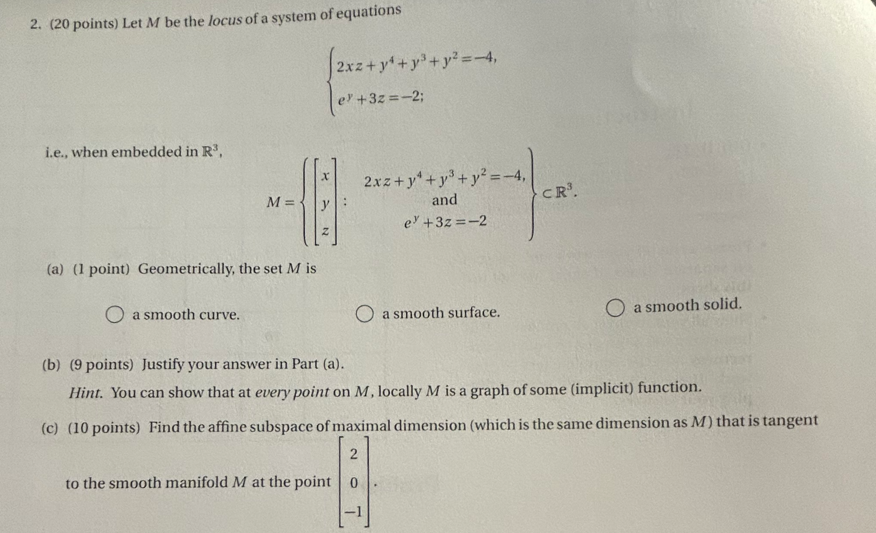 2. (20 points) Let M be the locus: of a system of equations
axz+yiHyityi=—h
er 43z=-2
i.e. when embedded in R*,
x pxzeyteyieyi=—hl
m={ly|: and CRE
z e’+3z=-2
(a) (1 point) Geometrically, the set M is
© asmooth curve. © asmooth surface. O asmooth solid.
(b) (9 points) Justify your answer in Part (a).
Hint. You can show that at every point on M, locally M is a graph of some (implicit) function.
(c) (10 points) Find the affine subspace of maximal dimension (which is the same dimension as M) that is tangent
2
to the smooth manifold M at the point | 0 |.
=1
This is AI generated Response.
Asked by: Rahul
Created at: 2025-11-19 03:20:43
Asked by: Rahul
Created at: 2025-11-19 03:20:43
Final Answer:
Rendered
Raw Text
Did you like this answer?
Let's proceed step by step as requested.
---
## Step 1: Geometric Nature of \( M \) (Part (a) and (b))
### (a) Geometrically, the set \( M \) is:
We are given two equations in three variables \((x, y, z)\):
\[
\begin{cases}
2xz + y^4 + y^3 + y^2 = -4, \\
e^y + 3z = -2
\end{cases}
\]
Each equation defines a surface in \(\mathbb{R}^3\). The intersection of two surfaces in three dimensions is typically a **curve** (1-dimensional object), provided the surfaces are not tangent everywhere they intersect.
**Answer:**
\(\boxed{\text{a smooth curve}}\)
**Explanation:**
Two independent equations in \(\mathbb{R}^3\) generally define a 1-dimensional locus (a curve).
---
## Step 2: Justification and Tangent Space at the Given Point (Part (b) and (c))
### (b) Justification
Let \( F(x, y, z) = \begin{pmatrix} 2xz + y^4 + y^3 + y^2 + 4 \\ e^y + 3z + 2 \end{pmatrix} \), so \( M = F^{-1}() \).
\( F: \mathbb{R}^3 \to \mathbb{R}^2 \).
If the Jacobian matrix of \( F \) has rank 2 everywhere on \( M \), the **Implicit Function Theorem** says that \( M \) is a smooth manifold of dimension \( 3-2 = 1 \), i.e., a smooth curve.
**Explanation:**
Locally, the solution set to two independent equations in three variables is a smooth 1-dimensional manifold (curve) if the equations are independent (their gradients are linearly independent).
---
### (c) Tangent Space at the Point \(\begin{pmatrix} 2 \\ \\ -1 \end{pmatrix}\)
#### 1. Compute the Jacobian of \( F \):
Let \( p = (x_, y_, z_) = (2, , -1) \).
- \( F_1(x, y, z) = 2xz + y^4 + y^3 + y^2 + 4 \)
- \( F_2(x, y, z) = e^y + 3z + 2 \)
Jacobian:
\[
J = \begin{bmatrix}
\frac{\partial F_1}{\partial x} & \frac{\partial F_1}{\partial y} & \frac{\partial F_1}{\partial z} \\
\frac{\partial F_2}{\partial x} & \frac{\partial F_2}{\partial y} & \frac{\partial F_2}{\partial z}
\end{bmatrix}
\]
Calculate partial derivatives at \( (2,,-1) \):
- \( \frac{\partial F_1}{\partial x} = 2z \) → \( 2 \times (-1) = -2 \)
- \( \frac{\partial F_1}{\partial y} = 4y^3 + 3y^2 + 2y \) →
- \( \frac{\partial F_1}{\partial z} = 2x \) → \( 2 \times 2 = 4 \)
- \( \frac{\partial F_2}{\partial x} = \)
- \( \frac{\partial F_2}{\partial y} = e^y \) → \( e^ = 1 \)
- \( \frac{\partial F_2}{\partial z} = 3 \)
So at \( (2,,-1) \):
\[
J = \begin{bmatrix}
-2 & & 4 \\
& 1 & 3
\end{bmatrix}
\]
#### 2. The tangent space is the null space of \( J \):
Let \( v = (a, b, c)^T \) be a tangent vector:
\[
J v = \implies
\begin{cases}
-2a + b + 4c = \\
a + 1b + 3c =
\end{cases}
\]
Solve:
- \( -2a + 4c = \implies a = 2c \)
- \( b + 3c = \implies b = -3c \)
So, tangent vectors are
\[
v = (2c, -3c, c) = c \begin{pmatrix} 2 \\ -3 \\ 1 \end{pmatrix}
\]
This is a 1-dimensional subspace (a line).
**Explanation:**
The tangent space to \( M \) at the point is the set of all vectors of the form \( \lambda \begin{pmatrix} 2 \\ -3 \\ 1 \end{pmatrix} \), for \( \lambda \in \mathbb{R} \).
---
## **Final Answers**
- **(a):** \( M \) is a **smooth curve**.
- **(b):** Because the solution set of two independent smooth equations in \(\mathbb{R}^3\) is generally a 1-dimensional smooth manifold (curve), by the Implicit Function Theorem.
- **(c):** The affine subspace tangent to \( M \) at \(\begin{pmatrix} 2 \\ \\ -1 \end{pmatrix}\) is
\[
\left\{ \lambda \begin{pmatrix} 2 \\ -3 \\ 1 \end{pmatrix} \,:\, \lambda \in \mathbb{R} \right\}
\]
or, equivalently, the line through \(\begin{pmatrix} 2 \\ \\ -1 \end{pmatrix}\) in the direction \(\begin{pmatrix} 2 \\ -3 \\ 1 \end{pmatrix}\).
📢 Instructions:
- Ask anything relatd to above question only.
- For new Question goto :