This is AI generated Response.
Asked by: Rahul
Created at: 2025-11-18 18:38:28
Final Answer:
RenderedRaw Text
Did you like this answer?
## Step 1: Understanding the Question
You are asked to show how **N-ethyl-N-methylpropan-2-amine** can be synthesized a **single step** from:
- A ketone
- An aldehyde
- Two different amides
You must choose the correct starting materials (one ketone, one aldehyde, and two amides) that, upon a single-step reaction, would yield **N-ethyl-N-methylpropan-2-amine**.
**Explanation:**
N-ethyl-N-methylpropan-2-amine is a tertiary amine (all three groups on nitrogen are carbon-based: ethyl, methyl, and isopropyl). The synthesis will likely involve forming the C–N bonds via nucleophilic substitution or reductive amination.
---
## Step 2: Matching Starting Materials to Product
Let's break down the molecule:
- **N-ethyl:** –CH₂CH₃ attached to N
- **N-methyl:** –CH₃ attached to N
- **propan-2-amine backbone:** the N is attached to the 2-position of propane (isopropyl group: –CH(CH₃)₂)
So, the full structure is:
**CH₃–CH(N(CH₂CH₃)(CH₃))–CH₃**
Now, consider how each class of starting material could contribute:
- **Ketone:** Reductive amination of a ketone with a secondary amine gives a tertiary amine.
- **Aldehyde:** Reductive amination with a secondary amine can also give a tertiary amine.
- **Amide:** Can be reduced to an amine (though usually gives a primary or secondary amine).
**The correct combinations are:**
**A. From a Ketone:**
Start with **propan-2-one (acetone)** (CH₃COCH₃) and react with **N-ethylmethylamine** (ethylmethylamine) under reductive amination conditions.
**B. From an Aldehyde:**
Start with **ethanal (acetaldehyde)** (CH₃CHO) and react with **N-methylisopropylamine** under reductive amination.
**C. From Amides:**
- **Amide 1:** N-ethyl-N-methylpropanamide (reduce to the amine via LiAlH₄)
- **Amide 2:** N-methyl-N-isopropylacetamide (reduce to the amine via LiAlH₄)
---
## **Final Answer (Summary Table):**
| Starting Material | Structure/Name | Product (single-step reduction or amination) |
|-----------------------|----------------------------------------------|-----------------------------------------------|
| **A Ketone** | Acetone + N-ethylmethylamine | N-ethyl-N-methylpropan-2-amine |
| **An Aldehyde** | Acetaldehyde + N-methylisopropylamine | N-ethyl-N-methylpropan-2-amine |
| **An Amide** | N-ethyl-N-methylpropanamide | N-ethyl-N-methylpropan-2-amine |
| **A different amide** | N-methyl-N-isopropylacetamide | N-ethyl-N-methylpropan-2-amine |
**Explanation:**
Each starting material, when subjected to either reductive amination (for ketone and aldehyde) or reduction (for amides), will give the same tertiary amine product, **N-ethyl-N-methylpropan-2-amine**. The key is matching the carbon fragments that will end up on the nitrogen.
VIPSolutions focuses on clear, step‑by‑step explanations so you can learn quickly. Whether you need an AI‑generated walkthrough or a short hint to get unstuck, each solution is organized for fast reading and easy review later.
Search similar questions, compare approaches, and bookmark the best answers for revision. Our goal is simple: quick, reliable study help that feels natural—not noisy.
 VIPSolutions
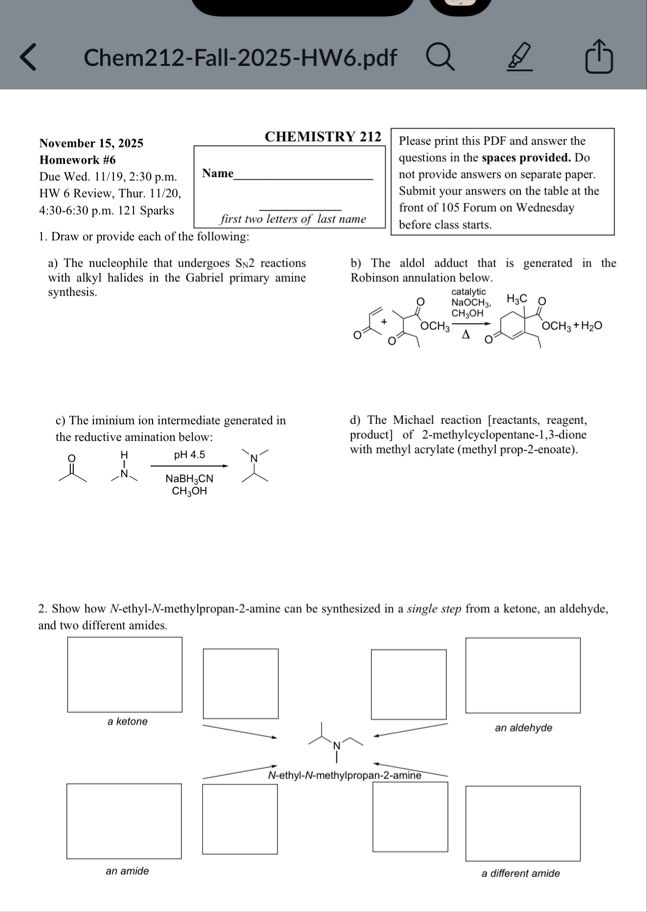 November 15, 2025 CHEMISTRY 212 | please print this PDF and answer the
Homework #6 questions in the spaces provided. Do
Due Wed. 11/19,230 pm. [Name || not provide answers on separate paper.
HW 6 Review, Thur. 11/20, Submit your answers on the table at the
430630 pm. 121 Sparks JE front of 105 Forum on Wednesday
ist ews Towers of Tasrname || pope opus one
1. Draw or provide cach of the Following:
5) The nucleophile that undergoes $\2 reactions b) The aldol adduct that is generated in the
with alkyl halides in the Gabril primary amine Robinson annulaion below.
Synthesis. cat
0 fdlh MC oo
Ig CHyOH
* OCH; —— OCH; +Hz0
© [} 4 of
©) The iminium ion intermediate generated in. d) The Michael reaction [reactants, reagent,
he reductive amination below: product] of 2-methyleyclopentane-1,3-dione
= P Wis Sy with methyl acrylate (methyl prop-2-¢noate).
An Thamen A
Sin
2. Show how N-cthyl-N-methylpropan-2-amine can be synthesized in single sep from ketone, an aldehyde,
and wo diffrent amides.
ane _ LC] L
an atte
TT Lp
|
——— Tiathymetnypropan ami
an amido a erent amide