 VIPSolutions
give answer in 2 step with explanation at the end of each step and final answer at the end:Consider the following reaction from Experiment 4 PN cae PUY & = 4-methyl-2-pentanol a. Draw the mechanism b. The product is a minor product. Assuming no carbocation rearrangements, briefly explain why this is the case. c. Propose a 2-step synthesis that would be a more effective way of transforming 4- methyl-2-pentanol into the given alkene. (i.e. Would make it the major product). Hint: Is the alkene Zaitsev or Hoffmann? How else can we make OH a good LG?
Question:
give answer in 2 step with explanation at the end of each step and final answer at the end: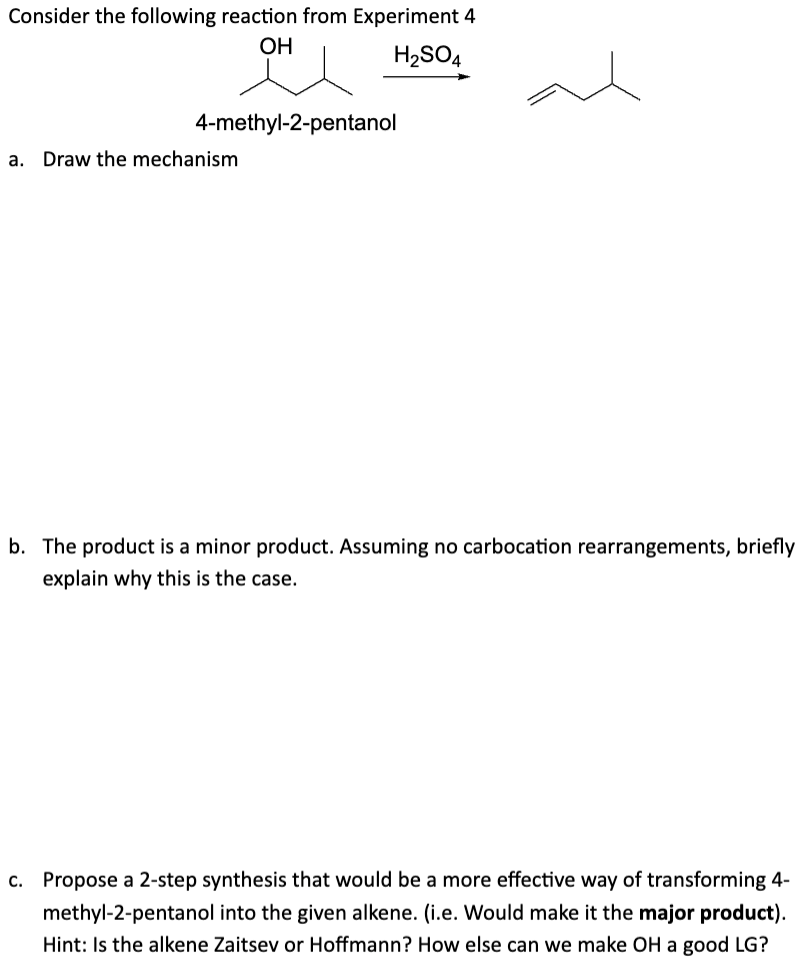 Consider the following reaction from Experiment 4
PN cae PUY
&
=
4-methyl-2-pentanol
a. Draw the mechanism
b. The product is a minor product. Assuming no carbocation rearrangements, briefly
explain why this is the case.
c. Propose a 2-step synthesis that would be a more effective way of transforming 4-
methyl-2-pentanol into the given alkene. (i.e. Would make it the major product).
Hint: Is the alkene Zaitsev or Hoffmann? How else can we make OH a good LG?
This is AI generated Response.
Asked by: Rahul
Created at: 2025-11-18 16:24:54
Asked by: Rahul
Created at: 2025-11-18 16:24:54
Final Answer:
Rendered
Raw Text
Did you like this answer?
## Step-by-Step Solutions
---
### a. **Draw the Mechanism**
**Step 1: Protonation of Alcohol (OH)**
- The hydroxyl group on 4-methyl-2-pentanol is protonated by sulfuric acid (H₂SO₄), converting it to a good leaving group (water).
**Step 2: Loss of Water, Formation of Carbocation**
- The protonated alcohol loses water, generating a secondary carbocation at C-2.
**Step 3: Elimination (E1 Mechanism)**
- A base (HSO₄⁻ or H₂O) abstracts a proton from an adjacent carbon (C-1 or C-3), resulting in the formation of a double bond.
- In this case, the product shown is 4-methyl-1-pentene, where the double bond is formed between C-1 and C-2 (less substituted alkene).
**Explanation:**
The mechanism is an **E1 elimination**: protonation → loss of water (carbocation) → deprotonation (alkene formation).
---
### b. **Why Is This the Minor Product?**
**Step 1: Analyze Alkene Substitution**
- The product shown (4-methyl-1-pentene) is a **less substituted alkene** (double bond at the end, terminal alkene).
**Step 2: Zaitsev's Rule**
- Zaitsev's rule states that **the more substituted alkene (internal alkene)** is typically the major product in E1 eliminations because it's more stable.
- The major product would be 4-methyl-2-pentene (double bond between C-2 and C-3), which is more substituted and thus more stable.
**Explanation:**
The given product is the **minor product** because it is the less substituted (and therefore less stable) alkene. The reaction prefers to form the more substituted, more stable alkene as the major product.
---
### c. **Propose a 2-Step Synthesis for the Major Product as Shown**
**Step 1: Make OH a Better Leaving Group**
- Convert the alcohol to a good leaving group (e.g., use tosyl chloride (TsCl) to make a tosylate, or PBr₃ to make an alkyl bromide).
**Step 2: Use a Strong, Bulky Base for E2 Elimination (Hofmann Product)**
- Treat the resulting tosylate or bromide with a **strong, bulky base** such as potassium tert-butoxide (t-BuOK).
- Bulky bases favor elimination at the **least substituted position** (Hofmann product), giving the terminal alkene (4-methyl-1-pentene) as the major product.
**Explanation:**
By making the alcohol a better leaving group and then using a bulky base, you favor **Hofmann elimination** (least substituted alkene), making 4-methyl-1-pentene the major product.
---
## **Final Answers**
**a.**
Draw the E1 mechanism:
1. Protonate OH → H₂O leaves → carbocation at C-2 → deprotonate C-1 → form 4-methyl-1-pentene.
**b.**
The product is a minor product because it is the less substituted alkene. Zaitsev's rule favors formation of the more substituted and stable alkene (4-methyl-2-pentene).
**c.**
1. Convert OH to a good leaving group (e.g., tosylate or bromide).
2. React with a strong, bulky base (e.g., t-BuOK) to favor E2 Hofmann elimination, making the terminal alkene (4-methyl-1-pentene) the major product.
📢 Instructions:
- Ask anything relatd to above question only.
- For new Question goto :