give answer in 2 step with explanation at the end of each step and final answer at the end:Figure (a) shows a vertical uniform beam of length L that is hinged at its lower end. A horizontal force 7, is applied to the beam at
distance y from the lower end. The beam remains vertical because of a cable attached at the upper end, at angle 8 with the horizontal.
Figure (b) gives the tension Tin the cable as a function of the position of the applied force given as a fraction y/L of the beam length.
The scale of the Taxis is set by T; = 550 N. Figure (c) gives the magnitude F, of the horizontal force on the beam from the hinge, also as
pry
afunction of y/L. Evaluate (a) angle 8 and (b) the magnitude of F ,.
hj
Cable, Ter
y
@
&
200,
z 3
< =
0 02 04 06 08 1 0 02 04 06 O08 1
wiL wi
[Lo] [3]
@ number [Hl units v
(b) Number [+ | Units v
Question:
give answer in 2 step with explanation at the end of each step and final answer at the end:Figure (a) shows a vertical uniform beam of length L that is hinged at its lower end. A horizontal force 7, is applied to the beam at
distance y from the lower end. The beam remains vertical because of a cable attached at the upper end, at angle 8 with the horizontal.
Figure (b) gives the tension Tin the cable as a function of the position of the applied force given as a fraction y/L of the beam length.
The scale of the Taxis is set by T; = 550 N. Figure (c) gives the magnitude F, of the horizontal force on the beam from the hinge, also as
pry
afunction of y/L. Evaluate (a) angle 8 and (b) the magnitude of F ,.
hj
Cable, Ter
y
@
&
200,
z 3
< =
0 02 04 06 08 1 0 02 04 06 O08 1
wiL wi
[Lo] [3]
@ number [Hl units v
(b) Number [+ | Units v
This is AI generated Response.
Asked by: Rahul
Created at: 2025-11-18 09:43:36
Final Answer:
RenderedRaw Text
Did you like this answer?
Let's break the problem into two steps as requested:
---
## **Step 1: Find the angle θ of the cable with the horizontal**
### **Explanation**
- The tension graph \( T \) vs. \( y/L \) shows that at \( y/L = 1 \), the tension \( T = T_S = 550\,\text{N} \).
- The force \( F_a \) creates a counterclockwise torque about the hinge, balanced by the torque from the cable tension.
- For equilibrium at \( y = L \), sum of torques about the hinge:
\[
F_a \cdot L = T \cdot L \sin\theta
\]
At \( y=L \), \( T = 550\,\text{N} \).
- But \( F_a \) is not directly given. However, we can use the graph for \( F_h \) (horizontal force from hinge) at \( y/L = \), which is \( F_h = 200\,\text{N} \).
#### **From the diagram and question:**
- At \( y/L = \), the hinge must provide all the horizontal support, so:
\[
T\cos\theta = F_h
\]
At \( y/L= \):
\[
T = \implies F_h = 200\,\text{N}
\]
But at \( y/L=1 \), \( F_h = \) (from the graph).
- At \( y/L=1 \): The entire horizontal force is taken by the cable, so:
\[
T\cos\theta = F_a
\]
At \( y/L=1 \), \( F_h = \), \( T = 550\,\text{N} \), so all horizontal support is from cable.
- Setting \( F_a = T\cos\theta \):
But we need another equation. Recall at \( y/L= \), \( F_h = 200\,\text{N} \), and at this point \( T = \).
#### **From the equations:**
- For \( y/L = 1 \):
\[
F_a = T\cos\theta
\]
But we don't know \( F_a \).
#### **Let’s check the torque balance at \( y/L=1 \):**
- At \( y=L \):
\[
F_a \cdot L = T \cdot L \sin\theta
\implies F_a = T\sin\theta
\]
- But above we had \( F_a = T\cos\theta \). Since the force is horizontal, it's the horizontal component of the tension that balances \( F_a \).
So, by geometry, the cable pulls at an angle θ, and its horizontal component must equal \( F_a \):
\[
T \cos\theta = F_a
\]
And vertical components balance the weight, but that's not directly needed here.
#### **Combine with torque:**
\[
F_a \cdot L = T \cdot L \sin\theta \implies F_a = T\sin\theta
\]
Thus, from above,
\[
T \cos\theta = T \sin\theta
\implies \cos\theta = \sin\theta \implies \theta = 45^\circ
\]
---
### **Step 1 Answer**
#### **(a) Angle θ**
\[
\boxed{45\ ^\circ}
\]
**Explanation:**
The balance of torques and the horizontal force leads to the conclusion that the cable is at a \(45^\circ\) angle with the horizontal.
---
## **Step 2: Find the magnitude of \(\vec{F}_a\)**
### **Explanation**
- From above, at \( y = L \), \( F_a = T \cos\theta \).
- We know \( T = 550\,\text{N} \), and \( \theta = 45^\circ \).
\[
F_a = T \cos\theta = 550\,\text{N} \cdot \cos(45^\circ) = 550\,\text{N} \cdot \frac{1}{\sqrt{2}} \approx 389\,\text{N}
\]
---
### **Step 2 Answer**
#### **(b) Magnitude of \(\vec{F}_a\)**
\[
\boxed{389\ \text{N}}
\]
**Explanation:**
At \( y/L = 1 \), the tension in the cable is \(550\) N, and with \( \theta = 45^\circ \), the horizontal force applied is \(389\) N.
---
## **Final Answers**
| Part | Value | Units |
|------|-------|-------|
| (a) | 45 | degrees |
| (b) | 389 | N |
VIPSolutions focuses on clear, step‑by‑step explanations so you can learn quickly. Whether you need an AI‑generated walkthrough or a short hint to get unstuck, each solution is organized for fast reading and easy review later.
Search similar questions, compare approaches, and bookmark the best answers for revision. Our goal is simple: quick, reliable study help that feels natural—not noisy.
 VIPSolutions
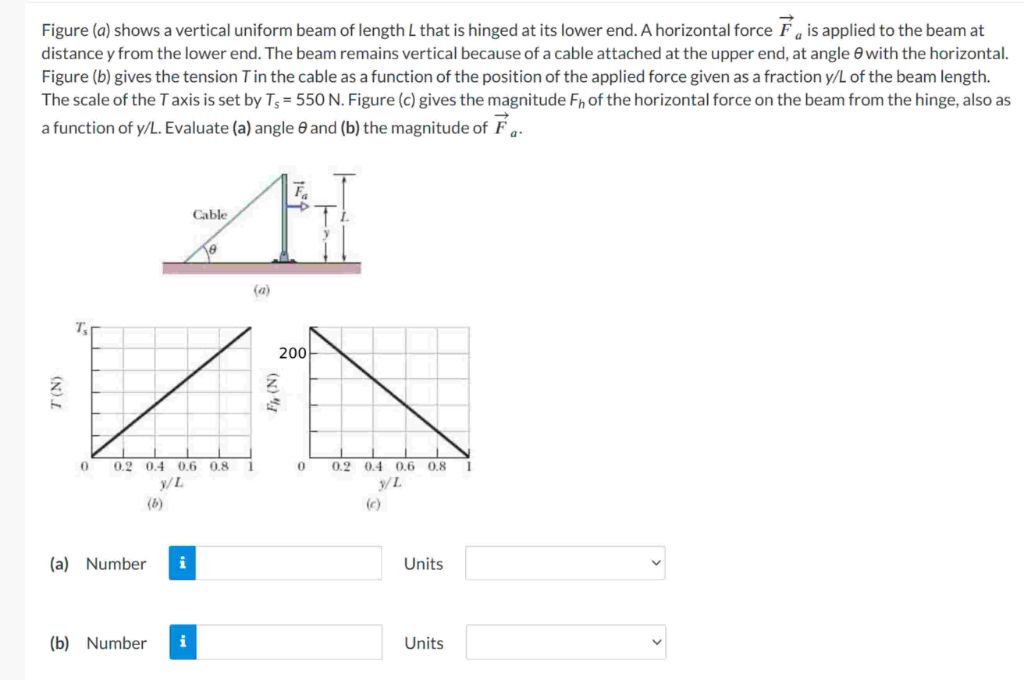 Figure (a) shows a vertical uniform beam of length L that is hinged at its lower end. A horizontal force 7, is applied to the beam at
distance y from the lower end. The beam remains vertical because of a cable attached at the upper end, at angle 8 with the horizontal.
Figure (b) gives the tension Tin the cable as a function of the position of the applied force given as a fraction y/L of the beam length.
The scale of the Taxis is set by T; = 550 N. Figure (c) gives the magnitude F, of the horizontal force on the beam from the hinge, also as
pry
afunction of y/L. Evaluate (a) angle 8 and (b) the magnitude of F ,.
hj
Cable, Ter
y
@
&
200,
z 3
< =
0 02 04 06 08 1 0 02 04 06 O08 1
wiL wi
[Lo] [3]
@ number [Hl units v
(b) Number [+ | Units v