 VIPSolutions
give answer in 2 step with explanation at the end of each step and final answer at the end:5. (4 marks) In this question, we focus on formulating an optimization problem in mathematical terms. Consider the following question. ‘What is the largest area A of a right triangle bounded by the z-axis, the y-axis, and a tangent line to y =e” in the first quadrant? Two sketches are provided below. The goal is to maximize the gray area. Your task is to describe the area A as a function of z and articulate your thinking process. The absolute maximum of your function A on an appropriate domain should be the answer to the above question. You DO NOT need to find the absolute maximum of A. Yy y 1 1 y=e* y=e* Ed z 1 2 3 1 2 3
Question:
give answer in 2 step with explanation at the end of each step and final answer at the end: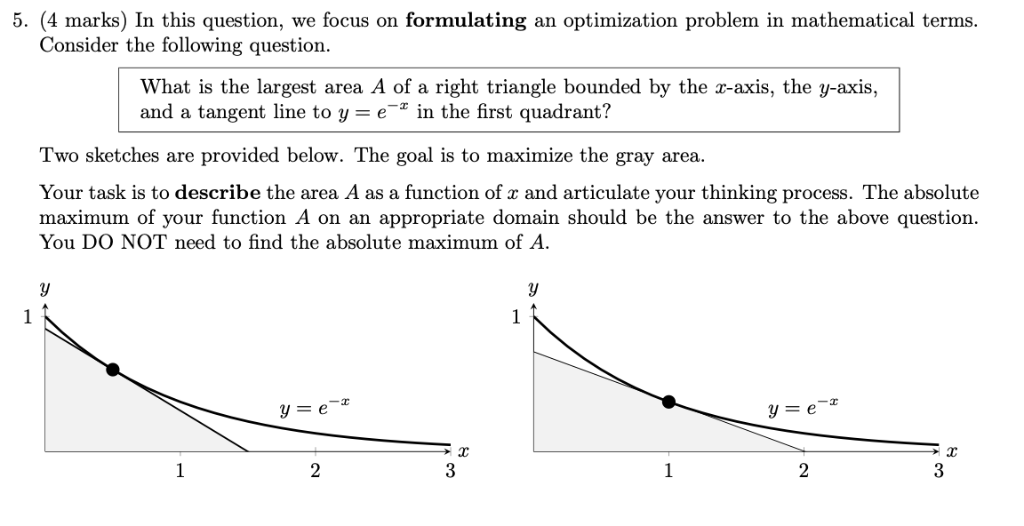 5. (4 marks) In this question, we focus on formulating an optimization problem in mathematical terms.
Consider the following question.
‘What is the largest area A of a right triangle bounded by the z-axis, the y-axis,
and a tangent line to y =e” in the first quadrant?
Two sketches are provided below. The goal is to maximize the gray area.
Your task is to describe the area A as a function of z and articulate your thinking process. The absolute
maximum of your function A on an appropriate domain should be the answer to the above question.
You DO NOT need to find the absolute maximum of A.
Yy y
1 1
y=e* y=e*
Ed z
1 2 3 1 2 3
This is AI generated Response.
Asked by: Rahul
Created at: 2025-11-18 08:00:32
Asked by: Rahul
Created at: 2025-11-18 08:00:32
Final Answer:
Rendered
Raw Text
Did you like this answer?
## Step 1: Equation of the Tangent Line
Let the point of tangency be at \( (a, e^{-a}) \).
The slope of the tangent to \( y = e^{-x} \) at \( x = a \) is:
\[
y' = -e^{-x} \implies \text{slope at } x=a \text{ is } -e^{-a}
\]
So, the equation of the tangent at \( x = a \) is:
\[
y - e^{-a} = -e^{-a}(x - a)
\]
\[
y = -e^{-a}(x - a) + e^{-a}
\]
\[
y = -e^{-a}x + a e^{-a} + e^{-a}
\]
\[
y = -e^{-a}x + e^{-a}(a + 1)
\]
**Explanation:**
This step formulates the tangent line’s equation in terms of \( a \), which is the \( x \)-coordinate where the tangent touches the curve.
---
## Step 2: Find the Intercepts (Triangle Vertices)
- **\( x \)-intercept:** Set \( y = \)
\[
= -e^{-a}x + e^{-a}(a + 1) \implies x = a + 1
\]
- **\( y \)-intercept:** Set \( x = \)
\[
y = -e^{-a}() + e^{-a}(a + 1) = e^{-a}(a + 1)
\]
The triangle is bounded by the \( x \)-axis, \( y \)-axis, and the tangent. The base is the segment on the \( x \)-axis from \( x= \) to \( x=a+1 \), and the height is the \( y \)-intercept.
The area \( A \) of the triangle is:
\[
A = \frac{1}{2} \cdot \text{base} \cdot \text{height} = \frac{1}{2} (a + 1) \cdot [e^{-a}(a + 1)] = \frac{1}{2} (a + 1)^2 e^{-a}
\]
**Explanation:**
This step finds the vertices of the triangle and expresses the area as a function of \( a \).
---
## **Final Answer**
The area \( A \) as a function of \( a \) is:
\[
\boxed{A(a) = \frac{1}{2} (a + 1)^2 e^{-a}}
\]
where \( a > \) (since the triangle is in the first quadrant).
To maximize the area, one would find the absolute maximum of \( A(a) \) over \( a > \).
📢 Instructions:
- Ask anything relatd to above question only.
- For new Question goto :