 VIPSolutions
give answer in 2 step with explanation at the end of each step and final answer at the end:A new electronic process monitor costs $990,000. This cost could be depreciated at 30% per year (Class 10). The monitor would actually be worthless in five years. The new monitor would save $460,000 per year before taxes and operating costs. If we require a 15% return, what is the NPV of the purchase? Assume a tax rate of 40% . (Do not round intermediate calculations. Round the final answer to 2 decimal places. Omit $ sign in your response.)
Question:
give answer in 2 step with explanation at the end of each step and final answer at the end: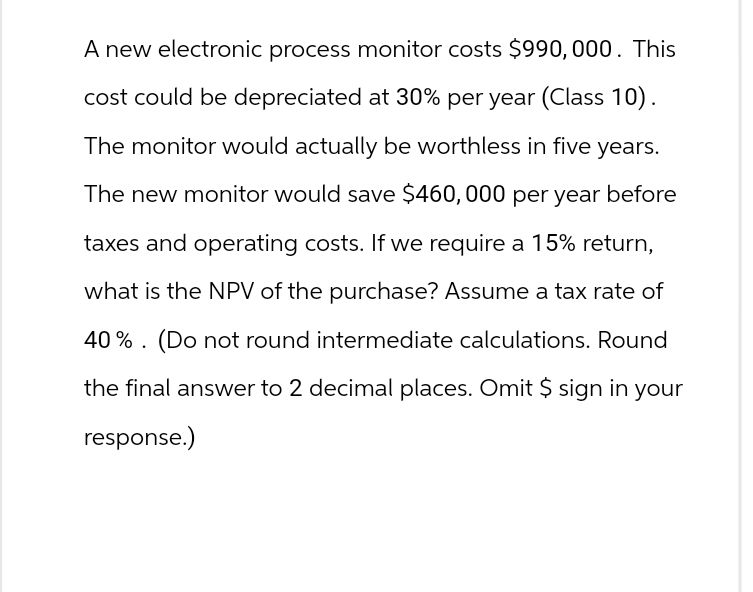 A new electronic process monitor costs $990,000. This
cost could be depreciated at 30% per year (Class 10).
The monitor would actually be worthless in five years.
The new monitor would save $460,000 per year before
taxes and operating costs. If we require a 15% return,
what is the NPV of the purchase? Assume a tax rate of
40% . (Do not round intermediate calculations. Round
the final answer to 2 decimal places. Omit $ sign in your
response.)
This is AI generated Response.
Asked by: Rahul
Created at: 2025-11-18 05:50:21
Asked by: Rahul
Created at: 2025-11-18 05:50:21
Final Answer:
Rendered
Raw Text
Did you like this answer?
## Step 1: Calculate Annual After-Tax Flow
**:**
- savings (before tax): $460,000
- Tax rate: 40%
- Initial cost: $990,000
- Depreciation rate: 30% (declining balance)
- Project life: 5 years
### **a. Depreciation Schedule**
- Year : Undepreciated Capital Cost (UCC) = $990,000
| Year | UCC Start | Depreciation (30%) | UCC End |
|------|-----------|--------------------|-------------|
| 1 | 990,000 | 297,000 | 693,000 |
| 2 | 693,000 | 207,900 | 485,100 |
| 3 | 485,100 | 145,530 | 339,570 |
| 4 | 339,570 | 101,871 | 237,699 |
| 5 | 237,699 | 71,309.70 | 166,389.30 |
### **b. Tax Shield Calculation**
- Tax shield = Depreciation × Tax Rate
| Year | Depreciation | Tax Shield |
|------|--------------|--------------|
| 1 | 297,000 | 118,800 |
| 2 | 207,900 | 83,160 |
| 3 | 145,530 | 58,212 |
| 4 | 101,871 | 40,748.40 |
| 5 | 71,309.70 | 28,523.88 |
### **c. After-Tax Cash Flow Calculation**
- Operating Cash Flow (OCF) = (Annual Savings - Taxes) + Tax Shield
- Taxes = (Annual Savings - Depreciation) × Tax Rate
But a simpler method:
- After-tax savings = Savings × (1 - Tax Rate) + Tax Shield
| Year | After-tax saving | Tax Shield | Total OCF |
|------|-----------------|------------|---------------|
| 1 | 276,000 | 118,800 | 394,800 |
| 2 | 276,000 | 83,160 | 359,160 |
| 3 | 276,000 | 58,212 | 334,212 |
| 4 | 276,000 | 40,748.40 | 316,748.40 |
| 5 | 276,000 | 28,523.88 | 304,523.88 |
**Explanation:**
We calculated the depreciation for each year, then used it to compute the tax shield, and finally combined the after-tax savings with the tax shield to get total annual after-tax cash flows.
---
## Step 2: Calculate NPV
**Discount Rate:** 15%
**Initial Investment:** $990,000 (outflow, so negative)
### **a. Terminal Value (UCC Write-Off in Year 5):**
- Since asset is worthless at end, entire remaining UCC ($166,389.30) can be written-off:
- Tax shield: $166,389.30 × 40% = $66,555.72 (add to year 5 cash flow)
**Year 5 total cash flow:** 304,523.88 + 66,555.72 = 371,079.60
### **b. Calculate NPV:**
NPV = -990,000 + Σ [CF_t / (1 + .15)^t]
| Year | Cash Flow | Discount Factor | Present Value |
|------|-------------|-----------------|------------------|
| 1 | 394,800 | .8696 | 343,400.64 |
| 2 | 359,160 | .7561 | 271,708.88 |
| 3 | 334,212 | .6575 | 219,762.09 |
| 4 | 316,748.40 | .5718 | 181,161.39 |
| 5 | 371,079.60 | .4972 | 184,532.69 |
Sum of PVs = 1,200,565.69
NPV = -990,000 + 1,200,565.69 = **210,565.69**
**Explanation:**
We discounted each year's after-tax cash flows (including the terminal tax shield in year 5) to present value and summed them up. Subtracting the initial investment gives the NPV.
---
## **Final Answer**
**NPV = 210,565.69**
📢 Instructions:
- Ask anything relatd to above question only.
- For new Question goto :