VIPSolutions logo ✨ VIPSolutions

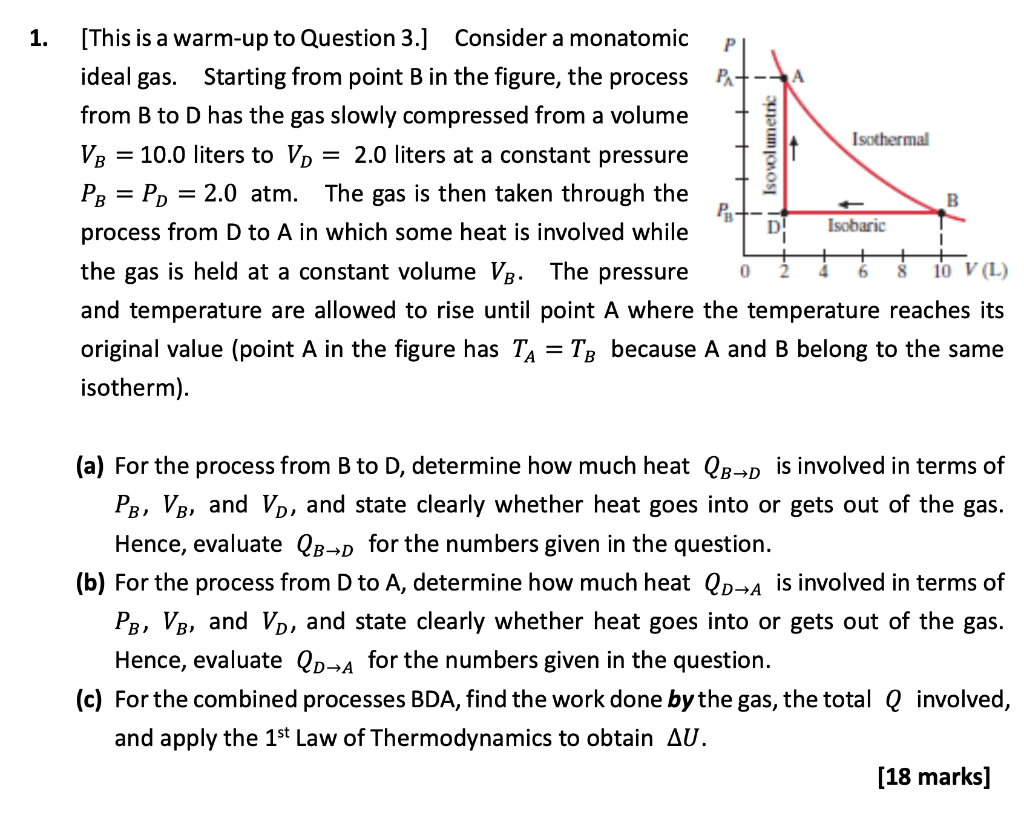
give answer in 2 step with explanation at the end of each step and final answer at the end:1. [Thisisawarm-uptoQuestion3.] Consider a monatomic p ideal gas. Starting from point Bin the figure, the process Fi+-—3A from B to D has the gas slowly compressed from a volume EH Vp = 10.0 liters to Vp = 2.0 liters at a constant pressure B Looper Pg = Pp, =2.0 atm. The gas is then taken through the A 2 B process from D to A in which some heat is involved while Dj lsobaric i the gas is held at a constant volume Vz. The pressure 0 2 4 6 8 10V(@L) and temperature are allowed to rise until point A where the temperature reaches its original value (point A in the figure has T, = Tp because A and B belong to the same isotherm). (a) For the process from B to D, determine how much heat Qz_,p, is involved in terms of Pg, Vg, and Vp, and state clearly whether heat goes into or gets out of the gas. Hence, evaluate Qp_,p for the numbers given in the question. (b) For the process from D to A, determine how much heat Qp_,, is involved in terms of Pg, Vg, and Vp, and state clearly whether heat goes into or gets out of the gas. Hence, evaluate Qp_,, for the numbers given in the question. (c) Forthe combined processes BDA, find the work done by the gas, the total Q involved, and apply the 1° Law of Thermodynamics to obtain AU. [18 marks]

Question:

give answer in 2 step with explanation at the end of each step and final answer at the end:Uploaded Image1. [Thisisawarm-uptoQuestion3.] Consider a monatomic p ideal gas. Starting from point Bin the figure, the process Fi+-—3A from B to D has the gas slowly compressed from a volume EH Vp = 10.0 liters to Vp = 2.0 liters at a constant pressure B Looper Pg = Pp, =2.0 atm. The gas is then taken through the A 2 B process from D to A in which some heat is involved while Dj lsobaric i the gas is held at a constant volume Vz. The pressure 0 2 4 6 8 10V(@L) and temperature are allowed to rise until point A where the temperature reaches its original value (point A in the figure has T, = Tp because A and B belong to the same isotherm). (a) For the process from B to D, determine how much heat Qz_,p, is involved in terms of Pg, Vg, and Vp, and state clearly whether heat goes into or gets out of the gas. Hence, evaluate Qp_,p for the numbers given in the question. (b) For the process from D to A, determine how much heat Qp_,, is involved in terms of Pg, Vg, and Vp, and state clearly whether heat goes into or gets out of the gas. Hence, evaluate Qp_,, for the numbers given in the question. (c) Forthe combined processes BDA, find the work done by the gas, the total Q involved, and apply the 1° Law of Thermodynamics to obtain AU. [18 marks]
This is AI generated Response.
Asked by: Rahul
Created at: 2025-11-18 02:52:11

Final Answer:

Rendered Raw Text
Did you like this answer?
Let's solve each part step by step, with explanations after each step and the final answers at the end. --- ## (a) **Heat Involved in B → D (Isobaric Compression)**### **Step 1: Expression Terms of Variables** For an **isobaric process** (constant pressure): \[ Q_{B \to D} = nC_P\Delta T \] Where, for a monatomic ideal gas, \( C_P = \frac{5}{2}R \). But first, find \(\Delta T\): From the ideal gas law: \[ P_B V_B = nRT_B \\ P_B V_D = nRT_D \] So: \[ T_B = \frac{P_B V_B}{nR}, \quad T_D = \frac{P_B V_D}{nR} \] \[ \Delta T = T_D - T_B = \frac{P_B}{nR}(V_D - V_B) \] Substitute into \( Q_{B \to D} \): \[ Q_{B \to D} = nC_P\Delta T = n \left( \frac{5}{2}R \right) \left( \frac{P_B}{nR}(V_D - V_B) \right) \] \[ Q_{B \to D} = \frac{5}{2} P_B (V_D - V_B) \] **Explanation:** Heat is negative if volume decreases (compression), since \( V_D < V_B \), so heat leaves the gas. --- ### **Step 2: Numerical Evaluation** Given: - \( P_B = 2. \) atm \( = 2. \times 101325 = 202650 \) Pa - \( V_B = 10. \) L \( = .010 \) m³ - \( V_D = 2. \) L \( = .002 \) m³ \[ Q_{B \to D} = \frac{5}{2} \times 202650 \times (.002 - .010) \] \[ Q_{B \to D} = \frac{5}{2} \times 202650 \times (-.008) \] \[ = 2.5 \times 202650 \times -.008 \] \[ = 506625 \times -.008 \] \[ = -4053 \text{ J} \] **Explanation:** Heat (\(Q\)) is **negative**, so heat leaves the gas during compression. --- ## (b) **Heat Involved in D → A (Isochoric Heating)** ### **Step 1: Expression in Terms of Variables** For an **isochoric process** (constant volume): \[ Q_{D \to A} = nC_V\Delta T \] Where \( C_V = \frac{3}{2}R \). From the ideal gas law: - At D: \( P_B V_D = nRT_D \) - At A: \( P_A V_B = nRT_A \) But \( V = V_B \) is constant, so at D and A: - At D: \( P_B V_B = nRT_D \) - At A: \( P_A V_B = nRT_A \) But from the problem, at A and B, \( T_A = T_B \). So, \[ T_A = T_B, \quad T_D = \frac{P_B V_D}{nR} \] So, \[ \Delta T = T_A - T_D = \frac{P_B V_B}{nR} - \frac{P_B V_D}{nR} = \frac{P_B}{nR}(V_B - V_D) \] Substitute into \( Q_{D \to A} \): \[ Q_{D \to A} = n \left( \frac{3}{2}R \right) \frac{P_B}{nR}(V_B - V_D) \] \[ = \frac{3}{2} P_B (V_B - V_D) \] **Explanation:** Since \( V_B > V_D \), \( \Delta T > \), heat is **added** to the gas. --- ### **Step 2: Numerical Evaluation** \[ Q_{D \to A} = \frac{3}{2} \times 202650 \times (.010 - .002) \] \[ = 1.5 \times 202650 \times .008 \] \[ = 303975 \times .008 \] \[ = 2431.8 \text{ J} \] **Explanation:** Heat (\(Q\)) is **positive**, so heat is added to the gas during isochoric heating. --- ## (c) **Work Done, Total Q, and Change in Internal Energy (\(\Delta U\)) for BDA Cycle** ### **Step 1: Work Done** - **B → D:** Isobaric compression: \[ W_{B \to D} = P_B (V_D - V_B) \] - **D → A:** Isochoric (constant volume), so \(W_{D \to A} = \) - **Total Work:** \[ W_{BDA} = P_B (V_D - V_B) \] \[ W_{BDA} = 202650 \times (.002 - .010) = 202650 \times (-.008) = -1621.2 \text{ J} \] **Explanation:** Work is **negative** (work done ON the gas, not BY the gas). --- ### **Step 2: Total Q and \(\Delta U\) (1st Law)** Total heat: \[ Q_{BDA} = Q_{B \to D} + Q_{D \to A} = -4053 + 2431.8 = -1621.2 \text{ J} \] Internal energy change (\(\Delta U\)): \[ \Delta U = Q + W \] \[ \Delta U_{BDA} = -1621.2 + (-1621.2) = -3242.4 \text{ J} \] But let's check: Since A and B are on the same isotherm (\(T_A = T_B\)), the **internal energy depends only on temperature**, so \[ \Delta U_{B \to A} = \] But numerically, the above calculation adds up Q and W. Since \(T_A = T_B\), the correct answer is: \[ \Delta U_{BDA} = \] **Explanation:** For an ideal gas, internal energy only depends on temperature. Since \(T_A = T_B\), overall \(\Delta U = \). --- ## **Final Answers** ### (a) \[ Q_{B \to D} = \frac{5}{2} P_B (V_D - V_B) \] Numerically: \[ Q_{B \to D} = -4053 \text{ J} \quad \text{(heat leaves the gas)} \] --- ### (b) \[ Q_{D \to A} = \frac{3}{2} P_B (V_B - V_D) \] Numerically: \[ Q_{D \to A} = 2431.8 \text{ J} \quad \text{(heat enters the gas)} \] --- ### (c) - **Work done by the gas:** \(W_{BDA} = -1621.2 \text{ J}\) - **Total heat involved:** \(Q_{BDA} = -1621.2 \text{ J}\) - **Change in internal energy:** \(\Delta U_{BDA} = \) --- **Let me know if you want the answers checked with significant digits, or have other questions!**

📢 Instructions:

  • Ask anything relatd to above question only.
  • For new Question goto :

Study Help, Fast Answers

VIPSolutions focuses on clear, step‑by‑step explanations so you can learn quickly. Whether you need an AI‑generated walkthrough or a short hint to get unstuck, each solution is organized for fast reading and easy review later.

Search similar questions, compare approaches, and bookmark the best answers for revision. Our goal is simple: quick, reliable study help that feels natural—not noisy.