This is AI generated Response.
Asked by: Rahul
Created at: 2025-11-17 14:08:38
Final Answer:
RenderedRaw Text
Did you like this answer?
Let's break down each part in **2 steps** with explanations after each step and final answers at the end.
---
## Activity 16B-1
### a. Wave Direction
**Step 1:**
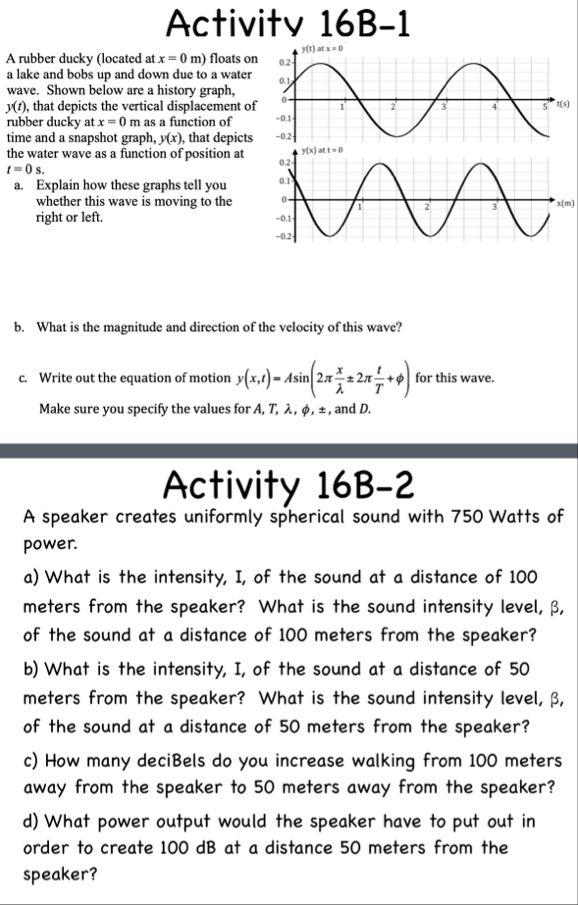
Compare the *history graph* \( y(t) \) at \( x= \) and the *snapshot graph* \( y(x) \) at \( t= \).
- Notice where the peaks/troughs occur in both graphs.
- The *history graph* shows motion over time at a fixed point; the *snapshot graph* shows motion over space at a fixed instant.
**Explanation:**
If, as time increases, the wave at \( x= \) matches what you see at greater \( x \) in the snapshot, the wave is moving in the **positive x-direction (right)**. If it matches smaller \( x \), it's moving **left**.
**Step 2:**
From the graphs, at \( t= \), the peak is at \( x= \) in the snapshot. At \( t> \), the peak at \( x= \) drops, and the peak appears at increasing \( x \) in the snapshot.
**Explanation:**
This means the wave is moving to the **right**.
**Final Answer:**
The wave is **moving to the right (positive x-direction)**.
---
### b. Magnitude and Direction of Velocity
**Step 1:**
Find the **wavelength (\( \lambda \))** and **period (\( T \))** from the graphs:
- Wavelength (\( \lambda \)) is the distance between two peaks in the snapshot graph (\( y(x) \)).
- Period (\( T \)) is the time between two peaks in the history graph (\( y(t) \)).
From the graphs:
- \( \lambda = 2\, \text{m} \) (distance between peaks in position graph)
- \( T = 4\, \text{s} \) (time between peaks in time graph)
**Explanation:**
The wave speed is \( v = \frac{\lambda}{T} \).
**Step 2:**
Calculate the speed:
\[
v = \frac{2\, \text{m}}{4\, \text{s}} = .5\, \text{m/s}
\]
Direction is **to the right** (from part a).
**Explanation:**
The positive value matches the direction found in (a).
**Final Answer:**
**Magnitude:** \( .5\, \text{m/s} \)
**Direction:** To the right
---
### c. Wave Equation
**Step 1:**
Write the general form:
\[
y(x, t) = A \sin\left(2\pi \frac{x}{\lambda} - 2\pi \frac{t}{T} + \phi \right)
\]
From graphs:
- Amplitude (\( A \)): \( .2\, \text{m} \)
- Wavelength (\( \lambda \)): \( 2\, \text{m} \)
- Period (\( T \)): \( 4\, \text{s} \)
- Phase (\( \phi \)): At \( x=, t= \), \( y= \), so \( \phi= \)
- Direction: minus sign since wave moves right
**Explanation:**
Plug in the values from the graphs.
**Step 2:**
\[
y(x, t) = .2 \sin\left(2\pi \frac{x}{2} - 2\pi \frac{t}{4}\right)
= .2 \sin\left(\pi x - \frac{\pi}{2} t\right)
\]
**Explanation:**
All values substituted as required.
**Final Answer:**
\[
y(x, t) = .2 \sin\left(\pi x - \frac{\pi}{2} t\right)
\]
---
## Activity 16B-2
### a. Intensity and Sound Intensity Level at 100 m
**Step 1:**
Intensity, \( I = \frac{P}{4\pi r^2} \)
- \( P = 750\, \text{W} \)
- \( r = 100\, \text{m} \)
\[
I = \frac{750}{4\pi (100)^2} = \frac{750}{125,663.7} \approx .006 \text{ W/m}^2
\]
**Explanation:**
Intensity is power per unit area for a sphere.
**Step 2:**
Sound intensity level, \( \beta = 10 \log_{10} \left( \frac{I}{I_} \right) \)
- \( I_ = 1 \times 10^{-12}\, \text{W/m}^2 \)
\[
\beta = 10 \log_{10} \left( \frac{.006}{1\times10^{-12}} \right) \approx 10 \times 9.78 = 97.8 \text{ dB}
\]
**Explanation:**
Convert intensity to dB using the reference level.
**Final Answer:**
- **Intensity at 100 m:** \( .006\, \text{W/m}^2 \)
- **Sound intensity level at 100 m:** \( 97.8\, \text{dB} \)
---
### b. Intensity and Sound Intensity Level at 50 m
**Step 1:**
\[
I = \frac{750}{4\pi (50)^2} = \frac{750}{31,415.9} \approx .024 \text{ W/m}^2
\]
**Explanation:**
Smaller distance means higher intensity.
**Step 2:**
\[
\beta = 10 \log_{10} \left( \frac{.024}{1\times10^{-12}} \right) \approx 10 \times 10.38 = 103.8 \text{ dB}
\]
**Explanation:**
Calculate dB level as before.
**Final Answer:**
- **Intensity at 50 m:** \( .024\, \text{W/m}^2 \)
- **Sound intensity level at 50 m:** \( 103.8\, \text{dB} \)
---
### c. Increase in Decibels from 100 m to 50 m
**Step 1:**
Subtract the dB at 100 m from the dB at 50 m:
\[
103.8\, \text{dB} - 97.8\, \text{dB} = 6\, \text{dB}
\]
**Explanation:**
Difference in dB levels gives the increase.
**Step 2:**
The increase is **6 dB**.
**Explanation:**
Every time you halve the distance, intensity quadruples, which increases dB by 6.
**Final Answer:**
**Increase:** \( 6\, \text{dB} \)
---
### d. Power Needed for 100 dB at 50 m
**Step 1:**
First, find the required intensity for 100 dB:
\[
100 = 10 \log_{10} \left( \frac{I}{1\times10^{-12}} \right) \implies I = 1\times10^{-10} \text{ W/m}^2
\]
**Explanation:**
Solve for \( I \) using the dB formula.
**Step 2:**
The area at 50 m: \( A = 4\pi (50)^2 = 31,415.9\, \text{m}^2 \).
Required power: \( P = I \times A = 1\times10^{-10} \times 31,415.9 = 3.14 \times 10^{-6} \text{ W} \).
**Explanation:**
Multiply the intensity by the area to get power.
**Final Answer:**
**Required power output:** \( 3.14 \times 10^{-6} \text{ W} \) (or about **3.1 μW**)
---
Let me know if you need step-by-step math for any individual part!
VIPSolutions focuses on clear, step‑by‑step explanations so you can learn quickly. Whether you need an AI‑generated walkthrough or a short hint to get unstuck, each solution is organized for fast reading and easy review later.
Search similar questions, compare approaches, and bookmark the best answers for revision. Our goal is simple: quick, reliable study help that feels natural—not noisy.
 VIPSolutions
 Activity 16B-1
A rubber ducky (located atx = 0m) floatson ~~ o,1 "
a lake and bobs up and down due to a water,
wave. Shown below are a history graph,
(0), that depicts the vertical displacement of 7 7 T Tw
rubber ducky atx = 0 m as a function of a1
time and a snapshot graph, (x), that depicts ©
the water wave as a function of position at | 470941°¢
1=0s. A
a. Explain how these graphs tell you «
‘whether this wave is moving to the o 0 ? xn)
right or left a
b. What is the magnitude and direction of the velocity of this wave?
©. Write out the equation of motion y(x,r) = tsn{2x 2x £9) for this wave.
Make sure you specify the values for 4, T, 4, , =, and D.
a
Activity 16B-2
A speaker creates uniformly spherical sound with 750 Watts of
power.
a) What is the intensity, I, of the sound at a distance of 100
meters from the speaker? What is the sound intensity level, 8,
of the sound at a distance of 100 meters from the speaker?
b) What is the intensity, I, of the sound at a distance of 50
meters from the speaker? What is the sound intensity level, 8,
of the sound at a distance of 50 meters from the speaker?
c) How many deciBels do you increase walking from 100 meters
away from the speaker to 50 meters away from the speaker?
d) What power output would the speaker have fo put out in
order to create 100 dB at a distance 50 meters from the
speaker?