 VIPSolutions
give answer in 2 step with explanation at the end of each step and final answer at the end:Bob is talking to Alice using a tin can telephone, which consists of two steel cans connected by a 20.0 -m- long taut steel wire (see the figure) . The wire has a linear density of 6.49 g/m, and the tension on the wire is 28.5 N.. The sound waves leave Bob's mouth, are collected by the can on the left, and then create vibrations in the wire, which travel to Alice's can and are transformed back into sound waves in air. Alice hears both the sound waves that have traveled through the wire (wave 1) and those that have traveled through the air (wave 2), bypassing the wire. Which wave arrives sooner and by how much? The speed of sound in air is 343 m/s. (Enter the time difference ins, enter a positive number if wave 1 arrives first, and enter a negative number if wave 2 arrives first. Enter 0 if both arrive at the same time.)
Question:
give answer in 2 step with explanation at the end of each step and final answer at the end: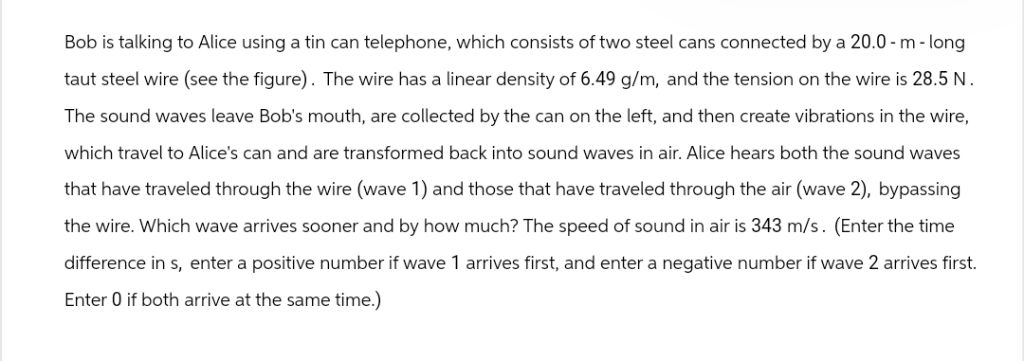 Bob is talking to Alice using a tin can telephone, which consists of two steel cans connected by a 20.0 -m- long
taut steel wire (see the figure) . The wire has a linear density of 6.49 g/m, and the tension on the wire is 28.5 N..
The sound waves leave Bob's mouth, are collected by the can on the left, and then create vibrations in the wire,
which travel to Alice's can and are transformed back into sound waves in air. Alice hears both the sound waves
that have traveled through the wire (wave 1) and those that have traveled through the air (wave 2), bypassing
the wire. Which wave arrives sooner and by how much? The speed of sound in air is 343 m/s. (Enter the time
difference ins, enter a positive number if wave 1 arrives first, and enter a negative number if wave 2 arrives first.
Enter 0 if both arrive at the same time.)
Asked by: Rahul
Created at: 2025-11-17 06:39:12
Final Answer:
📢 Instructions:
- Ask anything relatd to above question only.
- For new Question goto :