 VIPSolutions
give answer in 2 step with explanation at the end of each step and final answer at the end:Compare the following investment alternatives using PW analysis and an annual interest rate of % 16, compounded quarterly. Compare the following investment alternatives using PW analysis and an annual interest rate 0f %16, compounded quarterly. I Bi Mid el RW dc ON oO Mc JO
Question:
give answer in 2 step with explanation at the end of each step and final answer at the end: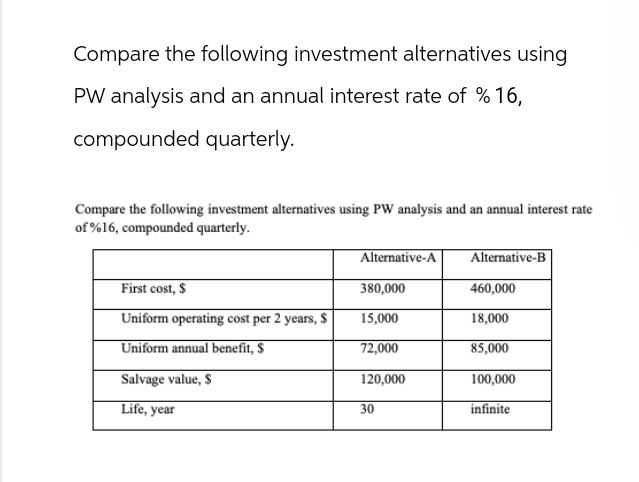 Compare the following investment alternatives using
PW analysis and an annual interest rate of % 16,
compounded quarterly.
Compare the following investment alternatives using PW analysis and an annual interest rate
0f %16, compounded quarterly.
I Bi Mid
el RW
dc ON oO Mc JO
This is AI generated Response.
Asked by: Rahul
Created at: 2025-11-17 04:53:52
Asked by: Rahul
Created at: 2025-11-17 04:53:52
Final Answer:
Rendered
Raw Text
Did you like this answer?
## Step 1: Convert Interest Rate and Find PW Factors
### **a. Convert nominal annual interest rate to quarterly rate**
Given:
Annual nominal interest rate, \( i = 16\% \) compounded quarterly
Number of quarters per year = 4
Quarterly interest rate (\( i_{quarter} \)) = \( \frac{16\%}{4} = 4\% \) per quarter
- For calculations, use \( i_{quarter} = .04 \).
### **b. Find PW factors for each alternative**
#### **Alternative A (Life = 30 years = 120 quarters):**
- **Uniform Series Present Worth Factor (USPW):**
\( P/A, i, n = \frac{1-(1+i)^{-n}}{i} \)
For \( n = 120 \), \( i = .04 \)
- **Single Payment Present Worth Factor (SPPW) for Salvage:**
\( P/F, i, n = (1+i)^{-n} \)
#### **Alternative B (Life = Infinite):**
- For infinite life, the Present Worth (PW) for a uniform series = \( PW = \frac{A}{i} \)
(since \( (1+i)^{-n} \to \) as \( n \to \infty \)).
---
**Explanation:**
Before comparing alternatives, we must convert all cash flows to present worth using the correct interest rate and period. Since the interest is compounded quarterly, all calculations must be done per quarter.
---
## Step 2: Calculate Present Worth for Each Alternative
### **a. Alternative A:**
#### **Convert all cash flows to quarterly:**
- **Operating Cost/Benefit:** Given per year, convert to per quarter:
- Operating Cost: \( 15,000 / 2 = 7,500 \) per year → \( 7,500 / 4 = 1,875 \) per quarter
- Uniform Benefit: \( 72,000 / 4 = 18,000 \) per quarter
- **Net Uniform Benefit:**
\( = 18,000 - 1,875 = 16,125 \) per quarter
- **PW Calculation:**
\[
PW_A = -380,000 + (16,125) \times (P/A, 4\%, 120) + 120,000 \times (P/F, 4\%, 120)
\]
Using tables or calculator:
- \( (P/A, 4\%, 120) \approx 25.97 \)
- \( (P/F, 4\%, 120) \approx .0291 \)
Plug in values:
\[
PW_A = -380,000 + 16,125 \times 25.97 + 120,000 \times .0291
\]
\[
PW_A = -380,000 + 418,916.25 + 3,492
\]
\[
PW_A = \$42,408.25
\]
---
### **b. Alternative B (Infinite Life):**
- **Operating Cost:** \( 18,000 / 2 = 9,000 \) per year → \( 9,000 / 4 = 2,250 \) per quarter
- **Uniform Benefit:** \( 85,000 / 4 = 21,250 \) per quarter
- **Net Uniform Benefit:**
\( = 21,250 - 2,250 = 19,000 \) per quarter
- **PW Calculation:**
\[
PW_B = -460,000 + \frac{19,000}{.04}
\]
\[
PW_B = -460,000 + 475,000
\]
\[
PW_B = \$15,000
\]
---
**Explanation:**
All cash flows are converted to present worth using the appropriate factors. For finite life, we use the PW factor and for infinite life, the uniform series formula.
---
## **Final Answer**
- **PW of Alternative A:** \$42,408.25
- **PW of Alternative B:** \$15,000
**Conclusion:**
**Alternative A is the better investment (higher Present Worth).**
📢 Instructions:
- Ask anything relatd to above question only.
- For new Question goto :