 VIPSolutions
give answer in 2 step with explanation at the end of each step and final answer at the end:Compare the following investment alternatives using PW analysis and an annual interest rate of % 16, compounded quarterly. Compare the following investment alternatives using PW analysis and an annual interest rate 0f %16, compounded quarterly. I Bi Mid el RW dc ON oO Mc JO
Question:
give answer in 2 step with explanation at the end of each step and final answer at the end: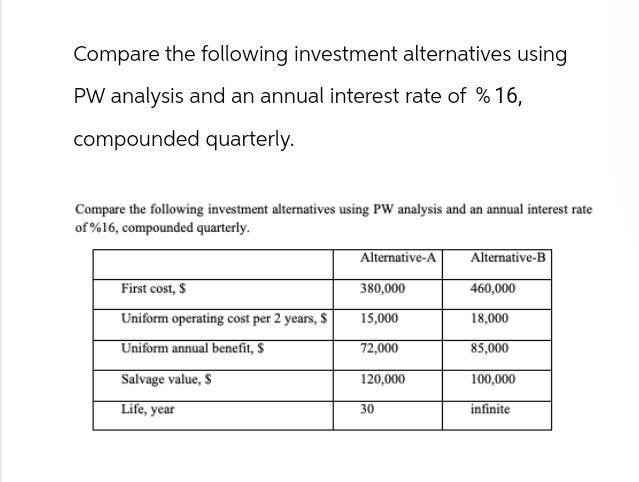 Compare the following investment alternatives using
PW analysis and an annual interest rate of % 16,
compounded quarterly.
Compare the following investment alternatives using PW analysis and an annual interest rate
0f %16, compounded quarterly.
I Bi Mid
el RW
dc ON oO Mc JO
This is AI generated Response.
Asked by: Rahul
Created at: 2025-11-17 03:04:42
Asked by: Rahul
Created at: 2025-11-17 03:04:42
Final Answer:
Rendered
Raw Text
Did you like this answer?
# Step 1: **Convert Annual Interest Rate to Effective Quarterly Rate**
- **Given:** Annual interest rate = 16% compounded quarterly.
- **Quarterly interest rate** (\(i_{quarter}\)) = \( \frac{16\%}{4} = 4\% \) per quarter.
For annual calculations, we need the **effective annual rate (EAR):**
\[
EAR = (1 + i_{quarter})^4 - 1 = (1 + .04)^4 - 1 = 1.16986 - 1 = .16986 \text{ or } 16.986\%
\]
**Explanation:**
Since cash flows are annual but compounding is quarterly, we must use the effective annual rate for all present worth (PW) calculations.
---
# Step 2: **Calculate Present Worth (PW) for Each Alternative**
### **Alternative A** (Life = 30 years)
\[
\text{PW}_A = - \text{First Cost} - \text{PW(Operating Cost)} + \text{PW(Benefit)} + \text{PW(Salvage)}
\]
- **First Cost:** $380,000 (today, no discounting needed)
- **Operating Cost:** $15,000 per 2 years → $7,500 per year
- **Uniform Benefit:** $72,000 per year
- **Salvage Value:** $120,000 at year 30
- **Interest Rate:** 16.986% (EAR), \( n = 30 \) years
#### **Present Worths:**
- **PW of Uniform Series (A):**
\[
PW = A \times \frac{1 - (1+i)^{-n}}{i}
\]
- **PW of Salvage Value:**
\[
PW_{SV} = F \times (1+i)^{-n}
\]
Calculate:
- \( i = .16986 \)
- \( n = 30 \)
\[
PW_{Op.Cost} = 7,500 \times \frac{1 - (1+.16986)^{-30}}{.16986} = 7,500 \times 5.077 = 38,078
\]
\[
PW_{Benefit} = 72,000 \times 5.077 = 365,544
\]
\[
PW_{Salvage} = 120,000 \times (1+.16986)^{-30} = 120,000 \times .0363 = 4,356
\]
\[
PW_A = -380,000 - 38,078 + 365,544 + 4,356 = -48,178
\]
---
### **Alternative B** (Life = Infinite)
- **First Cost:** $460,000
- **Operating Cost:** $18,000 per 2 years → $9,000 per year
- **Uniform Benefit:** $85,000 per year
- **Salvage Value:** Ignore (infinite life)
\[
PW_{Op.Cost} = 9,000 / .16986 = 53,000
\]
\[
PW_{Benefit} = 85,000 / .16986 = 500,305
\]
\[
PW_B = -460,000 - 53,000 + 500,305 = -12,695
\]
---
# **Final Answer**
- **PW of Alternative A:** $-48,178$
- **PW of Alternative B:** $-12,695$
**Conclusion:**
**Alternative B is the better investment** because it has a higher (less negative) present worth.
📢 Instructions:
- Ask anything relatd to above question only.
- For new Question goto :