 VIPSolutions
give answer in 2 step with explanation at the end of each step and final answer at the end:Part of the deflection system displayed in Fig. 1 employs vertically oriented electric fields E = Ek with variable E to manipulate the motion of charged particles. Ar time 1 = 0, when the applied field is some unknown E = E , a positively charged particle of charge ¢ and mass mx - axis in the figure, . Then, at a given time t = on the applied field is suddenly switched ro another unknown E = E, . Afterwards, ar another given time r = ot, this particle is observed at point B, of the same vertical position as point A, but moving now ar angle « away from the horizontal. Based on these observations, find the electric fields E and E, , including their signs, that were used ro effect the motion of the particle? What speed / does the particle have at point B? (Gravity can be neglected.) [| 1. Part of the deflection system displayed in Fig. 1 employs vertically oriented electric fields E = Ek with variable E' to manipulate the motion of charged particles. At time ¢ = 0, when the applied field is some unknown E = E\, a positively charged particle of charge ¢ and mass m is observed at point A moving horizontally (along the z-axis in the figure) with speed v,. Then, at a given time ¢ = t,, the applied field is suddenly switched to another unknown E = E;. Afterwards, at another given time t = {; + #5, this particle is observed at point B, of the same vertical position as point A, but moving now at angle a away from the horizontal. Based on these observations, find the electric fields Ey and E,, including their signs, that were used to effect the motion of the particle? What speed vy does the particle have at point B? (Gravity can be neglected.) Xx y=? , v=? 9 A A B Figure 1: Illustration for problem 1.
Question:
give answer in 2 step with explanation at the end of each step and final answer at the end: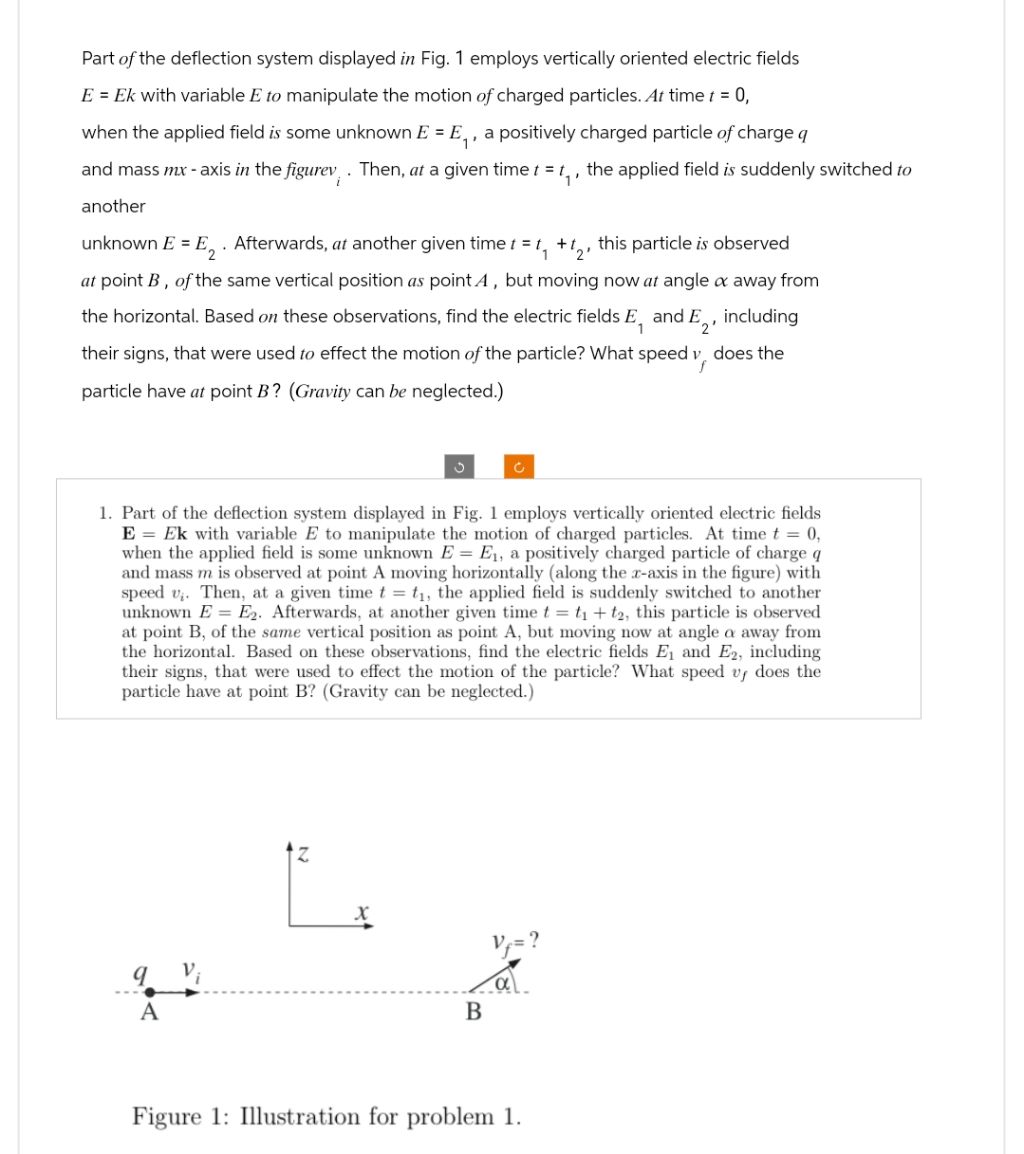 Part of the deflection system displayed in Fig. 1 employs vertically oriented electric fields
E = Ek with variable E to manipulate the motion of charged particles. Ar time 1 = 0,
when the applied field is some unknown E = E , a positively charged particle of charge ¢
and mass mx - axis in the figure, . Then, at a given time t = on the applied field is suddenly switched ro
another
unknown E = E, . Afterwards, ar another given time r = ot, this particle is observed
at point B, of the same vertical position as point A, but moving now ar angle « away from
the horizontal. Based on these observations, find the electric fields E and E, , including
their signs, that were used ro effect the motion of the particle? What speed / does the
particle have at point B? (Gravity can be neglected.)
[|
1. Part of the deflection system displayed in Fig. 1 employs vertically oriented electric fields
E = Ek with variable E' to manipulate the motion of charged particles. At time ¢ = 0,
when the applied field is some unknown E = E\, a positively charged particle of charge ¢
and mass m is observed at point A moving horizontally (along the z-axis in the figure) with
speed v,. Then, at a given time ¢ = t,, the applied field is suddenly switched to another
unknown E = E;. Afterwards, at another given time t = {; + #5, this particle is observed
at point B, of the same vertical position as point A, but moving now at angle a away from
the horizontal. Based on these observations, find the electric fields Ey and E,, including
their signs, that were used to effect the motion of the particle? What speed vy does the
particle have at point B? (Gravity can be neglected.)
Xx
y=?
, v=?
9 A
A B
Figure 1: Illustration for problem 1.
Asked by: Rahul
Created at: 2025-11-17 02:10:56
Final Answer:
📢 Instructions:
- Ask anything relatd to above question only.
- For new Question goto :