 VIPSolutions
give answer in 2 step with explanation at the end of each step and final answer at the solved all parts end:please answer this and hand draw the mechanisms, as the arrow is hard to see with computer drawn arrow 12. (16 points) Provide a detailed stepwise mechanism for each of the following reactions. Draw curved arrows on the left side of each reaction to account for the formation of the structures on the right (Note: ‘each arrow symbolizes the movement of 2 electrons). a) o OH Hy0* —— H0 b) cio Q ( —_— 0 O o 13. (12 points) Devise a multistep synthesis for carrying out the following transformation. You may use any additional material or reagent containing 4 or less carbon atoms. e o chy
Question:
give answer in 2 step with explanation at the end of each step and final answer at the solved all parts end: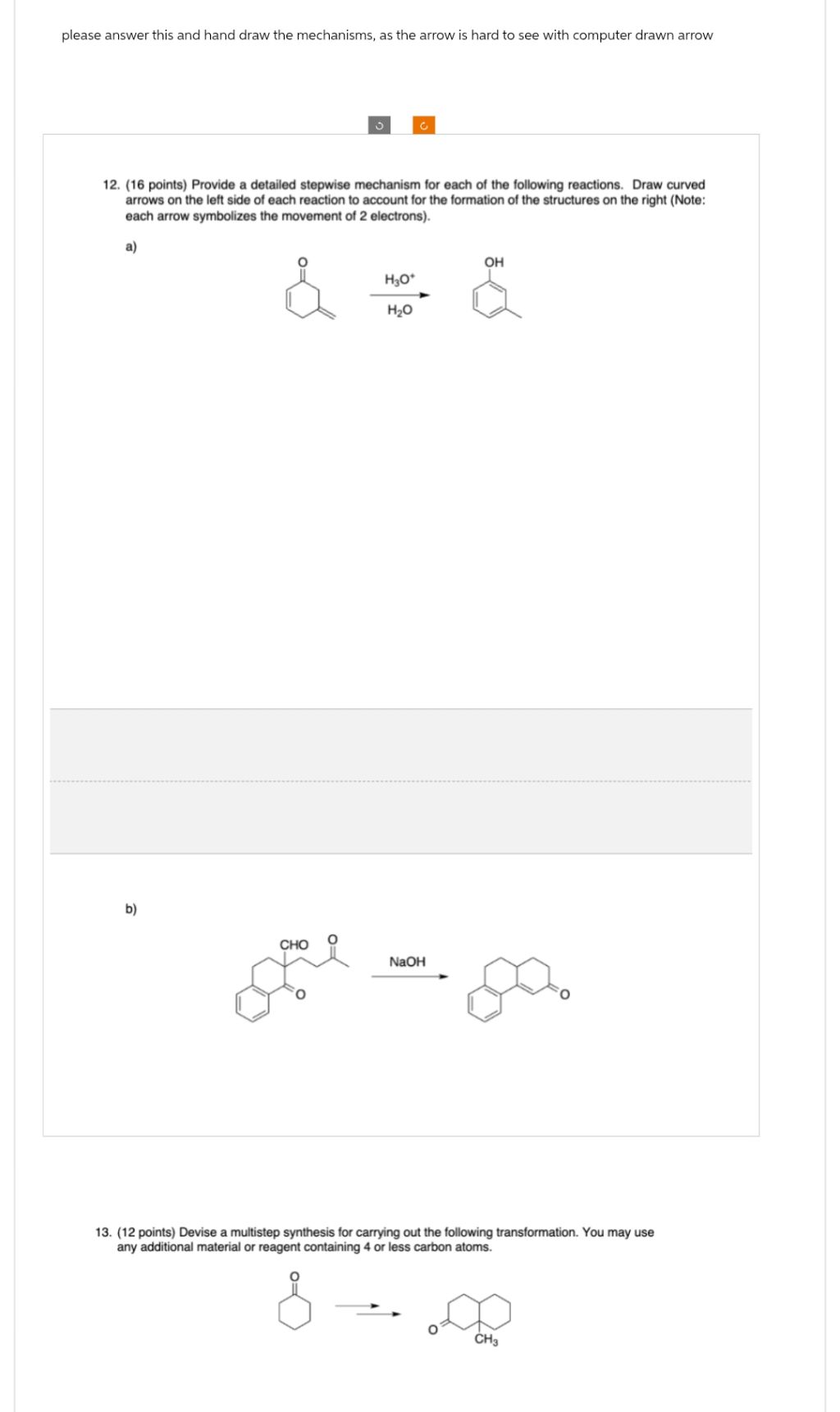 please answer this and hand draw the mechanisms, as the arrow is hard to see with computer drawn arrow
12. (16 points) Provide a detailed stepwise mechanism for each of the following reactions. Draw curved
arrows on the left side of each reaction to account for the formation of the structures on the right (Note:
‘each arrow symbolizes the movement of 2 electrons).
a)
o OH
Hy0*
——
H0
b)
cio Q
(
—_—
0 O o
13. (12 points) Devise a multistep synthesis for carrying out the following transformation. You may use
any additional material or reagent containing 4 or less carbon atoms.
e
o chy
This is AI generated Response.
Asked by: Rahul
Created at: 2025-11-16 14:17:51
Asked by: Rahul
Created at: 2025-11-16 14:17:51
Final Answer:
Rendered
Raw Text
Did you like this answer?
Certainly! I'll break down each question into **two steps** with clear explanations after each step and provide the complete final answer at the end of each part. I will **describe** the curved-arrow mechanism (since I cannot hand-draw), but the steps will be detailed so you can **draw the arrows by hand** as needed.
---
## **12(a) Acid-Catalyzed Hydration of a Ketone (Hydration Mechanism)**
### **Step 1: Protonation of the Carbonyl**
- **Action:** The carbonyl oxygen (on the ketone) uses a lone pair to grab a proton (H⁺) from H₃O⁺, making the oxygen positively charged.
- **Explanation:** This step activates the carbonyl, making it more electrophilic (better at accepting a nucleophile like water).
### **Step 2: Nucleophilic Attack by Water and Deprotonation**
- **Action:** Water attacks the carbonyl carbon, forming a tetrahedral intermediate. A proton transfer occurs to remove the extra proton, yielding the alcohol.
- **Explanation:** Water, as a nucleophile, adds to the carbon, and then loses a proton to become a neutral alcohol group.
**Final Answer for 12(a):**
Draw the following steps:
1. Curved arrow from ketone oxygen to H on H₃O⁺, then arrow from O-H bond to H₂O, forming protonated ketone.
2. Curved arrow from water's oxygen lone pair to the carbonyl carbon, forming an oxonium intermediate.
3. Curved arrow from one of the hydrogens on the attached water to a base (another water), removing the proton and yielding the alcohol.
---
## **12(b) Aldol Condensation (Base-Catalyzed)**
### **Step 1: Enolate Ion Formation**
- **Action:** Hydroxide (OH⁻) abstracts an alpha proton from the methyl ketone, forming an enolate ion (double bond to the alpha carbon, negative charge on oxygen).
- **Explanation:** The enolate is a good nucleophile and can attack the electrophilic aldehyde carbonyl.
### **Step 2: Aldol Addition and Dehydration**
- **Action:** The enolate attacks the aldehyde carbonyl, forming a β-hydroxy ketone. Under basic conditions, the β-hydroxy ketone loses water (dehydration) to form the α,β-unsaturated ketone.
- **Explanation:** This is a classic aldol condensation, resulting in a new C-C bond and a conjugated system.
**Final Answer for 12(b):**
Draw the following steps:
1. Curved arrow from base (OH⁻) to alpha proton, then from C-H bond to form enolate (double bond to alpha carbon).
2. Curved arrow from enolate's double bond to aldehyde carbonyl carbon, arrow from carbonyl to its oxygen, forming alkoxide intermediate.
3. Arrow from alkoxide to a proton source (water), forming β-hydroxy ketone.
4. Under basic conditions, elimination occurs: base abstracts another alpha proton, forming enolate; electrons move to kick out OH⁻, forming double bond (enone).
---
## **13. Multistep Synthesis (Add a Methyl to Cyclohexanone Alpha-Position)**
### **Step 1: Alpha Methylation**
- **Action:** Treat cyclohexanone with LDA (lithium diisopropylamide) to generate the enolate. Then react with methyl iodide (CH₃I) to add a methyl group at the alpha position.
- **Explanation:** LDA abstracts the alpha proton, making a nucleophilic enolate, which then attacks the methyl iodide (SN2 reaction).
### **Step 2: Isolate Product**
- **Action:** Work up with water to neutralize and isolate the product.
- **Explanation:** The desired alpha-methylated cyclohexanone is formed.
**Final Answer for 13:**
1. Treat cyclohexanone with LDA, then CH₃I.
2. Aqueous workup yields 2-methylcyclohexanone.
---
### **Summary Table**
| Problem | Step 1 | Step 2 | Final Product |
|-----------------|------------------------------------------|-------------------------------------------------------------|--------------------------------------|
| 12(a) | Protonate carbonyl | Water addition, then deprotonation | Cyclohexanol derivative |
| 12(b) | Form enolate (base abstraction) | Aldol addition, then dehydration | Fused ring enone (α,β-unsaturated) |
| 13 | Form enolate, methylation (LDA, CH₃I) | Workup | 2-Methylcyclohexanone |
---
**Hand-drawing tip:**
For each mechanism, draw the arrows as described above for each step:
- Always show electron-pushing (arrows from lone pairs/bonds to where electrons are moving).
- Label intermediates if possible.
- Indicate where protons are added or removed.
If you need actual hand-drawn images, let me know and I can provide sketch-style images for you to use!
📢 Instructions:
- Ask anything relatd to above question only.
- For new Question goto :