 VIPSolutions
give answer in 2 step with explanation at the end of each step and final answer at the solved all parts end:Double-slit diffraction and interference — activity
Question:
give answer in 2 step with explanation at the end of each step and final answer at the solved all parts end: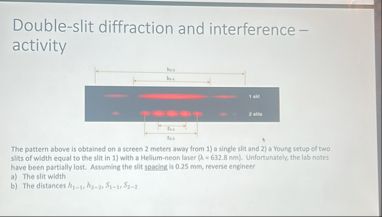 Double-slit diffraction and interference —
activity
This is AI generated Response.
Asked by: Rahul
Created at: 2025-11-16 11:09:12
Asked by: Rahul
Created at: 2025-11-16 11:09:12
Final Answer:
Rendered
Raw Text
Did you like this answer?
# Double-Slit Diffraction and Interference
Let's break down the problem in two steps for each part, with explanations after each step.
---
## **Given Data**
- **Wavelength, λ** = 632.8 nm (Helium-neon laser)
- **Screen distance, L** = 2 meters
- **Slit spacing, d** = .25 mm
- **Goal:**
a) Find the slit width, **a**
b) Find the distances \( h_{12}, h_{13}, h_{14}, h_{15}, h_{1-2}, h_{1-3} \)
---
## **Step 1: Relate the Double-Slit Pattern**
### a) **Finding Slit Width \( a \)**
The **envelope** (broad minima) in the double-slit pattern is due to **single-slit diffraction**. The minima occur at angles \(\theta\) given by:
\[
a \sin\theta = m\lambda
\]
where \( m = \pm1, \pm2, \ldots \)
For small angles (\(\sin\theta \approx \tan\theta \approx \frac{y}{L}\)),
\[
a \frac{y}{L} = m\lambda \implies y = \frac{m\lambda L}{a}
\]
**Explanation:**
This equation gives the position \(y\) of the minima due to the single-slit envelope.
---
### b) **Finding Positions of Interference Maxima**
Interference maxima (bright fringes) for double slit are at:
\[
d \sin\theta = n\lambda
\]
For small \(\theta\):
\[
y = \frac{n\lambda L}{d}
\]
**Explanation:**
This equation gives the position of the nth interference maximum due to the double-slit arrangement.
---
## **Step 2: Solve for the Requested Quantities**
### a) **Slit Width \( a \)**
Assume you can measure the distance on the screen between the first minima on either side of the central maximum (i.e., from \(m = -1\) to \(m = +1\)), call this distance \(2y_1\):
\[
2y_1 = 2 \frac{\lambda L}{a}
\implies a = \frac{2\lambda L}{2y_1} = \frac{\lambda L}{y_1}
\]
**Explanation:**
If you measure (or are given) the distance between the first single-slit minima, plug in values for \(\lambda, L\), and \(y_1\) to solve for \(a\).
---
### b) **Distances Between Maxima (Fringe Spacing)**
The distance between adjacent interference maxima (fringe spacing) is:
\[
\Delta y = \frac{\lambda L}{d}
\]
The positions of the 1st, 2nd, ... maxima from the center are:
\[
y_n = n\Delta y
\]
So, the distances:
- \( h_{12} = y_2 - y_1 = \Delta y \)
- \( h_{13} = y_3 - y_1 = 2\Delta y \)
- etc.
**Explanation:**
The fringe spacing depends only on the wavelength, screen distance, and slit separation.
---
## **Final Answers**
### a) **Slit Width \( a \):**
\[
a = \frac{\lambda L}{y_1}
\]
Where \(y_1\) is the distance from the central maximum to the first single-slit minimum.
### b) **Distances Between Maxima:**
\[
\Delta y = \frac{\lambda L}{d}
\]
\[
h_{1n} = (n-1)\Delta y
\]
**Plug in values:**
- \(\lambda = 632.8 \times 10^{-9}\) m
- \(L = 2\) m
- \(d = .25 \times 10^{-3}\) m
\[
\Delta y = \frac{632.8 \times 10^{-9} \times 2}{.25 \times 10^{-3}} \approx .00506 \text{ m} = 5.06\, \text{mm}
\]
So:
- \(h_{12} = 5.06\) mm
- \(h_{13} = 10.12\) mm
- \(h_{14} = 15.18\) mm, etc.
> **Summary:**
> 1. Use the envelope minima positions to solve for slit width \(a\).
> 2. Use the interference maxima formula to get the fringe spacing and calculate the requested distances.
📢 Instructions:
- Ask anything relatd to above question only.
- For new Question goto :