 VIPSolutions
give answer in 2 step with explanation at the end of each step and final answer at the solved all parts end:5. (2) Define the following (5 points): i) Lagrangian vs. Eulerian flow descriptions ii) One, Two and Three dimensional flows ii) Steady vs. Unsteady flows iv) Control Volume +) Continuity and Linear Momentum Equations (b) The velocity of a liquid (Specific Gravity = 1.4) in a 150 mm pipeline is 0.8 ms. Calculate the rate of flow in Lis, mvs, kgs, and kN/s (5 points).
Question:
give answer in 2 step with explanation at the end of each step and final answer at the solved all parts end: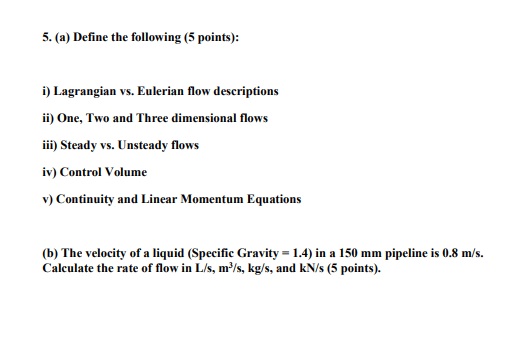 5. (2) Define the following (5 points):
i) Lagrangian vs. Eulerian flow descriptions
ii) One, Two and Three dimensional flows
ii) Steady vs. Unsteady flows
iv) Control Volume
+) Continuity and Linear Momentum Equations
(b) The velocity of a liquid (Specific Gravity = 1.4) in a 150 mm pipeline is 0.8 ms.
Calculate the rate of flow in Lis, mvs, kgs, and kN/s (5 points).
This is AI generated Response.
Asked by: Rahul
Created at: 2025-11-16 09:26:18
Asked by: Rahul
Created at: 2025-11-16 09:26:18
Final Answer:
Rendered
Raw Text
Did you like this answer?
# 5.a) Definitions
### i) Lagrangian vs. Eulerian Flow Descriptions
**Step 1:**
- **Lagrangian Description:** Follows individual fluid particles as they move, tracking their position and properties over time.
- **Eulerian Description:** Observes changes in fluid properties at fixed locations in space as the fluid moves past.
**Explanation:**
Lagrangian tracks particles; Eulerian fixes attention at spatial points.
---
### ii) One, Two, and Three Dimensional Flows
**Step 2:**
- **One-Dimensional Flow:** Flow parameters change only along one spatial dimension (e.g., flow in a straight pipe).
- **Two-Dimensional Flow:** Parameters vary in two dimensions (e.g., flow over a flat plate).
- **Three-Dimensional Flow:** Parameters vary in all three dimensions (e.g., real fluid flows in open space).
**Explanation:**
Dimensionality refers to how many directions the flow properties change.
---
### iii) Steady vs. Unsteady Flows
**Step 3:**
- **Steady Flow:** Fluid properties at any given point do not change with time.
- **Unsteady Flow:** Fluid properties at points change with time.
**Explanation:**
Steady = time-invariant; unsteady = time-variant flow characteristics.
---
### iv) Control Volume
**Step 4:**
- **Control Volume:** A defined region in space (real or imaginary) through which fluid may flow, used for analysis in fluid mechanics.
**Explanation:**
It helps analyze the behavior of fluids as they enter, exist, or interact within a specific region.
---
### v) Continuity and Linear Momentum Equations
**Step 5:**
- **Continuity Equation:** Expresses mass conservation; for incompressible flow, the mass entering a control volume equals the mass leaving it.
- **Linear Momentum Equation:** Derived from Newton's second law, relates the sum of forces on a control volume to the rate of change of momentum.
**Explanation:**
Continuity ensures mass conservation; momentum deals with force and motion in fluids.
---
---
# 5. (b) Flow Rate Calculations
### **Given Data**
- Specific Gravity (SG) = 1.4
- Pipe diameter, \( D = 150\, \text{mm} = .15\, \text{m} \)
- Velocity, \( V = .8\, \text{m/s} \)
---
## **Step 1: Calculate Volumetric Flow Rate**
\[
Q = A \times V
\]
\[
A = \frac{\pi}{4} D^2 = \frac{\pi}{4} (.15)^2 = .01767\, \text{m}^2
\]
\[
Q = .01767 \times .8 = .01414\, \text{m}^3/\text{s}
\]
- **In L/s:**
\( Q = .01414\, \text{m}^3/\text{s} \times 100 = 14.14\, \text{L/s} \)
**Explanation:**
Area of pipe is found and multiplied by velocity to get flow rate.
---
## **Step 2: Calculate Mass and Force Flow Rate**
- **Density:**
\( \rho = \text{SG} \times 100 = 1.4 \times 100 = 140\, \text{kg/m}^3 \)
- **Mass flow rate:**
\[
\dot{m} = \rho \times Q = 140 \times .01414 = 19.80\, \text{kg/s}
\]
- **Force flow rate (N/s or kN/s):**
(Force = mass × gravity; \(g = 9.81\, \text{m/s}^2\))
\[
\text{Force flow rate} = \dot{m} \times g = 19.80 \times 9.81 = 194.24\, \text{N/s} = .194\, \text{kN/s}
\]
**Explanation:**
Mass flow is density × volumetric flow. Force flow is mass flow × gravity.
---
## **Final Answers**
- **Flow rate:**
- \( \boxed{14.14\, \text{L/s}} \)
- \( \boxed{.01414\, \text{m}^3/\text{s}} \)
- \( \boxed{19.80\, \text{kg/s}} \)
- \( \boxed{.194\, \text{kN/s}} \)
📢 Instructions:
- Ask anything relatd to above question only.
- For new Question goto :