 VIPSolutions
give answer in 2 step with explanation at the end of each step and final answer at the solved all parts end:3. ropes hss ofthe produc Fm he ccd saving aera nds wy etree ee a Ee ote so. ee dn ee 0 nop Sd eS Hered rdele Hedtrbeoprly:
Question:
give answer in 2 step with explanation at the end of each step and final answer at the solved all parts end: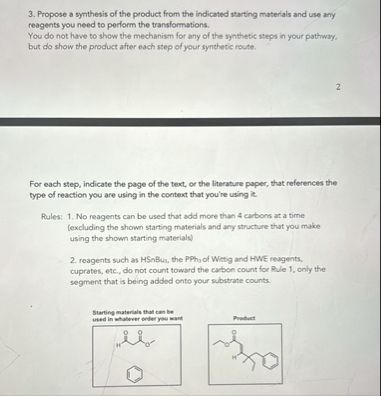 3. ropes hss ofthe produc Fm he ccd saving aera nds wy
etree
ee a Ee
ote so. ee dn ee 0 nop Sd eS
Hered rdele Hedtrbeoprly:
This is AI generated Response.
Asked by: Rahul
Created at: 2025-11-15 15:52:39
Asked by: Rahul
Created at: 2025-11-15 15:52:39
Final Answer:
Rendered
Raw Text
Did you like this answer?
# Stepwise Synthesis Solution
**Goal:** Synthesize the product from the given starting materials, following the rules stated (no >4C addition at a time, special reagents do not count for Rule 1).
## **Step 1: Alkylation of Acetophenone**
### **Reaction:**
Use acetophenone (starting material 1) and react with 1-bromopropane (starting material 2) via **enolate alkylation**.
- **Reagents:**
1. Base (e.g., NaOEt or LDA) to generate the enolate from acetophenone
2. 1-bromopropane (propyl bromide) as the alkylating agent
### **Product After Step 1:**
You get **1-phenyl-1-butanone**.
#### **Explanation:**
- The enolate of acetophenone acts as a nucleophile and attacks 1-bromopropane, adding a propyl group to the α-position of the ketone.
- This step is valid because you are adding a 3-carbon fragment, which meets the "no more than 4 carbons at a time" rule.
---
## **Step 2: Wittig Reaction to Form Alkene**
### **Reaction:**
React 1-phenyl-1-butanone with the Wittig reagent generated from benzyltriphenylphosphonium bromide and base.
- **Reagents:**
1. Benzyltriphenylphosphonium bromide (PhCH₂PPh₃⁺ Br⁻)
2. Strong base (e.g., n-BuLi or NaH) to generate the ylide
### **Product After Step 2 (Final Product):**
You get **(E)-1-phenyl-4-phenyl-1-butene**, which matches the product shown.
#### **Explanation:**
- The Wittig reaction converts the carbonyl group to a double bond (alkene), attaching the phenyl group from the ylide at the terminal position.
- The "segment" added is a phenylmethylene group, which is allowed under the rules for Wittig reagents.
---
# **Final Answer: Full Synthesis Route**
1. **Enolate Alkylation:**
Acetophenone + 1-bromopropane + base → 1-phenyl-1-butanone
2. **Wittig Reaction:**
1-phenyl-1-butanone + benzyltriphenylphosphonium ylide → (E)-1-phenyl-4-phenyl-1-butene (final product)
---
## **References for Reaction Types**
- **Enolate Alkylation:** Carey & Sundberg, "Advanced Organic Chemistry", Part B, 5th Ed., p. 112 (Alkylation of enolates)
- **Wittig Reaction:** Carey & Sundberg, "Advanced Organic Chemistry", Part B, 5th Ed., p. 63 (Wittig Olefination)
---
**Summary:**
**Step 1:** Alkylate acetophenone with propyl bromide to get 1-phenyl-1-butanone.
**Step 2:** Perform a Wittig reaction with benzyltriphenylphosphonium ylide to install the terminal alkene with a phenyl group.
**Final Product:** (E)-1-phenyl-4-phenyl-1-butene.
📢 Instructions:
- Ask anything relatd to above question only.
- For new Question goto :