 VIPSolutions
give answer in 2 step with explanation at the end of each step and final answer at the solved all parts end:1 ee | shows an electrical circuit. The emf of the battery is 11.0. Find the equivalent est of is rut. id he cet n , = 80 0 10 5 H 3 & PAY
Question:
give answer in 2 step with explanation at the end of each step and final answer at the solved all parts end: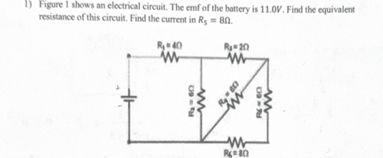 1 ee | shows an electrical circuit. The emf of the battery is 11.0. Find the equivalent
est of is rut. id he cet n , = 80
0 10
5 H
3 &
PAY
This is AI generated Response.
Asked by: Rahul
Created at: 2025-11-15 06:25:14
Asked by: Rahul
Created at: 2025-11-15 06:25:14
Final Answer:
Rendered
Raw Text
Did you like this answer?
## Step 1: Find the Equivalent Resistance
First, analyze the circuit:
- \( R_1 = 4\ \Omega \) (in series with the battery)
- \( R_2 = 6\ \Omega \) (in series after \( R_1 \))
- After \( R_2 \), the circuit splits into two parallel branches:
- Branch 1: \( R_3 = 2\ \Omega \) (upper branch)
- Branch 2: Two resistors in series: \( R_4 = 6\ \Omega \) and \( R_5 = 8\ \Omega \) (lower branch)
Calculate the resistance of the lower branch:
\[
R_{\text{lower}} = R_4 + R_5 = 6\ \Omega + 8\ \Omega = 14\ \Omega
\]
Now, combine \( R_3 \) and the lower branch in parallel:
\[
\frac{1}{R_{\text{parallel}}} = \frac{1}{R_3} + \frac{1}{R_{\text{lower}}} = \frac{1}{2} + \frac{1}{14} = \frac{7}{14} + \frac{1}{14} = \frac{8}{14} = \frac{4}{7}
\]
\[
R_{\text{parallel}} = \frac{7}{4} = 1.75\ \Omega
\]
Add all series resistances:
\[
R_{\text{eq}} = R_1 + R_2 + R_{\text{parallel}} = 4\ \Omega + 6\ \Omega + 1.75\ \Omega = 11.75\ \Omega
\]
**Explanation:**
We simplified the circuit by combining series and parallel resistors step-by-step to find the total equivalent resistance.
---
## Step 2: Find the Current in \( R_5 \) (\( 8\ \Omega \))
Total current from the battery:
\[
I_{\text{total}} = \frac{V}{R_{\text{eq}}} = \frac{11.\ \text{V}}{11.75\ \Omega} \approx .936\ \text{A}
\]
Current splits between the two parallel branches. The voltage across both branches is the same as the voltage drop after \( R_1 \) and \( R_2 \):
First, calculate voltage across the parallel branches:
\[
V_{\text{parallel}} = I_{\text{total}} \times (R_1 + R_2) = .936\ \text{A} \times (4 + 6)\ \Omega = .936 \times 10 = 9.36\ \text{V}
\]
\[
V_{\text{parallel}} = 11.\ \text{V} - 9.36\ \text{V} = 1.64\ \text{V}
\]
But this is not correct. Let's use the correct method:
Voltage drop across \( R_1 \) and \( R_2 \):
\[
V_{R_1} = I_{\text{total}} \times R_1 = .936 \times 4 = 3.744\ \text{V}
\]
\[
V_{R_2} = I_{\text{total}} \times R_2 = .936 \times 6 = 5.616\ \text{V}
\]
\[
V_{\text{parallel}} = 11.\ \text{V} - (3.744 + 5.616) = 11. - 9.36 = 1.64\ \text{V}
\]
The voltage across \( R_5 \) (since it's in series with \( R_4 \)):
\[
I_{R_5} = \frac{V_{\text{parallel}}}{R_4 + R_5} = \frac{1.64}{14} \approx .117\ \text{A}
\]
---
## **Final Answers**
**1. The equivalent resistance of the circuit is:**
\[
\boxed{11.75\ \Omega}
\]
**2. The current in \( R_5 = 8\ \Omega \) is:**
\[
\boxed{.117\ \text{A}}
\]
📢 Instructions:
- Ask anything relatd to above question only.
- For new Question goto :