 VIPSolutions
give answer in 2 step with explanation at the end of each step and final answer at the end:WRITTEN HOMEWORK ASSIGNMENT 0 iy pe a — 5 (4 me so de es ed EO fombpderesplommiopabl EE Epa Eo mnie wi (ds SE fie
Question:
give answer in 2 step with explanation at the end of each step and final answer at the end: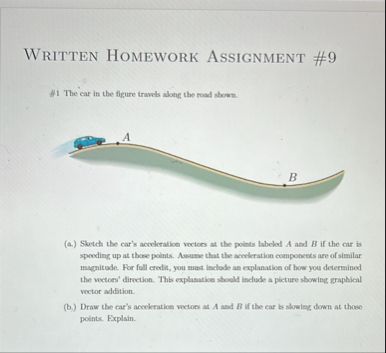 WRITTEN HOMEWORK ASSIGNMENT 0
iy pe
a
—
5
(4 me so de es ed EO
fombpderesplommiopabl
EE
Epa
Eo mnie wi (ds SE
fie
This is AI generated Response.
Asked by: Rahul
Created at: 2025-11-15 04:32:41
Asked by: Rahul
Created at: 2025-11-15 04:32:41
Final Answer:
Rendered
Raw Text
Did you like this answer?
# Step-by-Step Solution
## Step 1: **Acceleration Vectors When Speeding Up (Part a)**
**Explanation:**
When a car speeds up along a curved path, its acceleration has two components:
- **Tangential Acceleration (\(a_t\))**: Along the direction of motion (tangent to the curve), pointing forward.
- **Centripetal Acceleration (\(a_c\))**: Perpendicular to the velocity, pointing towards the center of curvature of the path.
At both points \(A\) and \(B\):
- Draw the tangential acceleration vector tangent to the road at each point, pointing forward (in the direction the car moves).
- Draw the centripetal acceleration vector perpendicular to the velocity and pointing towards the center of the curvature at each point.
**Graphical Explanation:**
- At \(A\) (a convex curve): The center of curvature is above the road, so the centripetal acceleration points upward (relative to the car).
- At \(B\) (a concave curve): The center of curvature is below the road, so centripetal acceleration points downward.
**Vector Addition:**
The total acceleration vector at each point is the vector sum of the tangential and centripetal accelerations. Draw these two vectors at each point and add them tip-to-tail to get the resultant acceleration.
---
## Step 2: **Acceleration Vectors When Slowing Down (Part b)**
**Explanation:**
If the car is slowing down, the tangential acceleration is:
- **Opposite** the direction of motion (tangent to the curve, but pointing backward).
The centripetal acceleration **remains** directed toward the center of curvature, as before.
At both points \(A\) and \(B\):
- Draw the tangential acceleration vector tangent to the road at each point, pointing backward (opposite the direction the car moves).
- Draw the centripetal acceleration vector as before.
**Graphical Explanation:**
- At \(A\): The tangential acceleration points backward (down the road), and the centripetal acceleration points upward.
- At \(B\): The tangential acceleration points backward (down the road), and the centripetal acceleration points downward.
The total acceleration vector is again the vector sum (tip-to-tail) of these two components.
---
## **Final Answer**
- **(a) When speeding up:** At both \(A\) and \(B\), the acceleration vector is the sum of a forward-pointing tangential vector and a perpendicular centripetal vector (upward at \(A\), downward at \(B\)).
- **(b) When slowing down:** At both \(A\) and \(B\), the acceleration vector is the sum of a backward-pointing tangential vector and a perpendicular centripetal vector (upward at \(A\), downward at \(B\)).
**In both cases, the acceleration vector is found by vector addition of the tangential and centripetal accelerations. The direction of the tangential component depends on whether the car is speeding up (forward) or slowing down (backward).**
Question:
Solve correct answer
This is AI generated Response.
Asked by: Rahul
Created at: 2025-11-15 04:34:04
Asked by: Rahul
Created at: 2025-11-15 04:34:04
Final Answer:
Rendered
Raw Text
Did you like this answer?
# Step-by-Step Solution
## Step 1: **Acceleration Vectors When Speeding Up (Part a)**
**Explanation:**
When a car speeds up along a curved path, its acceleration consists of two components:
- **Tangential Acceleration (\(a_t\))**: Directed along the path of motion (tangent to the curve), pointing forward.
- **Centripetal Acceleration (\(a_c\))**: Directed towards the center of the curvature, perpendicular to the velocity vector.
### At Points \(A\) and \(B\):
- **Point \(A\)**: The tangential acceleration vector is drawn tangent to the curve at point \(A\) and points forward. The centripetal acceleration points inward towards the center of curvature (above the road).
- **Point \(B\)**: Similar to \(A\), the tangential acceleration is forward. The centripetal acceleration points inward towards the center of curvature (below the road).
**Graphical Representation:**
You can visualize the total acceleration vector as the resultant of the tangential and centripetal components added together.
---
## Step 2: **Acceleration Vectors When Slowing Down (Part b)**
**Explanation:**
When the car is slowing down, the tangential acceleration \(a_t\) is now:
- **Opposite** to the direction of motion (tangent to the curve, but pointing backward).
The centripetal acceleration \(a_c\) still points towards the center of curvature.
### At Points \(A\) and \(B\):
- **Point \(A\)**: The tangential acceleration vector is drawn tangent to the curve at point \(A\) but points backward (opposite the direction of motion). The centripetal acceleration still points inward towards the center of curvature (above the road).
- **Point \(B\)**: The tangential acceleration points backward while the centripetal acceleration points inward towards the center of curvature (below the road).
**Graphical Representation:**
The total acceleration vector is again the resultant of the tangential and centripetal components added together, with the tangential component now pointing backward.
---
## **Final Answer**
- **(a) When speeding up:**
- At \(A\): Acceleration vector is the sum of a forward tangential vector and an upward centripetal vector.
- At \(B\): Acceleration vector is the sum of a forward tangential vector and a downward centripetal vector.
- **(b) When slowing down:**
- At \(A\): Acceleration vector is the sum of a backward tangential vector and an upward centripetal vector.
- At \(B\): Acceleration vector is the sum of a backward tangential vector and a downward centripetal vector.
**Overall, the acceleration vector is determined by vector addition of the tangential and centripetal accelerations, with direction depending on whether the car is speeding up or slowing down.**
📢 Instructions:
- Ask anything relatd to above question only.
- For new Question goto :