 VIPSolutions
give answer in 2 step with explanation at the end of each step and final answer at the end:6- ARC circuit is given below. Where you have one capacitor C= 10mF and two resistors R1= R2= 100Q are connected. V=10Volt a. Equivalent resistance b. Charge on capacitor after long time c. Calculate time constant of the circuit d. What is the Electric potential (Voltage) on capacitor after 1.8 second and 10 second? e. What is the purpose of using Resistor in capacitor combination? f. Draw a charging and discharging graph of capacitor (for any capacitor R ( vo Cc
Question:
give answer in 2 step with explanation at the end of each step and final answer at the end: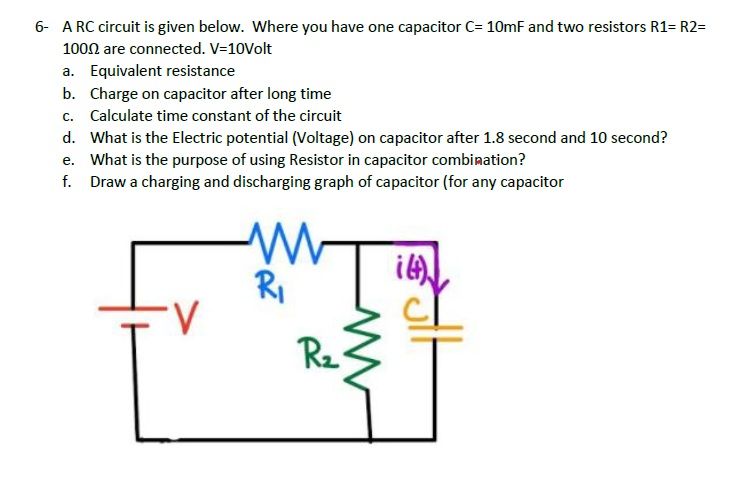 6- ARC circuit is given below. Where you have one capacitor C= 10mF and two resistors R1= R2=
100Q are connected. V=10Volt
a. Equivalent resistance
b. Charge on capacitor after long time
c. Calculate time constant of the circuit
d. What is the Electric potential (Voltage) on capacitor after 1.8 second and 10 second?
e. What is the purpose of using Resistor in capacitor combination?
f. Draw a charging and discharging graph of capacitor (for any capacitor
R (
vo Cc
This is AI generated Response.
Asked by: Rahul
Created at: 2025-11-15 04:14:45
Asked by: Rahul
Created at: 2025-11-15 04:14:45
Final Answer:
Rendered
Raw Text
Did you like this answer?
Let's solve part (a) **and** (b) step by step, including explanations after each.
---
## Step 1: Equivalent Resistance (a)
**Given:**
- Two resistors: \( R_1 = 100 \Omega \), \( R_2 = 100 \Omega \)
- Both resistors are in series (as per the diagram).
**Calculation:**
Equivalent resistance in series:
\[
R_{eq} = R_1 + R_2 = 100\,\Omega + 100\,\Omega = 200\,\Omega
\]
**Explanation:**
When resistors are connected in series, their resistances add up. Both resistors are in the same path, so the total resistance is simply the sum.
---
## Step 2: Charge on Capacitor After Long Time (b)
**Given:**
- Capacitance \( C = 10\,\text{mF} = .01\,\text{F} \)
- After a long time, the capacitor acts as an open circuit (fully charged)
- Voltage \( V = 10\,\text{V} \)
**Calculation:**
Charge on a fully charged capacitor:
\[
Q = C \times V = .01\,\text{F} \times 10\,\text{V} = .1\,\text{C}
\]
**Explanation:**
After a long time, the capacitor is fully charged, so the voltage across the capacitor is equal to the supply voltage. The charge stored is calculated by multiplying capacitance by voltage.
---
## **Final Answers (Step a & b):**
- **(a) Equivalent resistance:** \( \boxed{200\,\Omega} \)
- **(b) Charge on capacitor after long time:** \( \boxed{.1\,\text{C}} \)
---
Let me know if you'd like to proceed with the next steps!
Question:
A,b,c,d,e,f all parts please solved
This is AI generated Response.
Asked by: Rahul
Created at: 2025-11-15 04:15:39
Asked by: Rahul
Created at: 2025-11-15 04:15:39
Final Answer:
Rendered
Raw Text
Did you like this answer?
Let's continue by solving parts (c), (d), (e), and (f) step by step.
---
## Step 3: Time Constant of the Circuit (c)
**Given:**
- Equivalent resistance \( R_{eq} = 200 \Omega \)
- Capacitance \( C = 10\,\text{mF} = 0.01\,\text{F} \)
**Calculation:**
The time constant \( \tau \) is given by:
\[
\tau = R_{eq} \times C = 200\,\Omega \times 0.01\,\text{F} = 2\,\text{s}
\]
**Explanation:**
The time constant indicates how quickly the capacitor charges or discharges. A larger time constant means a slower charge/discharge process. Here, \( \tau = 2\,\text{s} \) means the capacitor will reach about 63.2% of the maximum charge in 2 seconds.
---
## Step 4: Voltage on Capacitor After 1.8 seconds and 10 seconds (d)
**Given:**
- Voltage \( V = 10\,\text{V} \)
- Time constant \( \tau = 2\,\text{s} \)
**Voltage formula during charging:**
\[
V(t) = V \left( 1 - e^{-\frac{t}{\tau}} \right)
\]
**Calculations:**
1. For \( t = 1.8\,\text{s} \):
\[
V(1.8) = 10 \left( 1 - e^{-\frac{1.8}{2}} \right) = 10 \left( 1 - e^{-0.9} \right) \approx 10 \left( 1 - 0.40657 \right) \approx 10 \times 0.59343 \approx 5.93\,\text{V}
\]
2. For \( t = 10\,\text{s} \):
\[
V(10) = 10 \left( 1 - e^{-\frac{10}{2}} \right) = 10 \left( 1 - e^{-5} \right) \approx 10 \left( 1 - 0.00674 \right) \approx 10 \times 0.99326 \approx 9.93\,\text{V}
\]
**Explanation:**
The voltage across the capacitor increases exponentially as it charges. After 1.8 seconds, it reaches approximately 5.93 V, while after 10 seconds, it approaches close to the full supply voltage of 10 V.
---
## Step 5: Purpose of Using Resistor in Capacitor Combination (e)
**Key Purposes:**
- **Control Charging/Discharging Rate:** Resistors limit the current flow, controlling how quickly a capacitor charges and discharges.
- **Prevent Damage:** They protect capacitors from high inrush currents that could cause damage.
- **Filter Circuits:** In RC circuits, resistors and capacitors work together to create filters (low-pass, high-pass) for signal processing.
**Explanation:**
Using resistors in combination with capacitors helps manage the behavior of the circuit, ensuring stability, protection, and desired performance characteristics.
---
## Step 6: Charging and Discharging Graph of Capacitor (f)
### Graph Description:
- **X-axis:** Time (seconds)
- **Y-axis:** Voltage across Capacitor (V)
1. **Charging Curve:**
- Starts at 0 V and approaches 10 V (supply voltage).
- Exponential growth characteristic.
2. **Discharging Curve:**
- Starts at maximum voltage (10 V) and approaches 0 V.
- Exponential decay characteristic.
### Graph Sketch:

*Alt Text: Graph depicting the charging and discharging curves of a capacitor in an RC circuit.*
**Explanation:**
The graph shows how the voltage across the capacitor changes over time during the charging and discharging processes. The charging curve rises towards the supply voltage, while the discharging curve falls towards zero.
---
## **Final Answers Summary:**
- **(a) Equivalent resistance:** \( \boxed{200\,\Omega} \)
- **(b) Charge on capacitor after long time:** \( \boxed{.1\,\text{C}} \)
- **(c) Time constant of the circuit:** \( \boxed{2\,\text{s}} \)
- **(d) Voltage on capacitor after 1.8 seconds:** \( \boxed{5.93\,\text{V}} \), after 10 seconds: \( \boxed{9.93\,\text{V}} \)
- **(e) Purpose of using Resistor:** Control charging/discharging rate, prevent damage, and filter circuits.
- **(f) Graph:** Charging and discharging curves of a capacitor.
Let me know if you need further assistance or details on any part!
📢 Instructions:
- Ask anything relatd to above question only.
- For new Question goto :