 VIPSolutions
give answer in 2 step with explanation at the end of each step and final answer at the end:Determine the range of mass m; for which the system is in equilibrium. The coefficient of static friction between the block and the incline is 1; = 0.36. Neglect friction associated with the pulley. my Hs. 26° mg Answers: ( B my)
Question:
give answer in 2 step with explanation at the end of each step and final answer at the end: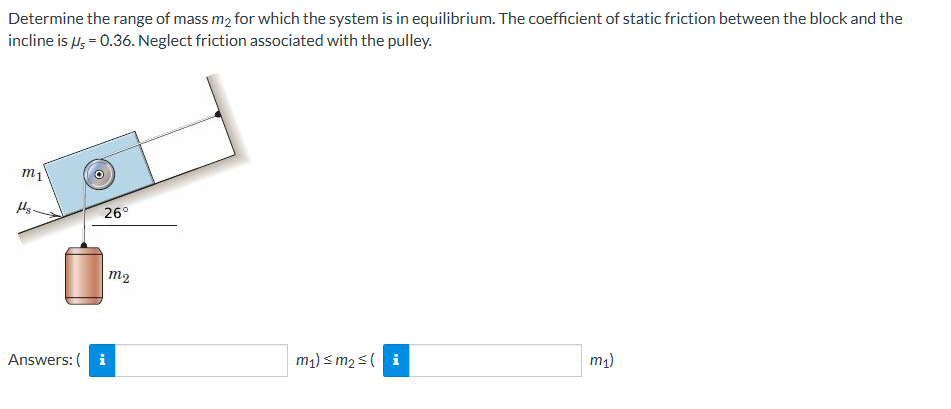 Determine the range of mass m; for which the system is in equilibrium. The coefficient of static friction between the block and the
incline is 1; = 0.36. Neglect friction associated with the pulley.
my
Hs. 26°
mg
Answers: ( B my)
This is AI generated Response.
Asked by: Rahul
Created at: 2025-11-15 04:09:53
Asked by: Rahul
Created at: 2025-11-15 04:09:53
Final Answer:
Rendered
Raw Text
Did you like this answer?
Let's solve the problem step by step.
---
### **Step 1: Draw Free Body Diagrams and Write Force Equilibrium Equations**
**For Block \( m_1 \) on the incline:**
- **Gravity**: \( m_1 g \) (acts downward)
- Component parallel to incline: \( m_1 g \sin\theta \)
- Component perpendicular to incline: \( m_1 g \cos\theta \)
- **Normal force**: \( N = m_1 g \cos\theta \)
- **Friction force**: \( f_s \leq \mu_s N = \mu_s m_1 g \cos\theta \)
- **Tension**: \( T \) (up the incline, due to hanging mass)
**For Hanging Mass \( m_2 \):**
- Gravity: \( m_2 g \) (down)
- Tension: \( T \) (up)
**Equilibrium equations:**
- For \( m_1 \) (along the incline): \( T = m_1 g \sin\theta \pm f_s \)
- For \( m_2 \): \( T = m_2 g \)
---
#### **Step 1A: Maximum \( m_2 \) (block about to move up incline)**
Friction acts **down** the incline (opposing upward motion):
\[
T = m_1 g \sin\theta + f_{s,\text{max}}
\]
\[
m_2 g = m_1 g \sin\theta + \mu_s m_1 g \cos\theta
\]
\[
m_2 = m_1 (\sin\theta + \mu_s \cos\theta)
\]
**Explanation:**
This is the maximum value of \( m_2 \) before the block slides **up** the incline.
---
#### **Step 1B: Minimum \( m_2 \) (block about to move down incline)**
Friction acts **up** the incline (opposing downward motion):
\[
T = m_1 g \sin\theta - f_{s,\text{max}}
\]
\[
m_2 g = m_1 g \sin\theta - \mu_s m_1 g \cos\theta
\]
\[
m_2 = m_1 (\sin\theta - \mu_s \cos\theta)
\]
**Explanation:**
This is the minimum value of \( m_2 \) before the block slides **down** the incline.
---
### **Step 2: Plug in the Given Values**
Given:
- \( \theta = 26^\circ \)
- \( \mu_s = .36 \)
Calculate:
- \( \sin 26^\circ \approx .4384 \)
- \( \cos 26^\circ \approx .8988 \)
**Minimum \( m_2 \):**
\[
m_2 = m_1 [.4384 - .36 \times .8988]
\]
\[
m_2 = m_1 [.4384 - .3236] = m_1 (.1148)
\]
**Maximum \( m_2 \):**
\[
m_2 = m_1 [.4384 + .36 \times .8988]
\]
\[
m_2 = m_1 [.4384 + .3236] = m_1 (.762)
\]
---
### **Final Answer**
\[
\boxed{(.1148\, m_1) \leq m_2 \leq (.762\, m_1)}
\]
**Explanation:**
For the system to remain in equilibrium, the hanging mass \( m_2 \) must be within this range. If it's less, the block will slide down; if it's more, the block will slide up.
📢 Instructions:
- Ask anything relatd to above question only.
- For new Question goto :