 VIPSolutions
give answer in 2 step with explanation at the end of each step and final answer at the end:Determine the range of mass m; for which the system is in equilibrium. The coefficient of static friction between the block and the incline is 1; = 0.36. Neglect friction associated with the pulley. my Hs. 26° mg Answers: ( B my)
Question:
give answer in 2 step with explanation at the end of each step and final answer at the end: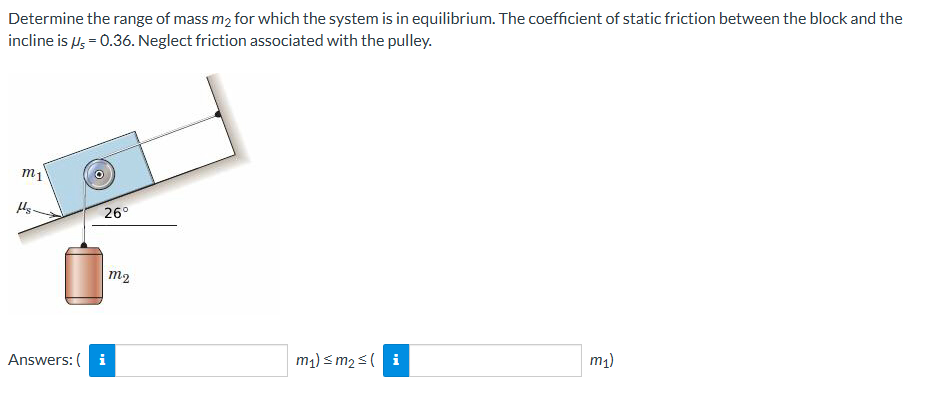 Determine the range of mass m; for which the system is in equilibrium. The coefficient of static friction between the block and the
incline is 1; = 0.36. Neglect friction associated with the pulley.
my
Hs. 26°
mg
Answers: ( B my)
This is AI generated Response.
Asked by: Rahul
Created at: 2025-11-15 02:13:16
Asked by: Rahul
Created at: 2025-11-15 02:13:16
Final Answer:
Rendered
Raw Text
Did you like this answer?
Let's solve the problem step by step:
---
## **Step 1: Draw Free Body Diagrams and Write Force Equilibrium Equations**
For **block \( m_1 \) on the incline**:
- Weight: \( m_1 g \) (acts vertically downward)
- Normal force: \( N \) (perpendicular to the incline)
- Friction force: \( f \) (opposes motion, parallel to the incline)
- Tension: \( T \) (along the incline, up)
Decompose \( m_1 g \):
- Parallel to incline: \( m_1 g \sin \theta \)
- Perpendicular to incline: \( m_1 g \cos \theta \)
**Friction force**: \( f \leq \mu_s N = \mu_s m_1 g \cos \theta \)
**Equilibrium condition (along the incline):**
\[ T = m_1 g \sin \theta \pm f \]
For **hanging mass \( m_2 \)**:
\[ T = m_2 g \]
---
### **Explanation (Step 1):**
We set up the force balance equations for both the block on the incline and the hanging mass, considering the direction of friction based on the tendency of motion.
---
## **Step 2: Find the Range for \( m_2 \) (Friction Up and Down the Incline)**
### **Case 1: Block tends to move UP the incline**
Friction acts DOWN the incline:
\[
m_2 g = m_1 g \sin\theta + \mu_s m_1 g \cos\theta
\]
\[
m_2 = m_1 (\sin\theta + \mu_s \cos\theta)
\]
### **Case 2: Block tends to move DOWN the incline**
Friction acts UP the incline:
\[
m_2 g = m_1 g \sin\theta - \mu_s m_1 g \cos\theta
\]
\[
m_2 = m_1 (\sin\theta - \mu_s \cos\theta)
\]
Plug in the values (\(\theta = 26^\circ\), \(\mu_s = .36\)):
\[
\sin 26^\circ \approx .4384
\]
\[
\cos 26^\circ \approx .8988
\]
\[
m_2 = m_1 (.4384 + .36 \times .8988) = m_1 (.4384 + .3236) = m_1 (.762)
\]
\[
m_2 = m_1 (.4384 - .36 \times .8988) = m_1 (.4384 - .3236) = m_1 (.1148)
\]
---
### **Explanation (Step 2):**
We analyzed both directions for possible impending motion, applied the friction force accordingly, and calculated the bounds for \( m_2 \).
---
## **Final Answer**
\[
\boxed{(.1148\, m_1) \leq m_2 \leq (.762\, m_1)}
\]
Where:
- \( .1148\, m_1 \) is the minimum value
- \( .762\, m_1 \) is the maximum value
This is the range of \( m_2 \) for which the system is in equilibrium.
📢 Instructions:
- Ask anything relatd to above question only.
- For new Question goto :