 VIPSolutions
give answer in 2 step with explanation at the end of each step and final answer at the end:What am | meant to fill in with the duration section and what are the formulas? What are the new prices and formulas to get them? dl A B c Db EB ¥ G H 1 J K L M N sw =] TF A EE + | oot po — F— a z Fo — 2 100
Question:
give answer in 2 step with explanation at the end of each step and final answer at the end: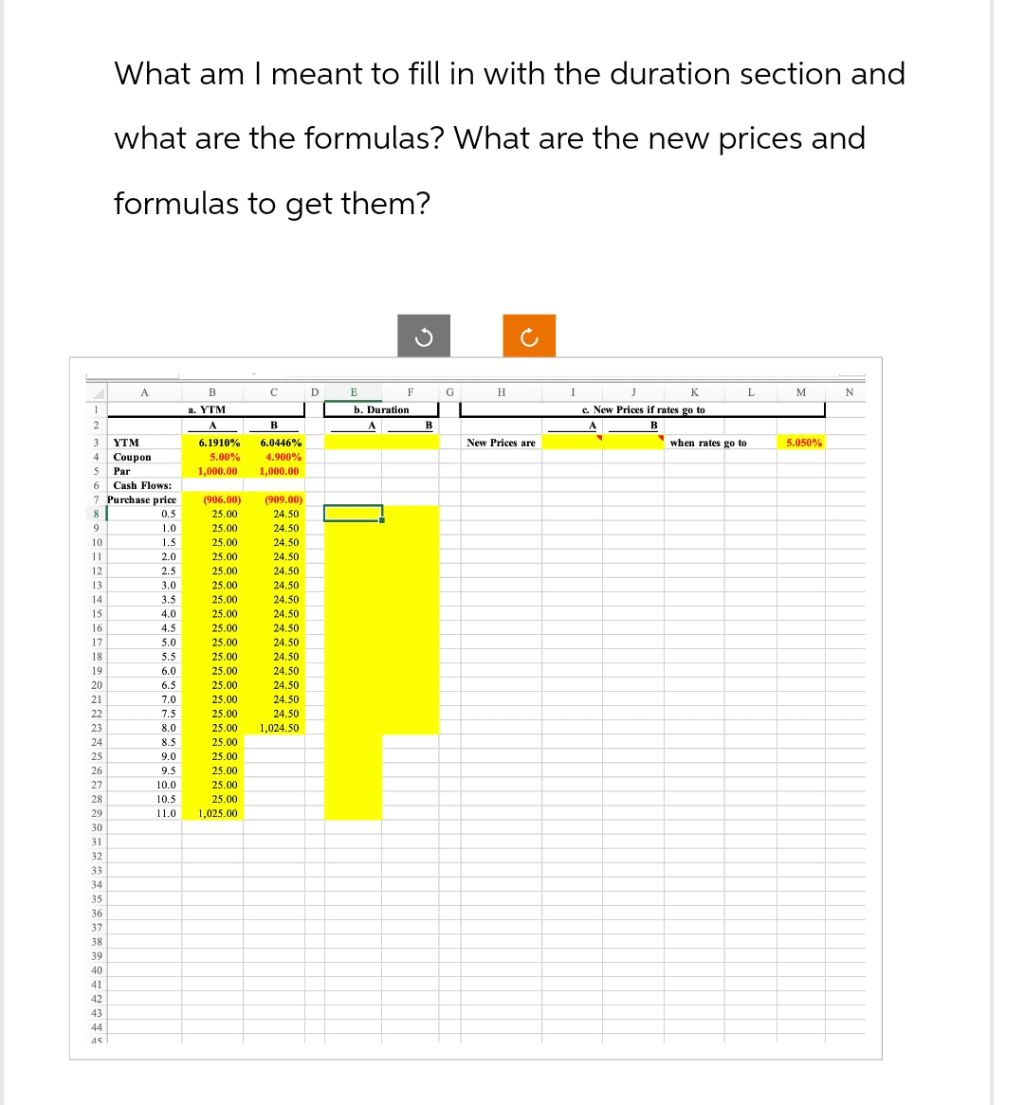 What am | meant to fill in with the duration section and
what are the formulas? What are the new prices and
formulas to get them?
dl A B c Db EB ¥ G H 1 J K L M N
sw =] TF A EE
+ | oot po
—
F—
a
z Fo
—
2 100
This is AI generated Response.
Asked by: Rahul
Created at: 2025-11-14 16:29:00
Asked by: Rahul
Created at: 2025-11-14 16:29:00
Final Answer:
Rendered
Raw Text
Did you like this answer?
## Step 1: **Duration Section - What to Fill and Formulas**
**What to Fill:**
For each (A and B), you need to calculate **Macaulay Duration** and/or **Modified Duration**.
- **Macaulay Duration** measures the weighted average time until cash flows are received.
- **Modified Duration** measures price sensitivity to yield changes.
**Formula for Macaulay Duration:**
\[
\text{Macaulay Duration} = \frac{\sum_{t=1}^{N} \frac{t \cdot CF_t}{(1+y)^t}}{\text{Bond Price}}
\]
Where:
- \( CF_t \) = cash flow at time \( t \)
- \( y \) = yield to maturity per period (YTM)
- \( t \) = time period
- Bond Price = present value of all future cash flows
**How to Enter in Excel:**
For each period, calculate:
- Present value of each cash flow: \( \text{PV}_t = \frac{CF_t}{(1+y)^t} \)
- Weight: \( \frac{\text{PV}_t}{\text{Bond Price}} \)
- Weighted time: \( t \times \frac{\text{PV}_t}{\text{Bond Price}} \)
Sum all weighted times for Macaulay Duration.
**Explanation:**
This tells you the average time in years you’ll get your money back, weighted by present value.
---
## Step 2: **New Prices Section - What to Fill and Formulas**
**What to Fill:**
Calculate the new bond prices if yields change (e.g., to 5.809%).
**Formula for New Price:**
\[
\text{New Price} = \sum_{t=1}^{N} \frac{CF_t}{(1+\text{new YTM})^t}
\]
Where:
- \( CF_t \) = cash flow at time \( t \)
- new YTM = the new yield to maturity (e.g., 5.809%)
- \( t \) = time period
**How to Enter in Excel:**
For each period, calculate the present value of each cash flow using the new YTM, then sum them up for the total bond price.
**Explanation:**
This shows how the bond’s price changes as interest rates/yields change.
---
## **Final Answer: Summary**
- **Duration Section:** Fill in each bond’s Macaulay or Modified Duration using the formulas above. This measures interest rate risk.
- **New Prices Section:** Fill in the recalculated bond prices using present value formulas with the new yield (e.g., 5.809%).
**Formulas to Use:**
- **Macaulay Duration:** \( \sum \left( \frac{t \cdot CF_t}{(1+y)^t} \right) / \text{Bond Price} \)
- **New Price:** \( \sum \left( \frac{CF_t}{(1+\text{new YTM})^t} \right) \)
Let me know if you want actual Excel formulas for each cell!
📢 Instructions:
- Ask anything relatd to above question only.
- For new Question goto :