 VIPSolutions
give answer in 2 step with explanation at the end of each step and final answer at the end:Organic Chemis 1 Old Bam Questions crea [ rvadamt agent prods hpe | Be; | ¢ a XY on GH 1. Hg(OACl, HO, THE IT ® ou 2 H;S0, HO [Ll & = Ld o CHLCH;CH CHC ZCH. LMT en Bh 2. H;05. H;0. NaOH [J " Qa a= 4 on or mom 2. HO", HO om rl 1. Nat, NH, or AER
Question:
give answer in 2 step with explanation at the end of each step and final answer at the end: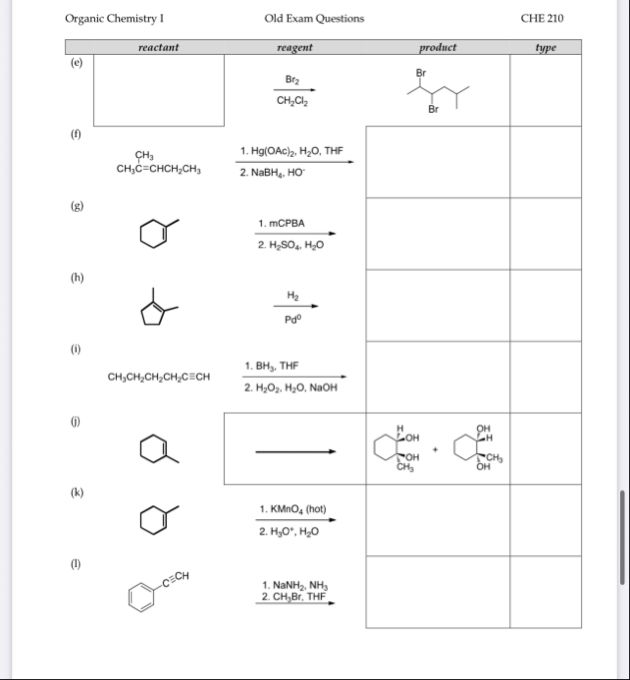 Organic Chemis 1 Old Bam Questions crea
[ rvadamt agent prods hpe |
Be; | ¢
a XY
on
GH 1. Hg(OACl, HO, THE
IT
®
ou
2 H;S0, HO
[Ll
& =
Ld
o
CHLCH;CH CHC ZCH. LMT
en Bh 2. H;05. H;0. NaOH
[J "
Qa a= 4
on
or mom
2. HO", HO
om
rl 1. Nat, NH,
or AER
This is AI generated Response.
Asked by: Rahul
Created at: 2025-11-14 15:10:21
Asked by: Rahul
Created at: 2025-11-14 15:10:21
Final Answer:
Rendered
Raw Text
Did you like this answer?
Let's answer each question step-by-step, with explanations after each step and a final answer at the end.
---
### (e)
**Reagent:** Br₂, CH₂Cl₂
**Product:** 2,3-dibromobutane
**Type:** Halogenation of alkene
**Step 1:**
Identify the reaction type based on the reagent. Br₂ in CH₂Cl₂ adds Br atoms across a double bond (anti addition).
**Step 2:**
The product shown is 2,3-dibromobutane, so the starting material must be 2-butene.
**Final Answer:**
- **Reactant:** 2-butene (CH₃CH=CHCH₃)
- **Type:** Alkene halogenation
---
### (f)
**Reagents:**
1. Hg(OAc)₂, H₂O, THF
2. NaBH₄, HO⁻
**Step 1:**
This is an oxymercuration-demercuration reaction, which adds H and OH across a double bond (Markovnikov, no rearrangement).
**Step 2:**
The double bond is between C2 and C3. OH goes to the more substituted carbon (C3), H to C2.
**Final Answer:**
- **Product:** CH₃CH(OH)CH₂CH₃ (2-butanol)
- **Type:** Oxymercuration-demercuration (hydration of alkene)
---
### (g)
**Reagents:**
1. mCPBA
2. H₂SO₄, H₂O
**Step 1:**
mCPBA forms an epoxide from cyclohexene.
**Step 2:**
Acidic hydrolysis opens the epoxide to give a trans-1,2-diol.
**Final Answer:**
- **Product:** trans-1,2-cyclohexanediol
- **Type:** Anti dihydroxylation
---
### (h)
**Reagents:** H₂, Pd⁰
**Step 1:**
Catalytic hydrogenation reduces double bonds to single bonds.
**Step 2:**
The product is 1,2,3,4-tetramethylcyclopentane.
**Final Answer:**
- **Product:** 1,2,3,4-tetramethylcyclopentane
- **Type:** Catalytic hydrogenation (alkene to alkane)
---
### (i)
**Reagents:**
1. BH₃, THF
2. H₂O₂, H₂O, NaOH
**Step 1:**
Hydroboration-oxidation adds H and OH across the triple bond in an anti-Markovnikov fashion.
**Step 2:**
The product is CH₃CH₂CH₂COH=CH₂ (an aldehyde: pentanal).
**Final Answer:**
- **Product:** Pentanal (CH₃CH₂CH₂CH₂CHO)
- **Type:** Hydroboration-oxidation of terminal alkyne (anti-Markovnikov addition)
---
### (j)
**Product Provided:** trans-1,2-cyclohexanediol (both enantiomers shown)
**Step 1:**
Identify the reaction that forms a vicinal diol from cyclohexene.
**Step 2:**
Osmium tetroxide (OsO₄) or cold KMnO₄ gives syn dihydroxylation. The question likely used OsO₄ or cold KMnO₄.
**Final Answer:**
- **Reagent:** OsO₄, H₂O₂ or KMnO₄ (cold, dilute)
- **Type:** Syn dihydroxylation
---
### (k)
**Reagents:**
1. KMnO₄ (hot)
2. H₃O⁺, H₂O
**Step 1:**
Hot KMnO₄ cleaves double bonds, fully oxidizing them.
**Step 2:**
For a methyl-substituted cyclohexene, this will result in ring opening and formation of a carboxylic acid.
**Final Answer:**
- **Product:** Adipic acid (hexanedioic acid)
- **Type:** Oxidative cleavage
---
### (l)
**Reagents:**
1. NaNH₂, NH₃
2. CH₃Br, THF
**Step 1:**
NaNH₂ deprotonates the terminal alkyne to form an acetylide ion.
**Step 2:**
Alkylation with CH₃Br adds a methyl group to the terminal carbon.
**Final Answer:**
- **Product:** Phenyl-1-butyne (C₆H₅C≡CCH₃)
- **Type:** Alkylation of terminal alkyne
---
Let me know if you want these in a table or need a specific chemical structure drawn!
📢 Instructions:
- Ask anything relatd to above question only.
- For new Question goto :