 VIPSolutions
give answer in 2 step with explanation at the end of each step and final answer at the end:1. Fill in the reagents that extend the the wheel beyond alkene reactions (pink boxes) Alkene Reaction Map 2. Fill in the functional group names under each structure. | Ofer “OH . “oH = uw So mCPBA HO" OR ® \ 5 [= @) NS Lag, He" on OO o° 0. CHCl or no oY Cr H A 1) BHg (as) Fale fe er OF, 2 CX ow cl of Alkene Reaction Map
Question:
give answer in 2 step with explanation at the end of each step and final answer at the end: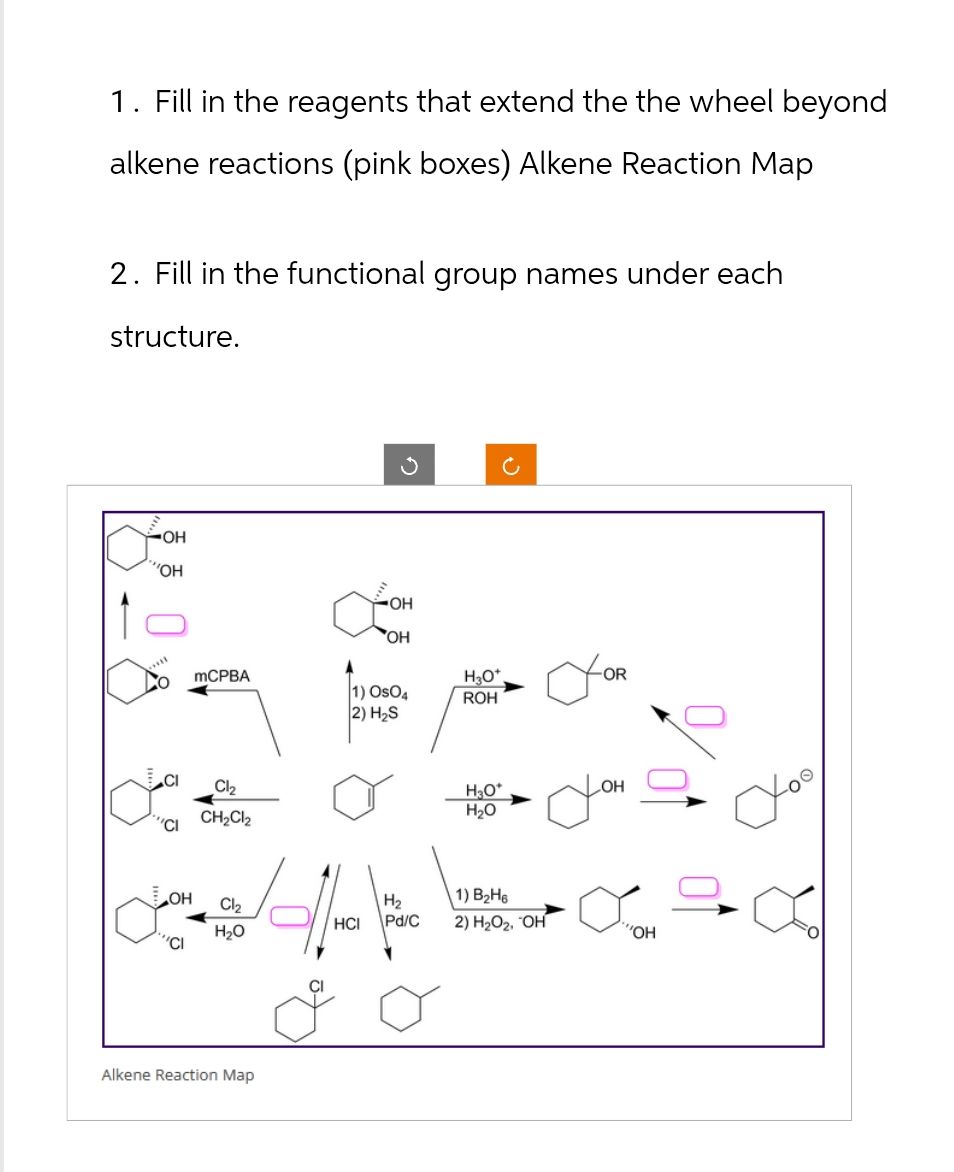 1. Fill in the reagents that extend the the wheel beyond
alkene reactions (pink boxes) Alkene Reaction Map
2. Fill in the functional group names under each
structure.
|
Ofer
“OH .
“oH
= uw
So mCPBA HO" OR
® \ 5 [= @) NS
Lag, He" on OO o°
0. CHCl or no oY Cr
H A 1) BHg (as)
Fale fe er OF, 2 CX
ow
cl of
Alkene Reaction Map
This is AI generated Response.
Asked by: Rahul
Created at: 2025-11-13 13:57:27
Asked by: Rahul
Created at: 2025-11-13 13:57:27
Final Answer:
Rendered
Raw Text
Did you like this answer?
## Step 1: Fill in the Reagents (Pink Boxes)
Let's identify the reactions and reagents needed for the pink boxes:
### Top Left Pink Box:
- **Reaction:** Vicinal diol → Ketone
- **Reagent:** **HIO₄ (periodic acid)** (oxidative cleavage of vicinal diol)
- **Explanation:** Periodic acid cleaves 1,2-diols to form two carbonyl compounds.
### Middle Right Pink Box:
- **Reaction:** Ether → Alkyl halide
- **Reagent:** **HX (e.g. HI or HBr)**
- **Explanation:** Strong acids like HI or HBr cleave ethers to give alkyl halides and alcohols.
### Rightmost Pink Box:
- **Reaction:** Alcohol → Ketone
- **Reagent:** **PCC or Jones’ reagent (CrO₃, H₂SO₄)**
- **Explanation:** PCC and other chromium-based reagents oxidize secondary alcohols to ketones.
### Bottom Right Pink Box:
- **Reaction:** Ketone → Alkene
- **Reagent:** **Wittig reagent (Ph₃P=CHR)**
- **Explanation:** Wittig reaction converts ketones or aldehydes into alkenes.
---
## Step 2: Fill in the Functional Group Names
Now, let's label the functional groups under each structure:
### Top Row (from left to right):
1. **1,2-diol (Vicinal diol)**
2. **Alcohol (Secondary alcohol)**
3. **Ether**
### Middle Row (from left to right):
1. **Alkene**
2. **Alcohol (Secondary alcohol)**
3. **Alcohol (Tertiary alcohol)**
4. **Ketone**
### Bottom Row (from left to right):
1. **Geminal dihalide (vicinal dihalide)**
2. **Alkyl halide**
3. **Alkane**
4. **Alcohol (Primary alcohol)**
5. **Ketone**
---
## Final Answer
### Reagents in Pink Boxes:
1. **HIO₄** (Top left)
2. **HX (e.g., HI or HBr)** (Middle right)
3. **PCC/CrO₃** (Rightmost)
4. **Ph₃P=CHR (Wittig reagent)** (Bottom right)
### Functional Groups:
- **1,2-diol**
- **Alcohol (secondary/tertiary/primary as shown)**
- **Ether**
- **Alkene**
- **Geminal/vicinal dihalide**
- **Alkyl halide**
- **Alkane**
- **Ketone**
---
**This completes the alkene reaction map with reagents and functional group names.**
📢 Instructions:
- Ask anything relatd to above question only.
- For new Question goto :