 VIPSolutions
give answer in 2 step with explanation at the end of each step and final answer at the end:Suppose you have a point charge ¢ above a grounded conducting plane as shown below letq=1x10%C.d = 1m plot using mathcad o(r),0
Question:
give answer in 2 step with explanation at the end of each step and final answer at the end: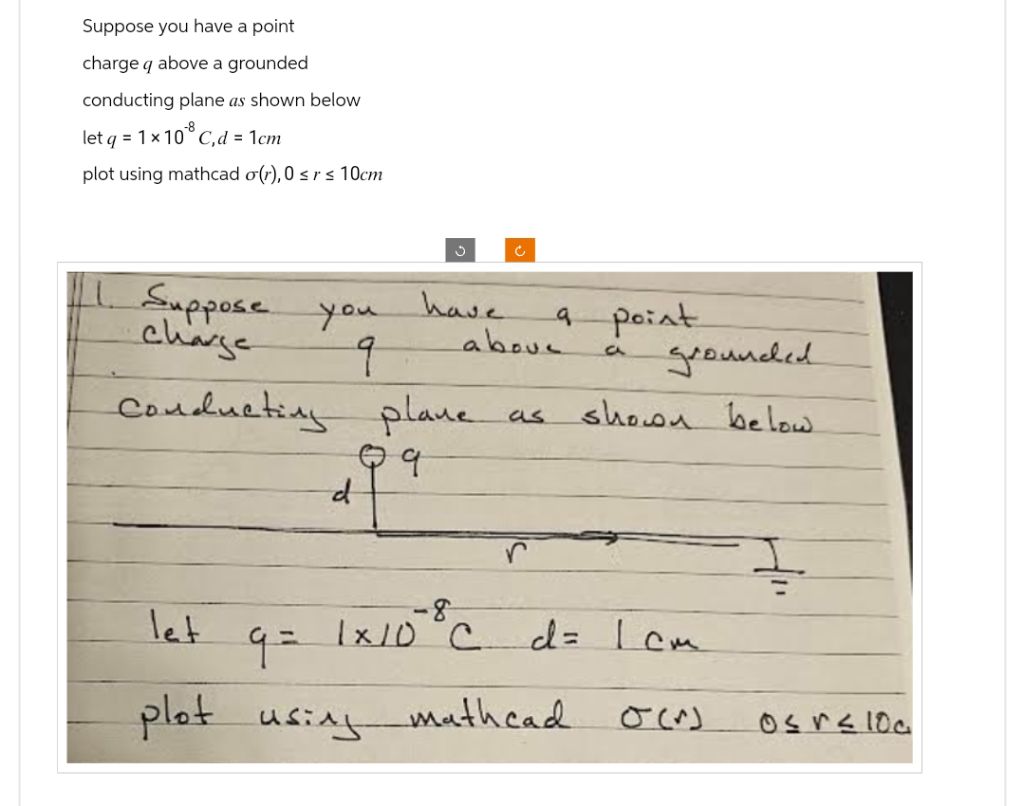 Suppose you have a point
charge ¢ above a grounded
conducting plane as shown below
letq=1x10%C.d = 1m
plot using mathcad o(r),0
This is AI generated Response.
Asked by: Rahul
Created at: 2025-11-13 08:15:05
Asked by: Rahul
Created at: 2025-11-13 08:15:05
Final Answer:
Rendered
Raw Text
Did you like this answer?
# Step 1: **Setting Up the Problem Using the Method of Images**
When a point charge \( q \) is placed a distance \( d \) above a grounded conducting plane, the **method of images** tells us that the effect of the plane can be replaced by placing an image charge \( -q \) a distance \( d \) below the plane.
- **Physical setup:**
- Real charge \( q \) at \((, , d)\)
- Image charge \( -q \) at \((, , -d)\)
The **surface charge density** \( \sigma(r) \) at a distance \( r \) from the origin on the plane (at \( z = \)) is given by:
\[
\sigma(r) = -\epsilon_ \left. \frac{\partial V}{\partial z} \right|_{z=}
\]
where \( V \) is the potential due to both charges.
**Explanation:**
This step uses the method of images to simplify the calculation by replacing the grounded plane with an image charge. The formula for surface charge density comes from the boundary condition for a conductor.
---
# Step 2: **Calculate and Write the Formula for \(\sigma(r)\)**
The potential at any point \( (r, ) \) on the plane due to both charges is:
\[
V = \frac{1}{4\pi\epsilon_} \left( \frac{q}{\sqrt{r^2 + d^2}} - \frac{q}{\sqrt{r^2 + d^2}} \right) =
\]
But we need the field just **above** the plane:
\[
E_z = -\frac{\partial V}{\partial z}
\]
Calculate the \( z \)-component of the electric field at \( z= \) due to both charges:
\[
E_z = \frac{q d}{2\pi\epsilon_ (r^2 + d^2)^{3/2}}
\]
So, the **surface charge density** is:
\[
\sigma(r) = \epsilon_ E_z = \frac{q d}{2\pi (r^2 + d^2)^{3/2}}
\]
**Explanation:**
We differentiate the potential with respect to \( z \) and evaluate at the surface to get the perpendicular field, then use Gauss’s law to relate this to surface charge density.
---
# **Final Answer**
The surface charge density on the plane at distance \( r \) from the origin is:
\[
\boxed{
\sigma(r) = \frac{q d}{2\pi (r^2 + d^2)^{3/2}}
}
\]
where \( q = 1 \times 10^{-8} \) C, \( d = 1 \) cm \( = .01 \) m, and \( \leq r \leq .1 \) m (10 cm).
**To plot in Mathcad:**
Use the above formula and plot for \( r \) from to .1 m.
Question:
Then solved
This is AI generated Response.
Asked by: Rahul
Created at: 2025-11-13 08:15:47
Asked by: Rahul
Created at: 2025-11-13 08:15:47
Final Answer:
Rendered
Raw Text
Did you like this answer?
# Step 1: **Setting Up the Problem Using the Method of Images**
When a point charge \( q \) is placed a distance \( d \) above a grounded conducting plane, we can simplify the problem using the **method of images**. This method replaces the effect of the grounded plane with an image charge \( -q \) located at a distance \( d \) below the plane.
- **Physical Setup:**
- Real charge \( q \) at \((0, 0, d)\)
- Image charge \( -q \) at \((0, 0, -d)\)
The **surface charge density** \( \sigma(r) \) at a distance \( r \) on the plane (where \( z = 0 \)) is calculated by:
\[
\sigma(r) = -\epsilon_0 \left. \frac{\partial V}{\partial z} \right|_{z=0}
\]
where \( V \) is the potential due to both charges.
**Explanation:**
This step applies the method of images, allowing us to replace the grounded conducting plane with an equivalent image charge. The formula for surface charge density is derived from the boundary condition for conductors.
---
# Step 2: **Calculate and Write the Formula for \(\sigma(r)\)**
The potential \( V \) at any point \( (r, 0) \) on the plane due to both the real and image charges is:
\[
V = \frac{1}{4\pi\epsilon_0} \left( \frac{q}{\sqrt{r^2 + d^2}} - \frac{q}{\sqrt{r^2 + d^2}} \right) = 0
\]
However, we need the electric field just **above** the plane:
\[
E_z = -\frac{\partial V}{\partial z}
\]
Calculating the \( z \)-component of the electric field at \( z = 0 \) due to both charges gives:
\[
E_z = \frac{q d}{2\pi \epsilon_0 (r^2 + d^2)^{3/2}}
\]
Thus, the **surface charge density** is:
\[
\sigma(r) = \epsilon_0 E_z = \frac{q d}{2\pi (r^2 + d^2)^{3/2}}
\]
**Explanation:**
We differentiate the potential with respect to \( z \) at the surface to get the electric field, then apply Gauss's law to relate this field to the surface charge density.
---
# **Final Answer**
The surface charge density on the plane at distance \( r \) from the origin is:
\[
\boxed{
\sigma(r) = \frac{q d}{2\pi (r^2 + d^2)^{3/2}}
}
\]
Where:
- \( q = 1 \times 10^{-8} \) C
- \( d = 1 \) m
- \( 0 < r \leq 0.1 \) m (10 cm)
**To plot in Mathcad:**
Use the above formula and plot for \( r \) from \( 0 \) to \( 0.1 \) m.
📢 Instructions:
- Ask anything relatd to above question only.
- For new Question goto :