 VIPSolutions
give answer in 2 step with explanation at the end of each step and final answer at the end:10. A motorized pulley is used to drag a block across a horizontal floor. The block has a mass m= 2.8 kg and the pulley has radius R = 0.12 m and moment of inertia I = 0.040 kg m. The pulley has a frictional torque of 1¢=0.05 N-m with its axis of rotation. What torque must the motor apply to cause the block to accelerate at 2.00 m/s*? fa
Question:
give answer in 2 step with explanation at the end of each step and final answer at the end: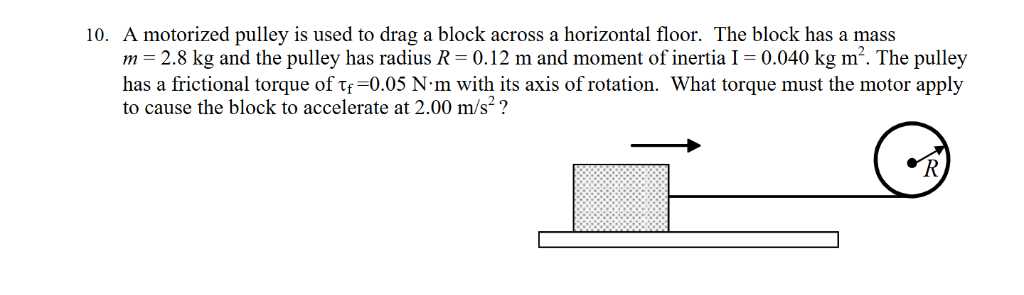 10. A motorized pulley is used to drag a block across a horizontal floor. The block has a mass
m= 2.8 kg and the pulley has radius R = 0.12 m and moment of inertia I = 0.040 kg m. The pulley
has a frictional torque of 1¢=0.05 N-m with its axis of rotation. What torque must the motor apply
to cause the block to accelerate at 2.00 m/s*?
fa
This is AI generated Response.
Asked by: Rahul
Created at: 2025-11-13 08:11:19
Asked by: Rahul
Created at: 2025-11-13 08:11:19
Final Answer:
Rendered
Raw Text
Did you like this answer?
Let's break the problem into **2 steps** and explain each step clearly.
---
## **Step 1: Find the total force needed to accelerate the block**
The block of mass m = .8\,text{kg} \) must accelerate at \( a = 2.00\,\text{m/s}^2 \).
**Force needed to accelerate the block:**
\[
F = m a = 2.8 \times 2. = 5.6\,\text{N}
\]
**Explanation:**
This is the force the string must apply to the block to achieve the desired acceleration.
---
## **Step 2: Relate the force to the torque applied by the motor**
### **a. Torque due to the block:**
The tension in the string creates a torque at the pulley's edge:
\[
\tau_{\text{block}} = F \times R = 5.6 \times .12 = .672\,\text{N}\cdot\text{m}
\]
### **b. Torque to accelerate the pulley:**
The pulley has a moment of inertia \( I = .040\,\text{kg}\cdot\text{m}^2 \).
First, relate the block's acceleration to the pulley's angular acceleration:
\[
a = \alpha R \implies \alpha = \frac{a}{R} = \frac{2.}{.12} = 16.67\,\text{rad/s}^2
\]
Torque to accelerate the pulley:
\[
\tau_{\text{pulley}} = I \alpha = .040 \times 16.67 = .667\,\text{N}\cdot\text{m}
\]
### **c. Include frictional torque:**
The frictional torque is given as \( \tau_f = .05\,\text{N}\cdot\text{m} \).
### **d. Total torque required:**
\[
\tau_{\text{total}} = \tau_{\text{block}} + \tau_{\text{pulley}} + \tau_f = .672 + .667 + .05 = 1.389\,\text{N}\cdot\text{m}
\]
**Explanation:**
We add the torques needed to (1) pull the block, (2) accelerate the pulley, and (3) overcome friction.
---
## **Final Answer**
\[
\boxed{1.39 \;\text{N}\cdot\text{m}}
\]
The motor must apply a torque of **1.39 N·m** to accelerate the block at \(2.00 \;\text{m/s}^2\).
📢 Instructions:
- Ask anything relatd to above question only.
- For new Question goto :