give answer in 2 step with explanation at the end of each step and final answer at the end:Do the following problems by applying Shell Balance approach
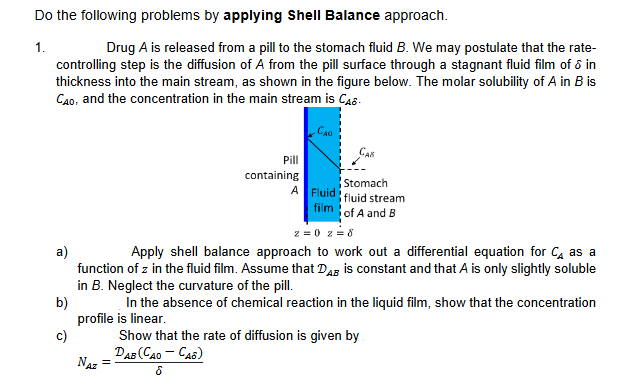
1 Drug As released from a pill to the stomach fluid B. We may postulate that the rate-
controling step is the diffusion of A from the pill surface through a stagnant fluid fim of & in
thickness into the main stream, as shown in the figure below. The molar solubilty of Ain Bis
Cao, and the concentration in the main stream is Cas
Car
pill SS
containing
Stomach
4 fluid stream
of Aand 8
220228
a) Apply shell balance approach to work out a differential equation for C, as a
function of z in the fluid film. Assume that D5 is constant and that A is only slightly soluble
in B. Neglect the curvature of the pill
b) In the absence of chemical reaction in the liquid fim, show that the concentration
profile is linear.
E) ‘Show that the rate of diffusion is given by
= Das (Cao — Gas)
Nee ==
Question:
give answer in 2 step with explanation at the end of each step and final answer at the end:Do the following problems by applying Shell Balance approach
1 Drug As released from a pill to the stomach fluid B. We may postulate that the rate-
controling step is the diffusion of A from the pill surface through a stagnant fluid fim of & in
thickness into the main stream, as shown in the figure below. The molar solubilty of Ain Bis
Cao, and the concentration in the main stream is Cas
Car
pill SS
containing
Stomach
4 fluid stream
of Aand 8
220228
a) Apply shell balance approach to work out a differential equation for C, as a
function of z in the fluid film. Assume that D5 is constant and that A is only slightly soluble
in B. Neglect the curvature of the pill
b) In the absence of chemical reaction in the liquid fim, show that the concentration
profile is linear.
E) ‘Show that the rate of diffusion is given by
= Das (Cao — Gas)
Nee ==
This is AI generated Response.
Asked by: Rahul
Created at: 2025-11-13 03:15:53
Final Answer:
RenderedRaw Text
Did you like this answer?
Certainly! Let’s solve the problem step by step using the **Shell Balance approach**.
---
## **Step 1: Write the Shell Balance and Differential Equation (Part a)**
### **Shell Balance on Species A in a Thin Slab**
- **Control volume:** A thin slab of thickness \( \Delta z \) at position \( z \).
- **At steady state:** Rate in by diffusion = Rate out by diffusion (no accumulation, no reaction).
Let \( N_{Az} \) be the flux of A (mol/(area·time)), and \( C_A \) be the concentration of A at position \( z \).
#### **Shell Balance:**
\[
\text{In by diffusion at } z: N_{Az}|_z \\
\text{Out by diffusion at } z + \Delta z: N_{Az}|_{z+\Delta z}
\]
\[
\text{Net accumulation in shell: } N_{Az}|_z - N_{Az}|_{z+\Delta z} =
\]
\[
\Rightarrow N_{Az}|_z = N_{Az}|_{z+\Delta z}
\]
#### **Fick’s Law:**
\[
N_{Az} = -D_{AB} \frac{dC_A}{dz}
\]
#### **Plug Into the Balance:**
\[
\frac{dN_{Az}}{dz} = \implies \frac{d}{dz} \left(-D_{AB} \frac{dC_A}{dz}\right) =
\]
If \( D_{AB} \) is constant,
\[
\frac{d^2 C_A}{dz^2} =
\]
**Explanation:**
The shell balance shows that, at steady state and with no reaction, the flux of A through any cross-section is constant. Using Fick's law, this gives a second-order differential equation for \( C_A \).
---
## **Step 2: Solve for Concentration Profile and Rate (Parts b & c)**
### **(b) Linear Profile**
From step 1,
\[
\frac{d^2 C_A}{dz^2} =
\]
Integrate once:
\[
\frac{dC_A}{dz} = \text{constant} = m
\]
Integrate again:
\[
C_A(z) = mz + b
\]
**Boundary Conditions:**
- At \( z = \): \( C_A = C_{A} \)
- At \( z = \delta \): \( C_A = C_{A\delta} \)
Plug in:
\[
C_A() = b = C_{A}
\]
\[
C_A(\delta) = m\delta + b = C_{A\delta}
\]
\[
m = \frac{C_{A\delta} - C_{A}}{\delta}
\]
So,
\[
C_A(z) = C_{A} + \frac{C_{A\delta} - C_{A}}{\delta} z
\]
**Explanation:**
The absence of reaction and steady state means the concentration profile is linear between the pill and the main stream.
---
### **(c) Rate of Diffusion**
From Fick’s law:
\[
N_{Az} = -D_{AB} \frac{dC_A}{dz}
\]
From above, \( \frac{dC_A}{dz} = \frac{C_{A\delta} - C_{A}}{\delta} \):
\[
N_{Az} = -D_{AB} \left(\frac{C_{A\delta} - C_{A}}{\delta}\right)
= \frac{D_{AB}(C_{A} - C_{A\delta})}{\delta}
\]
---
## **Final Answer:**
\[
\boxed{
N_{Az} = \frac{D_{AB}(C_{A} - C_{A\delta})}{\delta}
}
\]
---
### **Summary of Steps:**
- **Step 1:** Shell balance and Fick's law yield \( \frac{d^2 C_A}{dz^2} = \).
- **Step 2:** The solution is a linear concentration profile, and the rate is given by the above equation.
Question:
Please solved all parts a,b,c
This is AI generated Response.
Asked by: Rahul
Created at: 2025-11-13 03:16:52
Final Answer:
RenderedRaw Text
Did you like this answer?
Certainly! Let's solve the problem step-by-step using the **Shell Balance approach**.
---
## **Step 1: Write the Shell Balance and Differential Equation (Part a)**
### **Shell Balance on Species A in a Thin Slab**
1. **Control Volume:** Consider a thin slab of thickness \( \Delta z \) at position \( z \).
2. **Steady State:** Rate in by diffusion = Rate out by diffusion (no accumulation, no reaction).
Let \( N_{Az} \) be the flux of A (mol/(area·time)), and \( C_A \) be the concentration of A at position \( z \).
#### **Shell Balance:**
\[
\text{Net flux into the control volume: } N_{Az}|_z - N_{Az}|_{z+\Delta z}
\]
At steady state, the net accumulation is zero:
\[
N_{Az}|_z - N_{Az}|_{z+\Delta z} = 0
\]
Which leads to:
\[
N_{Az}|_z = N_{Az}|_{z+\Delta z}
\]
#### **Fick’s Law:**
\[
N_{Az} = -D_{AB} \frac{dC_A}{dz}
\]
#### **Plug Into the Balance:**
Using Fick's law:
\[
\frac{dN_{Az}}{dz} = -D_{AB} \frac{d^2 C_A}{dz^2} = 0
\]
If \( D_{AB} \) is constant, we have:
\[
\frac{d^2 C_A}{dz^2} = 0
\]
**Explanation:**
This shell balance indicates that, under steady state with no reactions, the flux of A through any cross-section is constant. Therefore, the concentration \( C_A \) must satisfy a second-order differential equation.
---
## **Step 2: Solve for Concentration Profile and Rate (Parts b & c)**
### **(b) Linear Profile**
From step 1, we have:
\[
\frac{d^2 C_A}{dz^2} = 0
\]
Integrate once:
\[
\frac{dC_A}{dz} = m \quad \text{(a constant)}
\]
Integrate again:
\[
C_A(z) = mz + b
\]
**Boundary Conditions:**
- At \( z = 0 \): \( C_A(0) = C_{A0} \)
- At \( z = \delta \): \( C_A(\delta) = C_{A\delta} \)
Plugging in these boundary conditions:
1. From \( C_A(0) = b \):
\[
b = C_{A0}
\]
2. From \( C_A(\delta) = m \delta + C_{A0} = C_{A\delta} \):
\[
m = \frac{C_{A\delta} - C_{A0}}{\delta}
\]
Thus, the concentration profile is:
\[
C_A(z) = C_{A0} + \frac{C_{A\delta} - C_{A0}}{\delta} z
\]
**Explanation:**
The concentration profile is linear between the pill and the main stream due to the absence of reaction and steady state conditions.
---
### **(c) Rate of Diffusion**
Using Fick's law:
\[
N_{Az} = -D_{AB} \frac{dC_A}{dz}
\]
From the linear concentration profile, we have:
\[
\frac{dC_A}{dz} = \frac{C_{A\delta} - C_{A0}}{\delta}
\]
Substituting into Fick's law:
\[
N_{Az} = -D_{AB} \left(\frac{C_{A\delta} - C_{A0}}{\delta}\right)
= \frac{D_{AB}(C_{A0} - C_{A\delta})}{\delta}
\]
---
## **Final Answer:**
The rate of diffusion is given by:
\[
\boxed{N_{Az} = \frac{D_{AB}(C_{A0} - C_{A\delta})}{\delta}}
\]
---
### **Summary of Steps:**
- **Step 1:** Shell balance and Fick's law yield \( \frac{d^2 C_A}{dz^2} = 0 \).
- **Step 2:** Solving the differential equation gives a linear concentration profile, and the rate of diffusion is as stated above.
VIPSolutions focuses on clear, step‑by‑step explanations so you can learn quickly. Whether you need an AI‑generated walkthrough or a short hint to get unstuck, each solution is organized for fast reading and easy review later.
Search similar questions, compare approaches, and bookmark the best answers for revision. Our goal is simple: quick, reliable study help that feels natural—not noisy.
 VIPSolutions
 Do the following problems by applying Shell Balance approach
1 Drug As released from a pill to the stomach fluid B. We may postulate that the rate-
controling step is the diffusion of A from the pill surface through a stagnant fluid fim of & in
thickness into the main stream, as shown in the figure below. The molar solubilty of Ain Bis
Cao, and the concentration in the main stream is Cas
Car
pill SS
containing
Stomach
4 fluid stream
of Aand 8
220228
a) Apply shell balance approach to work out a differential equation for C, as a
function of z in the fluid film. Assume that D5 is constant and that A is only slightly soluble
in B. Neglect the curvature of the pill
b) In the absence of chemical reaction in the liquid fim, show that the concentration
profile is linear.
E) ‘Show that the rate of diffusion is given by
= Das (Cao — Gas)
Nee ==