 VIPSolutions
give answer in 2 step with explanation at the end of each step and final answer at the end:Er . 3 | A]. = een TTT 4 ee BE
Question:
give answer in 2 step with explanation at the end of each step and final answer at the end: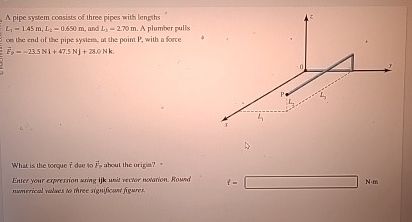 Er .
3 | A].
=
een TTT 4
ee BE
This is AI generated Response.
Asked by: Rahul
Created at: 2025-11-12 22:40:13
Asked by: Rahul
Created at: 2025-11-12 22:40:13
Final Answer:
Rendered
Raw Text
Did you like this answer?
Let's break the problem into **two steps**:
1. **Find the position vector \( \vec{r} \) from the origin to point P.**
2. **Calculate the torque \( \vec{\tau} = \vec{r} \times \vec{F} \) about the origin.**
---
### **Step 1: Find the Position Vector \(\vec{r}\) to Point P**
Pipe lengths:
- \( L_1 = 1.45\, \text{m} \) (along the x-axis)
- \( L_2 = .650\, \text{m} \) (along the y-axis)
- \( L_3 = 2.70\, \text{m} \) (along the z-axis)
So,
\[
\vec{r} = L_1\hat{i} + L_2\hat{j} + L_3\hat{k}
= (1.45 \hat{i} + .650 \hat{j} + 2.70 \hat{k})~\text{m}
\]
> **Explanation:**
> The position vector is just the sum of the displacements along each axis, so we add each segment in its respective direction.
---
### **Step 2: Calculate the Torque \(\vec{\tau} = \vec{r} \times \vec{F}\)**
Given force at P:
\[
\vec{F} = (-23.5 \hat{i} + 47.5 \hat{j} + 28. \hat{k})~\text{N}
\]
The cross product \(\vec{\tau} = \vec{r} \times \vec{F}\):
\[
\vec{\tau} =
\begin{vmatrix}
\hat{i} & \hat{j} & \hat{k} \\
1.45 & .650 & 2.70 \\
-23.5 & 47.5 & 28. \\
\end{vmatrix}
\]
Expanding the determinant:
- \( \hat{i}: (.650 \cdot 28. - 2.70 \cdot 47.5) \)
- \( \hat{j}: -(1.45 \cdot 28. - 2.70 \cdot -23.5) \)
- \( \hat{k}: (1.45 \cdot 47.5 - .650 \cdot -23.5) \)
Compute each component:
1. **\( \hat{i} \):**
\[
.650 \cdot 28. = 18.2
\]
\[
2.70 \cdot 47.5 = 128.25
\]
\[
18.2 - 128.25 = -110.05
\]
2. **\( \hat{j} \):**
\[
1.45 \cdot 28. = 40.6
\]
\[
2.70 \cdot (-23.5) = -63.45
\]
\[
40.6 - (-63.45) = 40.6 + 63.45 = 104.05; \text{but overall negative: } -104.05
\]
3. **\( \hat{k} \):**
\[
1.45 \cdot 47.5 = 68.875
\]
\[
.650 \cdot (-23.5) = -15.275
\]
\[
68.875 - (-15.275) = 68.875 + 15.275 = 84.15
\]
So,
\[
\boxed{
\vec{\tau} = -110\hat{i} - 104\hat{j} + 84.2\hat{k}~\text{N}\cdot\text{m}
}
\]
(Rounded to three significant figures.)
> **Explanation:**
> The torque is found using the cross product of position and force vectors. Each component is calculated using the determinant expansion.
---
## **Final Answer**
\[
\boxed{
\vec{\tau} = -110\hat{i} - 104\hat{j} + 84.2\hat{k}~\text{N}\cdot\text{m}
}
\]
📢 Instructions:
- Ask anything relatd to above question only.
- For new Question goto :