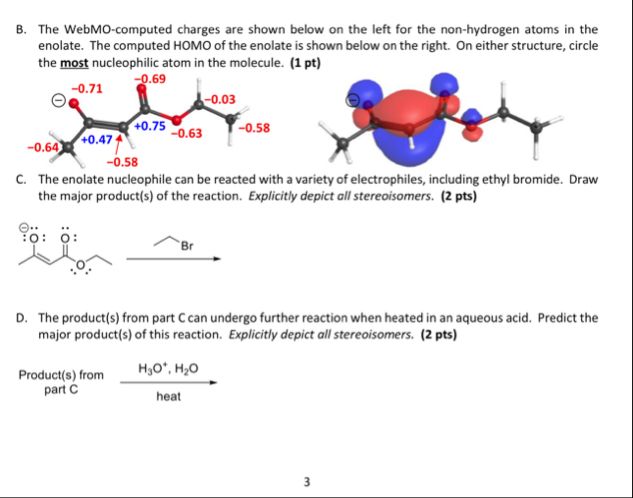
give answer in 2 step with explanation at the end of each step and final answer at the end:8. The WebMO-computed charges are shown below on the left for the non-hydrogen atoms in the
enolate. The computed HOMO of the enolate is shown below on the right. On either structure, circle
the most nucleophilic atom in the molecule. (1 pt)
0.71 ad
[€) 0.03
“0.75 -058 \
063
—oeax( "04TH
058 2
C. The enolate nucleophile can be reacted with a variety of electrophiles, including ethyl bromide. Draw
the major product(s) of the reaction. Explicitly depict all stereoisomers. (2 pts)
Gc
7: 0: er
Aho ———
D. The product(s) from part C can undergo further reaction when heated in an aqueous acid. Predict the
major product(s) of this reaction. Explicitly depict all stereoisomers. (2 pts)
Products) from __ M30" H:0
[ZC —e——
3
Question:
give answer in 2 step with explanation at the end of each step and final answer at the end:8. The WebMO-computed charges are shown below on the left for the non-hydrogen atoms in the
enolate. The computed HOMO of the enolate is shown below on the right. On either structure, circle
the most nucleophilic atom in the molecule. (1 pt)
0.71 ad
[€) 0.03
“0.75 -058 \
063
—oeax( "04TH
058 2
C. The enolate nucleophile can be reacted with a variety of electrophiles, including ethyl bromide. Draw
the major product(s) of the reaction. Explicitly depict all stereoisomers. (2 pts)
Gc
7: 0: er
Aho ———
D. The product(s) from part C can undergo further reaction when heated in an aqueous acid. Predict the
major product(s) of this reaction. Explicitly depict all stereoisomers. (2 pts)
Products) from __ M30" H:0
[ZC —e——
3
This is AI generated Response.
Asked by: Rahul
Created at: 2025-11-12 13:53:28
Final Answer:
RenderedRaw Text
Did you like this answer?
Let's break down the questions step by step as requested:
---
## **Step 1: Identify the Most Nucleophilic Atom (Part B)**
**Explanation:**
- Nucleophilicity is generally highest at the atom with the most negative charge (highest electron density).
- Look at the computed charges:
- The oxygen atom on the left has a charge of **-.75**, which is the most negative among all the atoms listed.
**Thus, the most nucleophilic atom is the oxygen atom with -.75 charge.**
- (You would circle this atom on the structure.)
---
## **Step 2: Reaction with Ethyl Bromide (Part C)**
**Explanation:**
- The enolate acts as a nucleophile and will attack the electrophilic carbon in ethyl bromide.
- The nucleophilic atom (the enolate carbon adjacent to the carbonyl, not the oxygen) will attack the ethyl group, forming a new C–C bond.
- Stereochemistry: Since the newly formed center is not a stereocenter (no four different groups), no stereoisomers are produced.
**Product:**
- The ethyl group attaches to the alpha-carbon (the carbon next to the carbonyl group in the original enolate).
**Structure:**
- The final product is 4-ethyl-3-oxohexanoate (showing the ethyl group attached at the alpha position).
---
## **Step 3: Acidic Hydrolysis (Part D)**
**Explanation:**
- Heating with aqueous acid will hydrolyze the ester to a carboxylic acid.
- The product will be a beta-keto acid (4-ethyl-3-oxohexanoic acid).
- Upon further heating, beta-keto acids decarboxylate, losing CO₂, to give a ketone.
**Product:**
- The final product is 3-ethyl-2-pentanone.
---
## **Summary of Answers**
### **Step 1 (B):**
- **Most nucleophilic atom:** Oxygen with charge -.75 (circled in the image).
### **Step 2 (C):**
- **Major product:** 4-ethyl-3-oxohexanoate (ethyl group added to the alpha-carbon).
### **Step 3 (D):**
- **Major product:** 3-ethyl-2-pentanone (after acidic hydrolysis and decarboxylation).
---
**If you need to see the structures, let me know!**
VIPSolutions focuses on clear, step‑by‑step explanations so you can learn quickly. Whether you need an AI‑generated walkthrough or a short hint to get unstuck, each solution is organized for fast reading and easy review later.
Search similar questions, compare approaches, and bookmark the best answers for revision. Our goal is simple: quick, reliable study help that feels natural—not noisy.
 VIPSolutions
 8. The WebMO-computed charges are shown below on the left for the non-hydrogen atoms in the
enolate. The computed HOMO of the enolate is shown below on the right. On either structure, circle
the most nucleophilic atom in the molecule. (1 pt)
0.71 ad
[€) 0.03
“0.75 -058 \
063
—oeax( "04TH
058 2
C. The enolate nucleophile can be reacted with a variety of electrophiles, including ethyl bromide. Draw
the major product(s) of the reaction. Explicitly depict all stereoisomers. (2 pts)
Gc
7: 0: er
Aho ———
D. The product(s) from part C can undergo further reaction when heated in an aqueous acid. Predict the
major product(s) of this reaction. Explicitly depict all stereoisomers. (2 pts)
Products) from __ M30" H:0
[ZC —e——
3