 VIPSolutions
give answer in 2 step with explanation at the end of each step and final answer at the end:Find oa Vg for: aw, =60 bw, =1000 caw, =100000 dw, =10x10° [ c ] 6) + Fri R=5/L TAR Lan (=7(0° 1600F & 00 b) Wy = [000 c) Jy = loo ceo ly = 1010
Question:
give answer in 2 step with explanation at the end of each step and final answer at the end: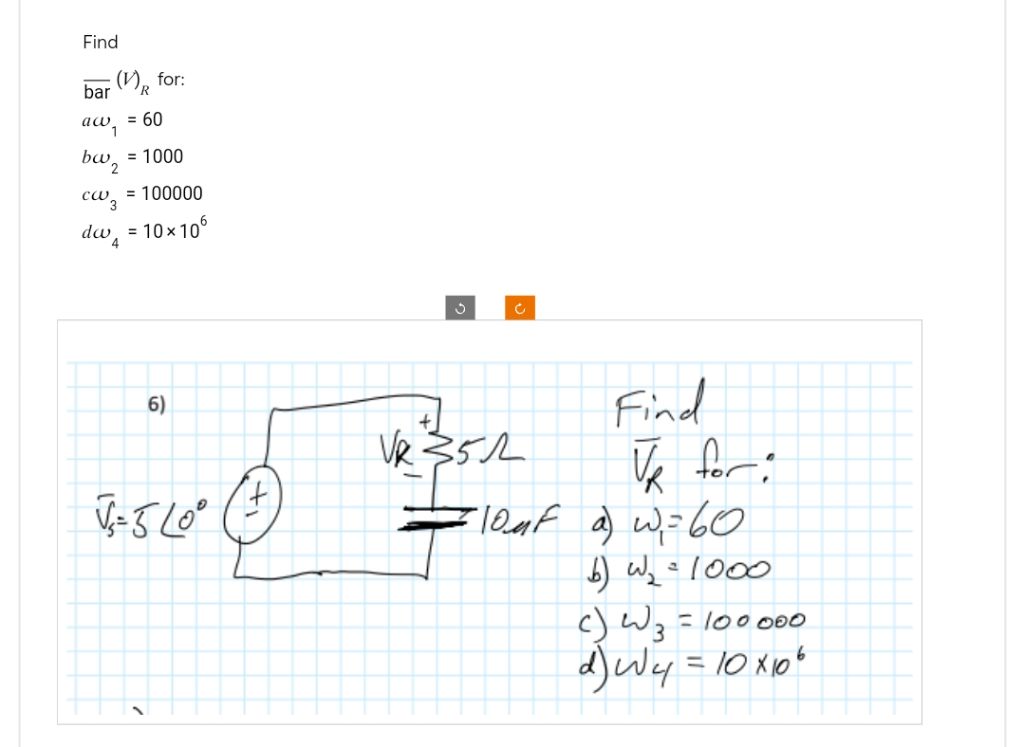 Find
oa Vg for:
aw, =60
bw, =1000
caw, =100000
dw, =10x10°
[ c ]
6) + Fri
R=5/L TAR Lan
(=7(0° 1600F & 00
b) Wy = [000
c) Jy = loo ceo
ly = 1010
This is AI generated Response.
Asked by: Rahul
Created at: 2025-11-12 10:00:04
Asked by: Rahul
Created at: 2025-11-12 10:00:04
Final Answer:
Rendered
Raw Text
Did you like this answer?
## Step 1: **Write the Impedance and Circuit Equation**
Given:
- AC Source: \( \bar{V}_s = 5\angle ^\circ \)
- Resistor: \( R = 5\,\Omega \)
- Capacitor: \( C = 10\,\mu\text{F} = 10 \times 10^{-6}\,\text{F} \)
The total impedance \( Z \) of the series circuit is:
\[
Z = R + \frac{1}{j\omega C}
\]
The voltage across the resistor (\( \bar{V}_R \)) can be found using the voltage divider rule:
\[
\bar{V}_R = \bar{V}_s \times \frac{R}{R + \frac{1}{j\omega C}}
\]
**Explanation:**
This sets up the relationship for the voltage across the resistor in terms of the circuit parameters and the frequency \( \omega \).
---
## Step 2: **Calculate \( \bar{V}_R \) for Each \( \omega \)**
Let's compute for \( \omega_1 = 60 \) as an example:
### First, Calculate Capacitive Reactance:
\[
X_C = \frac{1}{\omega C} = \frac{1}{60 \times 10 \times 10^{-6}} = \frac{1}{.0006} \approx 1666.67\,\Omega
\]
Total impedance:
\[
Z = 5 - j1666.67
\]
### Magnitude of Impedance:
\[
|Z| = \sqrt{5^2 + 1666.67^2} \approx 1666.68
\]
### Voltage Divider:
\[
\bar{V}_R = 5\angle ^\circ \times \frac{5}{1666.68} \approx .015\,\angle ^\circ \text{ V}
\]
**Explanation:**
Plug in the values for \( \omega \), calculate the impedance, then use the voltage divider to find \( \bar{V}_R \).
---
## Final Answers (Repeat Step 2 for Each \( \omega \)):
### a) \( \omega_1 = 60 \)
\[
\bar{V}_R \approx .015\,\angle ^\circ \text{ V}
\]
### b) \( \omega_2 = 100 \)
\[
X_C = \frac{1}{100 \times 10 \times 10^{-6}} = 100\,\Omega
\]
\[
Z = 5 - j100, \quad |Z| \approx 100.12
\]
\[
\bar{V}_R = 5 \times \frac{5}{100.12} \approx .25\,\angle ^\circ \text{ V}
\]
### c) \( \omega_3 = 100{}000 \)
\[
X_C = \frac{1}{100{,}000 \times 10 \times 10^{-6}} = 1\,\Omega
\]
\[
Z = 5 - j1, \quad |Z| \approx 5.10
\]
\[
\bar{V}_R = 5 \times \frac{5}{5.10} \approx 4.90\,\angle ^\circ \text{ V}
\]
### d) \( \omega_4 = 10 \times 10^6 \)
\[
X_C = \frac{1}{10^7 \times 10 \times 10^{-6}} = .01\,\Omega
\]
\[
Z = 5 - j.01, \quad |Z| \approx 5.00
\]
\[
\bar{V}_R = 5 \times \frac{5}{5.00} = 5.00\,\angle ^\circ \text{ V}
\]
---
## **Summary Table**
| \( \omega \) | \( \bar{V}_R \) (V) |
|-----------------|--------------------|
| 60 | .015 |
| 100 | .25 |
| 100,000 | 4.90 |
| 10,000,000 | 5.00 |
**Final Answer:**
The voltage across the resistor increases as frequency increases, approaching the source voltage as the capacitor's reactance becomes very small.
📢 Instructions:
- Ask anything relatd to above question only.
- For new Question goto :