 VIPSolutions
give answer in 2 step with explanation at the end of each step and final answer at the end:1. (The figure below shows a Gaussian surface in the shape of a cube with edge length 1.5m. (a) (10pt) What is the net flux # enclosed by the surface if E=(~4.02{)N/C. with r in meters? (b) (10pt) What is the net charge g,,. enclosed by the surface if £= [-3.0i+5.0k] N/C?
Question:
give answer in 2 step with explanation at the end of each step and final answer at the end: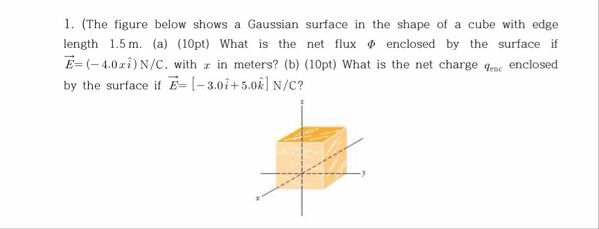 1. (The figure below shows a Gaussian surface in the shape of a cube with edge
length 1.5m. (a) (10pt) What is the net flux # enclosed by the surface if
E=(~4.02{)N/C. with r in meters? (b) (10pt) What is the net charge g,,. enclosed
by the surface if £= [-3.0i+5.0k] N/C?
This is AI generated Response.
Asked by: Rahul
Created at: 2025-11-12 09:53:11
Asked by: Rahul
Created at: 2025-11-12 09:53:11
Final Answer:
Rendered
Raw Text
Did you like this answer?
## Step-by-Step Solution
---
### **Step 1: Net Flux Enclosed by the Surface**
#### **Given:**
- Cube edge length, \( L = 1.5 \) m
- Electric field for part (a): \( \vec{E} = (-4.x \hat{i}) \) N/C (where \( x \) is in meters)
#### **To Find:**
Net flux \( \Phi \) through the cube.
#### **Calculation:**
The net flux through a closed surface is given by Gauss’s Law:
\[
\Phi = \oint_S \vec{E} \cdot d\vec{A}
\]
Since \( \vec{E} \) only has an \( x \)-component and varies with \( x \), only the faces perpendicular to the \( x \)-axis contribute.
- At \( x = \): \( E_x = \)
- At \( x = L \): \( E_x = -4.L \)
Flux through the face at \( x=L \) (outward normal \( +\hat{i} \)):
\[
\Phi_{x=L} = E_x \cdot A = (-4.L) \cdot (L^2)
\]
Flux through the face at \( x= \) (outward normal \( -\hat{i} \)):
\[
\Phi_{x=} = () \cdot (L^2) =
\]
Total flux:
\[
\Phi = \Phi_{x=L} + \Phi_{x=} = -4.L^3
\]
Substitute \( L = 1.5 \) m:
\[
\Phi = -4. \times (1.5)^3 = -4. \times 3.375 = -13.5~\text{N}\cdot\text{m}^2/\text{C}
\]
**Explanation:**
Only the two faces perpendicular to the \( x \)-axis contribute, since the electric field is only in the \( x \)-direction and depends on \( x \). The flux at \( x= \) is zero because \( E= \) there.
---
### **Step 2: Net Charge Enclosed by the Surface**
#### **Given:**
- Electric field for part (b): \( \vec{E} = [-3.\hat{i} + 5.\hat{k}] \) N/C (constant)
#### **To Find:**
Net charge \( q_{\text{enc}} \) enclosed by the surface.
#### **Calculation:**
The total flux through a closed surface with a **constant** electric field is zero (since the flux leaving one side is exactly balanced by the flux entering the opposite side):
\[
\Phi = \oint_S \vec{E} \cdot d\vec{A} =
\]
From Gauss’s Law:
\[
\Phi = \frac{q_{\text{enc}}}{\epsilon_}
\]
\[
q_{\text{enc}} = \Phi \cdot \epsilon_ =
\]
**Explanation:**
For a constant electric field, the net flux through a closed surface is always zero, so no net charge is enclosed.
---
## **Final Answers**
**(a) Net flux enclosed by the surface:**
\[
\boxed{-13.5~\text{N}\cdot\text{m}^2/\text{C}}
\]
**(b) Net charge enclosed by the surface:**
\[
\boxed{}
\]
📢 Instructions:
- Ask anything relatd to above question only.
- For new Question goto :