 VIPSolutions
give answer in 2 step with explanation at the end of each step and final answer at the end:1. Rank the alkenes according to the rate of protonation of the double bond. Explain your reasoning (3 pt). a pr b sos c Fey 2. Write the possible mechanism for this transformation (3 pt). \ H =a HO! = [e}
Question:
give answer in 2 step with explanation at the end of each step and final answer at the end: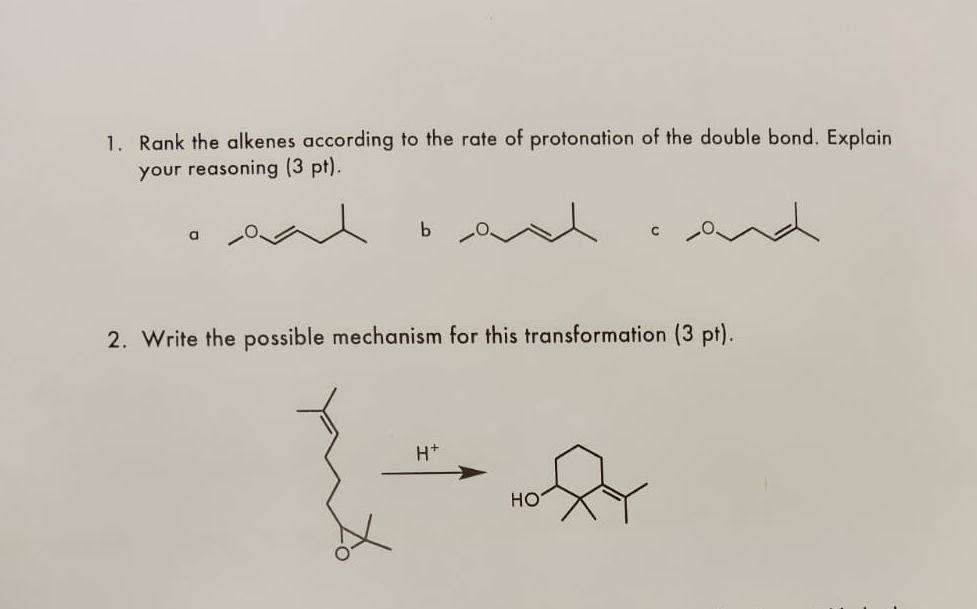 1. Rank the alkenes according to the rate of protonation of the double bond. Explain
your reasoning (3 pt).
a pr b sos c Fey
2. Write the possible mechanism for this transformation (3 pt).
\
H
=a
HO! =
[e}
This is AI generated Response.
Asked by: Rahul
Created at: 2025-11-11 14:30:20
Asked by: Rahul
Created at: 2025-11-11 14:30:20
Final Answer:
Rendered
Raw Text
Did you like this answer?
## Step 1: Ranking Alkenes According to Rate of Protonation
**Explanation:**
The rate of protonation of an alkene depends on the stability of the carb intermediate formed after protonation. More substituted carbocations are more stable (tertiary > secondary > primary), and groups like oxygen (as in ethers) can stabilize carbocations via resonance or induction.
- **a:** Forms a secondary carbocation, with resonance stabilization from the oxygen.
- **b:** Forms a tertiary carbocation, also with resonance stabilization from the oxygen.
- **c:** Forms a primary carbocation, with resonance stabilization from the oxygen.
**Ranking (fastest to slowest):**
**b > a > c**
- **b**: Tertiary carbocation + resonance (most stable, fastest)
- **a**: Secondary carbocation + resonance (moderately stable)
- **c**: Primary carbocation + resonance (least stable, slowest)
---
## Step 2: Mechanism for the Transformation
**Explanation:**
This is an acid-catalyzed cyclization (likely a Prins cyclization). Let's break down the steps:
1. **Protonation of Alkene:** The alkene is protonated to form a carbocation (most stable, tertiary position).
2. **Cyclization:** The oxygen's lone pair attacks the carbocation, forming a new C–O bond and creating a six-membered ring.
3. **Deprotonation:** Loss of a proton from the oxygen gives the final alcohol product.
**Mechanism Steps (with structures):**
1. **Protonation:**
The alkene reacts with H⁺, forming a carbocation at the most substituted position.
2. **Ring closure:**
The oxygen atom attacks the carbocation, leading to cyclization and formation of the six-membered ring (tetrahydropyran ring).
3. **Deprotonation:**
The oxygen loses a proton, giving the final alcohol.
---
## Final Answers
### 1. **Ranking:**
**b > a > c**
*(Tertiary > Secondary > Primary carbocation stability, with resonance from oxygen)*
### 2. **Mechanism:**
- Protonation of alkene → carbocation formation
- Intramolecular attack by oxygen → ring closure
- Deprotonation → alcohol formation
**This is an acid-catalyzed cyclization forming a tetrahydropyran ring.**
📢 Instructions:
- Ask anything relatd to above question only.
- For new Question goto :