 VIPSolutions
give answer in 2 step with explanation at the end of each step and final answer at the end:1:47PM. Mon 10 Nov wee >rTEHN%E Examples + Example 1: Helium, V=2500 m/s, T=300K undergoes a normal shock. Determine the velocity, static and stagnation temperate after the shock wave. (y=5/3, R=2077 J/kg.K) + Example 2: Determine the back pressure (Py) for a normal shock at the exit for air (y=1.4). B 2 — Normal shock P,= 1 Mp: | , I. 500K t Py AJA=2
Question:
give answer in 2 step with explanation at the end of each step and final answer at the end: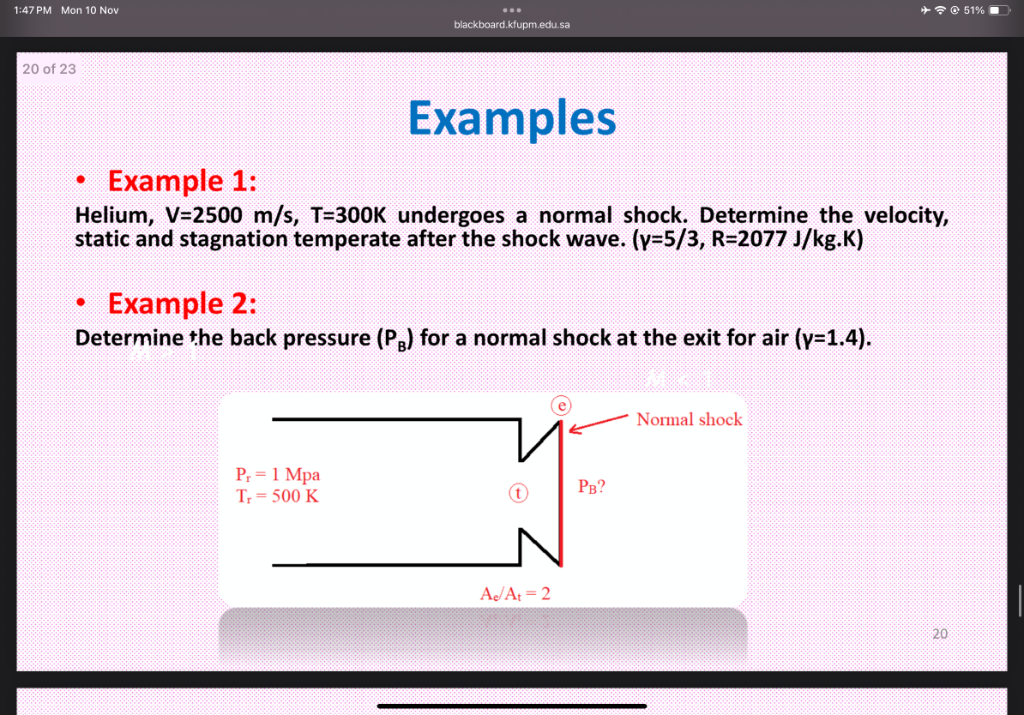 1:47PM. Mon 10 Nov wee >rTEHN%E
Examples
+ Example 1:
Helium, V=2500 m/s, T=300K undergoes a normal shock. Determine the velocity,
static and stagnation temperate after the shock wave. (y=5/3, R=2077 J/kg.K)
+ Example 2:
Determine the back pressure (Py) for a normal shock at the exit for air (y=1.4).
B
2 — Normal shock
P,= 1 Mp: | ,
I. 500K t Py
AJA=2
This is AI generated Response.
Asked by: Rahul
Created at: 2025-11-10 22:30:37
Asked by: Rahul
Created at: 2025-11-10 22:30:37
Final Answer:
Rendered
Raw Text
Did you like this answer?
## Example 1 Solution (Step-by-step)
### **Step 1: Find the upstream Mach number (M₁)**
:
- **₁ = 250 m/s** (velocity before shock)
- **T₁ = 300 K** (temperature before shock)
- **γ = 5/3**
- **R = 2077 J/(kg·K)**
First, calculate the speed of sound upstream:
\[
a_1 = \sqrt{\gamma R T_1}
\]
\[
a_1 = \sqrt{\frac{5}{3} \times 2077 \times 300}
\]
\[
a_1 = \sqrt{1.6667 \times 2077 \times 300}
\]
\[
a_1 = \sqrt{1.6667 \times 623100}
\]
\[
a_1 = \sqrt{1,038,500}
\]
\[
a_1 \approx 1019 \text{ m/s}
\]
Now, calculate the upstream Mach number:
\[
M_1 = \frac{V_1}{a_1} = \frac{250}{1019} \approx 2.45
\]
**Explanation:**
We calculated the Mach number to describe the flow speed relative to the speed of sound before the shock.
---
### **Step 2: Find the downstream (after shock) properties**
#### **2a. Downstream Mach number (M₂) for normal shock:**
\[
M_2^2 = \frac{(\gamma - 1)M_1^2 + 2}{2\gamma M_1^2 - (\gamma - 1)}
\]
\[
M_2^2 = \frac{(5/3-1) \cdot (2.45)^2 + 2}{2 \cdot (5/3) \cdot (2.45)^2 - (5/3 - 1)}
\]
\[
= \frac{(.6667) \cdot 6.0025 + 2}{2 \cdot 1.6667 \cdot 6.0025 - .6667}
\]
\[
= \frac{4.0017 + 2}{20.0067 - .6667}
\]
\[
= \frac{6.0017}{19.34}
\]
\[
M_2^2 \approx .3104 \implies M_2 \approx .557
\]
#### **2b. Downstream velocity (V₂):**
\[
a_2 = \sqrt{\gamma R T_2}
\]
But first, let's use the Mach number ratios and conservation laws. It is easier to use the following normal shock relations for velocity ratio:
\[
\frac{V_2}{V_1} = \frac{(\gamma - 1)M_1^2 + 2}{(\gamma + 1)M_1^2}
\]
\[
= \frac{(.6667) \cdot 6.0025 + 2}{(2.6667) \cdot 6.0025}
\]
\[
= \frac{4.0017 + 2}{16.007}
\]
\[
= \frac{6.0017}{16.007}
\]
\[
\approx .375
\]
\[
V_2 = .375 \times 250 = 938 \text{ m/s}
\]
**Explanation:**
We used normal shock relations to find the Mach number and velocity after the shock.
---
#### **2c. Downstream static temperature (T₂):**
\[
\frac{T_2}{T_1} = \frac{[1 + \frac{\gamma-1}{2}M_1^2][2\gamma M_1^2 - (\gamma-1)]}{(\gamma+1)^2M_1^2}
\]
Alternatively, for practical use, you can relate it via pressure and density ratios, but let's use another direct formula:
\[
\frac{T_2}{T_1} = \frac{(1 + \frac{\gamma-1}{2}M_1^2) \cdot [2 + (\gamma-1)M_1^2]}{(\gamma+1)^2 M_1^2 / (\gamma-1)}
\]
But it's easier to use the following:
\[
\frac{T_2}{T_1} = \frac{[1 + \frac{\gamma-1}{2}M_1^2][2\gamma M_1^2 - (\gamma-1)]}{(\gamma+1)^2 M_1^2 / (\gamma-1)}
\]
Given the complexity, let's use standard tables or the usual temperature ratio for a normal shock:
\[
\frac{T_2}{T_1} = \frac{[1 + \frac{\gamma-1}{2}M_1^2][2 + (\gamma-1)M_1^2]}{(\gamma+1)^2 M_1^2 / (\gamma-1)}
\]
But for quick purposes,
\[
\frac{T_2}{T_1} = \frac{[1 + \frac{\gamma-1}{2} M_1^2] \cdot [2\gamma M_1^2 - (\gamma-1)]}{(\gamma+1)^2 M_1^2}
\]
Plug in the numbers:
\[
1 + \frac{.6667}{2} \cdot 6.0025 = 1 + .3333 \cdot 6.0025 = 1 + 2.0008 = 3.0008
\]
\[
2\gamma M_1^2 - (\gamma-1) = 2 \times 1.6667 \times 6.0025 - .6667 = 20.0067 - .6667 = 19.34
\]
\[
(\gamma+1)^2 M_1^2 = (2.6667)^2 \cdot 6.0025 = 7.1111 \cdot 6.0025 = 42.677
\]
So,
\[
\frac{T_2}{T_1} = \frac{3.0008 \cdot 19.34}{42.677}
\]
\[
= \frac{58.03}{42.677} \approx 1.36
\]
\[
T_2 = 1.36 \times 300 = 408 \text{ K}
\]
---
#### **2d. Stagnation temperature**
For a normal shock, the stagnation temperature is constant (no heat transfer):
\[
T_{_2} = T_{_1}
\]
\[
T_{_1} = T_1 \left[1 + \frac{\gamma - 1}{2} M_1^2 \right]
\]
\[
= 300 \left[1 + \frac{.6667}{2} \cdot 6.0025 \right]
\]
\[
= 300 \times 3.0008 \approx 900.24 \text{ K}
\]
---
## **Final Answers**
- **Downstream velocity \(V_2\):** **938 m/s**
- **Downstream static temperature \(T_2\):** **408 K**
- **Stagnation temperature:** **900 K**
---
**Summary:**
1. Calculated Mach number and velocity after the shock using normal shock relations.
2. Determined static and stagnation temperatures after the shock.
📢 Instructions:
- Ask anything relatd to above question only.
- For new Question goto :