 VIPSolutions
give answer in 2 step with explanation at the end of each step and final answer at the end:5. (20 points) For the following hypothetical reaction, AC(g) + BC(g) > 2AB(s) + Cafaq) a. It was determined that AH, = —72.48 kJ and AS, = —324.8 L When, if ever, is the reaction spontaneous? b. AH and AS do not change with temperature. Determine the value of AG and the equilibrium constant at 137 °C.
Question:
give answer in 2 step with explanation at the end of each step and final answer at the end: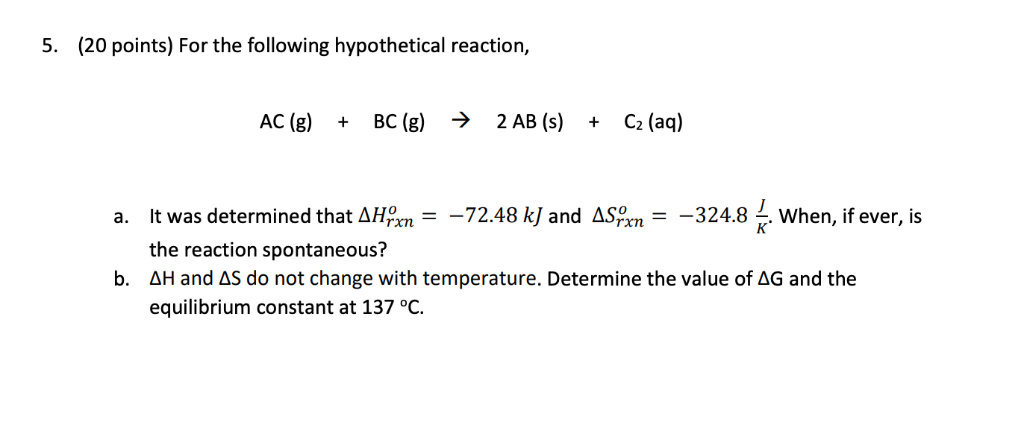 5. (20 points) For the following hypothetical reaction,
AC(g) + BC(g) > 2AB(s) + Cafaq)
a. It was determined that AH, = —72.48 kJ and AS, = —324.8 L When, if ever, is
the reaction spontaneous?
b. AH and AS do not change with temperature. Determine the value of AG and the
equilibrium constant at 137 °C.
This is AI generated Response.
Asked by: Rahul
Created at: 2025-11-10 20:35:47
Asked by: Rahul
Created at: 2025-11-10 20:35:47
Final Answer:
Rendered
Raw Text
Did you like this answer?
Let's solve the problem step by step:
---
## **a. When is the reaction spontaneous?**
### **Step 1: Write the Gibbs Free Energy Equation**
\[
\Delta G = \Delta H - T\Delta S
\]
- **\(\Delta H^\circ_{rxn} = -72.48 \text{ kJ} = -72480 \text{ J}\)**
- **\(\Delta S^\circ_{rxn} = -324.8 \text{ J/K}\)**
A reaction is spontaneous when \(\Delta G < \).
---
### **Step 2: Set up the inequality for spontaneity**
\[
\Delta G < \implies \Delta H - T\Delta S <
\]
\[
-72480 - T(-324.8) <
\]
\[
-72480 + 324.8T <
\]
\[
324.8T < 72480
\]
\[
T < \frac{72480}{324.8}
\]
\[
T < 223.2 \text{ K}
\]
#### **Explanation:**
- The reaction is spontaneous **only when the temperature is less than 223.2 K**.
---
## **b. Calculate \(\Delta G\) and \(K_{eq}\) at 137°C**
### **Step 1: Calculate \(\Delta G\) at 137°C**
- \(T = 137^\circ C = 137 + 273.15 = 410.15\) K
\[
\Delta G = \Delta H - T\Delta S
\]
\[
\Delta G = -72480\ \text{J} - (410.15\ \text{K})(-324.8\ \text{J/K})
\]
\[
\Delta G = -72480 + 133282.072
\]
\[
\Delta G = 60799.1\ \text{J} = 60.8\ \text{kJ}
\]
#### **Explanation:**
- The Gibbs free energy at 137°C is **+60.8 kJ** (non-spontaneous at this temperature).
---
### **Step 2: Calculate the equilibrium constant (\(K_{eq}\))**
\[
\Delta G = -RT \ln K_{eq}
\]
\[
60,799.1\ \text{J} = -(8.314\ \text{J/mol·K})(410.15\ \text{K}) \ln K_{eq}
\]
\[
60,799.1 = -3411.5 \ln K_{eq}
\]
\[
\ln K_{eq} = \frac{60,799.1}{-3411.5} = -17.83
\]
\[
K_{eq} = e^{-17.83} \approx 1.80 \times 10^{-8}
\]
#### **Explanation:**
- The equilibrium constant at 137°C is **\(K_{eq} \approx 1.80 \times 10^{-8}\)**, indicating the reaction heavily favors reactants.
---
## **Final Answers**
### **a.** The reaction is spontaneous when **\(T < 223.2\) K**.
### **b.** At 137°C (**410.15 K**):
- **\(\Delta G = +60.8 \text{ kJ}\)**
- **\(K_{eq} = 1.80 \times 10^{-8}\)**
📢 Instructions:
- Ask anything relatd to above question only.
- For new Question goto :