 VIPSolutions
give answer in 2 step with explanation at the end of each step and final answer at the end:Question 1: (5 marks) Use Initial and Final-value Theorems to find f(0+) and f (22) for the function: __S*42s+4 FO= Gee Question 2: (5 marks) ‘Apply Laplace Transform to solve the ODE: £(¢) + 5x(t) + 6x(¢) = 1; x(0) = 1,(0) = 4
Question:
give answer in 2 step with explanation at the end of each step and final answer at the end: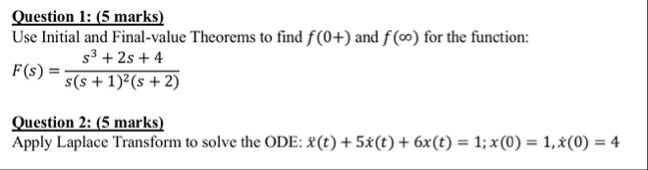 Question 1: (5 marks)
Use Initial and Final-value Theorems to find f(0+) and f (22) for the function:
__S*42s+4
FO= Gee
Question 2: (5 marks)
‘Apply Laplace Transform to solve the ODE: £(¢) + 5x(t) + 6x(¢) = 1; x(0) = 1,(0) = 4
This is AI generated Response.
Asked by: Firdos
Created at: 2025-11-10 04:34:02
Asked by: Firdos
Created at: 2025-11-10 04:34:02
Final Answer:
Rendered
Raw Text
Did you like this answer?
Let's solve ** question in steps** with and final answers---
## ** 1**
Given:
\( F(s) = \frac{s^3 + 2s + 4}{s(s+1)^2(s+2)} \)
We need to find **\( f(^+) \) (initial value)** and **\( f(\infty) \) (final value)** using the Initial and Final Value Theorems.
---
### **Step 1: Initial Value Theorem**
**Formula:**
\[
f(^+) = \lim_{s \to \infty} sF(s)
\]
**Calculation:**
\[
sF(s) = \frac{s(s^3 + 2s + 4)}{s(s+1)^2(s+2)} = \frac{s^3 + 2s + 4}{(s+1)^2(s+2)}
\]
Now, as \( s \to \infty \), the highest power of \( s \) in the numerator is \( s^3 \), and in the denominator it's \( s^3 \).
\[
\lim_{s \to \infty} \frac{s^3 + 2s + 4}{(s+1)^2(s+2)} = \lim_{s \to \infty} \frac{s^3}{s^3} = 1
\]
**Explanation:**
For very large \( s \), lower degree terms are negligible, so the ratio approaches 1.
---
### **Step 2: Final Value Theorem**
**Formula:**
\[
f(\infty) = \lim_{s \to } sF(s)
\]
**Calculation:**
\[
sF(s) = \frac{s^3 + 2s + 4}{(s+1)^2(s+2)}
\]
Plug \( s = \):
Numerator: \( ^3 + 2() + 4 = 4 \)
Denominator: \( (+1)^2 (+2) = 1 \times 2 = 2 \)
\[
f(\infty) = \frac{4}{2} = 2
\]
**Explanation:**
Substitute \( s = \) to get the steady-state (long-term) value.
---
#### **Final Answers**
- \( f(^+) = 1 \)
- \( f(\infty) = 2 \)
---
## **Question 2**
Given ODE:
\[
\ddot{x}(t) + 5\dot{x}(t) + 6x(t) = 1, \quad x() = 1, \quad \dot{x}() = 4
\]
---
### **Step 1: Take Laplace Transform**
Let \( X(s) = \mathcal{L}\{x(t)\} \).
Laplace of ODE:
\[
\begin{align*}
\mathcal{L}\{\ddot{x}(t)\} &= s^2 X(s) - s x() - \dot{x}() \\
\mathcal{L}\{5\dot{x}(t)\} &= 5[s X(s) - x()] \\
\mathcal{L}\{6x(t)\} &= 6 X(s) \\
\mathcal{L}\{1\} &= \frac{1}{s}
\end{align*}
\]
Plug in initial values (\( x() = 1, \dot{x}() = 4 \)):
\[
s^2 X(s) - s(1) - 4 + 5[s X(s) - 1] + 6 X(s) = \frac{1}{s}
\]
\[
(s^2 + 5s + 6)X(s) - s - 4 - 5 = \frac{1}{s}
\]
\[
(s^2 + 5s + 6)X(s) - (s + 9) = \frac{1}{s}
\]
\[
(s^2 + 5s + 6)X(s) = \frac{1}{s} + s + 9
\]
\[
X(s) = \frac{1}{s(s^2 + 5s + 6)} + \frac{s + 9}{s^2 + 5s + 6}
\]
**Explanation:**
We applied Laplace to each term and substituted initial conditions.
---
### **Step 2: Solve for \( x(t) \) using Partial Fractions and Inverse Laplace**
Factor denominator:
\( s^2 + 5s + 6 = (s + 2)(s + 3) \)
So,
\[
X(s) = \frac{1}{s(s+2)(s+3)} + \frac{s+9}{(s+2)(s+3)}
\]
Decompose \( \frac{1}{s(s+2)(s+3)} \):
Let
\[
\frac{1}{s(s+2)(s+3)} = \frac{A}{s} + \frac{B}{s+2} + \frac{C}{s+3}
\]
Solve for A, B, C:
Plug \( s = \):
\( 1 = A(2)(3) \implies A = \frac{1}{6} \)
Plug \( s = -2 \):
\( 1 = B(-2)(1) \implies B = -\frac{1}{2} \)
Plug \( s = -3 \):
\( 1 = C(-3)(-1) \implies C = \frac{1}{3} \)
So,
\[
\frac{1}{s(s+2)(s+3)} = \frac{1}{6s} - \frac{1}{2(s+2)} + \frac{1}{3(s+3)}
\]
Next,
\[
\frac{s+9}{(s+2)(s+3)} = \frac{D}{s+2} + \frac{E}{s+3}
\]
\( s+9 = D(s+3) + E(s+2) \)
Plug \( s = -2 \):
\( -2+9 = D(1) + E() \implies D = 7 \)
Plug \( s = -3 \):
\( -3+9 = D() + E(-1) \implies E = -6 \)
So,
\[
\frac{s+9}{(s+2)(s+3)} = \frac{7}{s+2} - \frac{6}{s+3}
\]
Combine all:
\[
X(s) = \frac{1}{6s} - \frac{1}{2(s+2)} + \frac{1}{3(s+3)} + \frac{7}{s+2} - \frac{6}{s+3}
\]
\[
= \frac{1}{6s} + \left(-\frac{1}{2} + 7\right)\frac{1}{s+2} + \left(\frac{1}{3} - 6\right)\frac{1}{s+3}
\]
\[
= \frac{1}{6s} + \frac{13}{2}\frac{1}{s+2} - \frac{17}{3}\frac{1}{s+3}
\]
Take inverse Laplace:
\[
x(t) = \frac{1}{6} + \frac{13}{2}e^{-2t} - \frac{17}{3}e^{-3t}
\]
**Explanation:**
We used partial fractions and Laplace tables to get the time-domain solution.
---
### **Final Answer**
\[
\boxed{
x(t) = \frac{1}{6} + \frac{13}{2}e^{-2t} - \frac{17}{3}e^{-3t}
}
\]
📢 Instructions:
- Ask anything relatd to above question only.
- For new Question goto :