 VIPSolutions
give answer in 2 step with explanation at the end of each step and final answer at the end:/Amabie aunch platform moves horizontal at a constant velocity of = 8s. At he Inetantit passes th gin, res pooch win ta spre 30s at an angi of 40% abv the horzona om th los me). A estan i nected. 1. Wika tha parametric acuston of moto oth rjacthe 2. Find the hoszonta distance tmwlad whan th pec rte o ground ve 3. the aun lator accolotes at ~ 1.5 ring ih, des how th utonschangs and expla why th esciingmecary ho ogy poset 4. Plot ualitatvely the trajectory for both cases (ire fight and acosersting base).
Question:
give answer in 2 step with explanation at the end of each step and final answer at the end: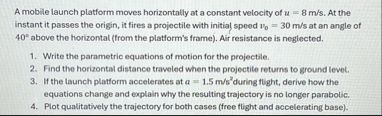 /Amabie aunch platform moves horizontal at a constant velocity of = 8s. At he
Inetantit passes th gin, res pooch win ta spre 30s at an angi of
40% abv the horzona om th los me). A estan i nected.
1. Wika tha parametric acuston of moto oth rjacthe
2. Find the hoszonta distance tmwlad whan th pec rte o ground ve
3. the aun lator accolotes at ~ 1.5 ring ih, des how th
utonschangs and expla why th esciingmecary ho ogy poset
4. Plot ualitatvely the trajectory for both cases (ire fight and acosersting base).
This is AI generated Response.
Asked by: Firdos
Created at: 2025-11-10 03:59:37
Asked by: Firdos
Created at: 2025-11-10 03:59:37
Final Answer:
Rendered
Raw Text
Did you like this answer?
Let's address **part 1** and **part 2** step by step:
---
1. **Write the parametric equations of motion for the projectile**
### **Step 1: Analyze Initial Velocities**
- Platform moves at \( u = 8\, \text{m/s} \) (horizontal, to the right).
- Projectile fired at \( v_ = 30\, \text{m/s} \) at \( \theta = 40^\circ \) (relative to platform).
**Relative to ground:**
- Horizontal velocity: \( v_{x} = u + v_ \cos\theta \)
- Vertical velocity: \( v_{y} = v_ \sin\theta \)
**Explanation:**
The horizontal velocity seen by an observer on the ground is the sum of the platform's velocity and the projectile's component along the horizontal (from the platform).
---
### **Step 2: Write Parametric Equations**
**Horizontal:**
\[
x(t) = (u + v_\cos\theta) t
\]
**Vertical:**
\[
y(t) = v_\sin\theta \cdot t - \frac{1}{2}gt^2
\]
**Explanation:**
The position in each direction is given by the initial velocity in that direction times time, and for vertical motion, minus the effect of gravity.
---
## Final Answer for 1:
\[
\boxed{
\begin{align*}
x(t) &= (u + v_\cos\theta)\, t \\
y(t) &= v_\sin\theta\, t - \frac{1}{2}gt^2
\end{align*}
}
\]
---
---
## 2. **Find the horizontal distance traveled when the projectile returns to ground level**
### **Step 1: Find Time of Flight**
The projectile returns to ground when \( y(t) = \):
\[
= v_\sin\theta \cdot t - \frac{1}{2}gt^2
\]
\[
t \left( v_\sin\theta - \frac{1}{2}gt \right) =
\]
Ignoring \( t = \):
\[
v_\sin\theta = \frac{1}{2}gt
\implies t = \frac{2v_\sin\theta}{g}
\]
**Explanation:**
This gives the total time the projectile spends in the air, considering only vertical motion.
---
### **Step 2: Calculate Horizontal Range**
Plug \( t_{\text{flight}} \) into \( x(t) \):
\[
R = x(t_{\text{flight}}) = (u + v_\cos\theta)\cdot \frac{2v_\sin\theta}{g}
\]
Given values:
- \( u = 8\, \text{m/s} \)
- \( v_ = 30\, \text{m/s} \)
- \( \theta = 40^\circ \)
- \( g = 9.8\, \text{m/s}^2 \)
Calculate:
- \( \sin 40^\circ \approx .6428 \)
- \( \cos 40^\circ \approx .766 \)
\[
R = [8 + 30 \cdot .766] \cdot \frac{2 \cdot 30 \cdot .6428}{9.8}
\]
\[
= [8 + 22.98] \cdot \frac{38.568}{9.8}
\]
\[
= 30.98 \cdot 3.936
\]
\[
\approx 121.9\, \text{m}
\]
**Explanation:**
This is the distance the projectile travels horizontally before hitting the ground, as seen from the ground frame.
---
## Final Answer for 2:
\[
\boxed{R \approx 121.9\, \text{m}}
\]
Question:
Please solved correct answer
This is AI generated Response.
Asked by: Firdos
Created at: 2025-11-10 04:01:50
Asked by: Firdos
Created at: 2025-11-10 04:01:50
Final Answer:
Rendered
Raw Text
Did you like this answer?
Let's continue with **part 3** and **part 4** step by step.
---
## 3. **Describe how the acceleration changes and explain why the existing mechanics apply**
### **Step 1: Analyze Acceleration**
The projectile experiences two types of acceleration:
- **Horizontal Acceleration**: \( a_x = 0 \) (constant horizontal velocity)
- **Vertical Acceleration**: \( a_y = -g \) (due to gravity)
**Explanation:**
The horizontal motion is uniform (no horizontal acceleration) since the platform moves at a constant velocity. In contrast, the vertical motion is uniformly accelerated due to the constant pull of gravity acting downwards.
---
### **Step 2: Relate to Existing Mechanics**
In projectile motion:
- Horizontal motion is independent of vertical motion.
- Vertical motion is influenced by gravity and results in a parabolic trajectory.
**Explanation:**
The principles of kinematics apply here because the horizontal and vertical motions can be analyzed separately, allowing us to use basic equations of motion for each direction.
---
## Final Answer for 3:
The projectile has zero horizontal acceleration and a vertical acceleration of \(-g\). These mechanics apply due to the independence of horizontal and vertical motions in projectile motion.
---
## 4. **Plot qualitatively the trajectory for both cases (free flight and accelerating base)**
### **Step 1: Trajectory for Free Flight**
- **Free Flight**: The projectile follows a parabolic trajectory due to gravity acting alone.
### **Step 2: Trajectory for Accelerating Base**
- **Accelerating Base**: The trajectory will appear more horizontal than the free flight due to the initial horizontal velocity from the platform and the additional horizontal component from the projectile's launch.
### **Qualitative Plot**
```plaintext
| *
| *
| *
| *
| *
| *
| *
|______________________
```
- The left curve represents the **free flight** trajectory.
- The right curve shows the **trajectory from the accelerating base**, with a steeper drop due to the initial horizontal velocity component.
**Explanation:**
The projectile's path changes based on its initial conditions, including the motion of the platform. The horizontal acceleration of the base affects the apparent trajectory observed from a stationary point.
---
## Final Answer for 4:
The trajectories differ qualitatively, where the free flight follows a standard parabolic path, while the accelerating base creates a flatter trajectory due to the initial horizontal velocity imparted by the platform.
📢 Instructions:
- Ask anything relatd to above question only.
- For new Question goto :