This is AI generated Response.
Asked by: Firdos
Created at: 2025-11-10 03:45:24
Final Answer:
RenderedRaw Text
Did you like this answer?
Let's break down the solution into **two steps** as requested, with explanations after each step.
---
## **Step 1: Writing the Differential Equation (Part a)**
### **Analysis**
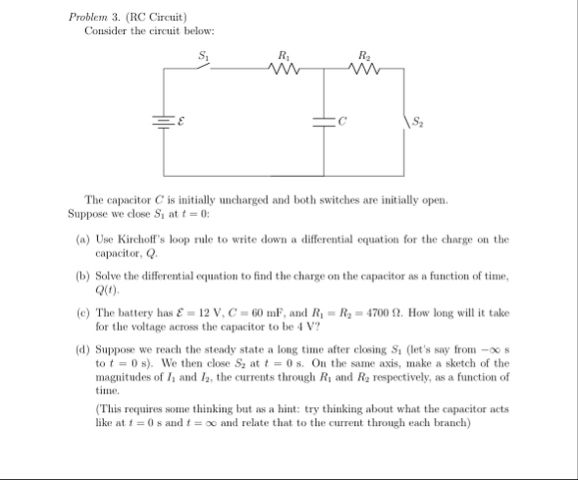
- When \( S_1 \) is closed at \( t = \), the circuit forms a loop with the battery \( \mathcal{E} \), resistor \( R_1 \), and the series combination of \( R_2 \) and the capacitor \( C \).
- The capacitor is **initially uncharged**.
### **Kirchhoff's Loop Rule**
Let \( Q \) be the charge on the capacitor at time \( t \). The voltage across the capacitor is \( \frac{Q}{C} \).
Using Kirchhoff’s loop rule:
\[
\mathcal{E} - I R_1 - I R_2 - \frac{Q}{C} =
\]
But, the current \( I = \frac{dQ}{dt} \), so:
\[
\mathcal{E} - R_1 \frac{dQ}{dt} - R_2 \frac{dQ}{dt} - \frac{Q}{C} =
\]
Combine \( R_1 \) and \( R_2 \) since they're in series:
\[
\mathcal{E} - (R_1 + R_2)\frac{dQ}{dt} - \frac{Q}{C} =
\]
Or,
\[
(R_1 + R_2)\frac{dQ}{dt} + \frac{Q}{C} = \mathcal{E}
\]
**Explanation:**
We used Kirchhoff’s loop rule to sum the voltage drops (across resistors and the capacitor) and set it equal to the battery voltage, resulting in a first-order differential equation for charge \( Q \).
---
## **Step 2: Solving the Differential Equation (Part b)**
### **Differential Equation**
\[
(R_1 + R_2)\frac{dQ}{dt} + \frac{Q}{C} = \mathcal{E}
\]
Rearrange:
\[
\frac{dQ}{dt} + \frac{1}{(R_1 + R_2)C} Q = \frac{\mathcal{E}}{R_1 + R_2}
\]
This is a linear first-order ODE. The integrating factor is:
\[
\mu(t) = \exp\left(\frac{t}{(R_1 + R_2)C}\right)
\]
The general solution is:
\[
Q(t) = Q_f + (Q_ - Q_f) e^{-t/\tau}
\]
Where:
- \( Q_f = C\mathcal{E} \) (final charge as \( t \to \infty \))
- \( Q_ = \) (initial charge since capacitor is uncharged)
- \( \tau = (R_1 + R_2)C \) (time constant)
So,
\[
Q(t) = C\mathcal{E} \left(1 - e^{-t/\tau}\right)
\]
**Explanation:**
We solved the first-order ODE using the integrating factor method, yielding the standard charging equation for a capacitor in a series RC circuit.
---
## **Final Answers**
### **(a) Differential Equation:**
\[
(R_1 + R_2)\frac{dQ}{dt} + \frac{Q}{C} = \mathcal{E}
\]
### **(b) Solution for Charge:**
\[
Q(t) = C\mathcal{E} \left(1 - e^{-t/[(R_1 + R_2)C]}\right)
\]
---
Let me know if you’d like to proceed to parts (c) and (d)!
Question:
Please solved all parts
This is AI generated Response.
Asked by: Firdos
Created at: 2025-11-10 03:45:58
Final Answer:
RenderedRaw Text
Did you like this answer?
Let's continue with the remaining parts of the problem, following the structured approach.
---
## **Step 3: Finding Time for Voltage to be 4 V (Part c)**
### **Given Parameters**
- Battery Voltage \( \mathcal{E} = 12 \, V \)
- Capacitor Voltage \( V_C = \frac{Q}{C} \)
- Desired Voltage \( V_C = 4 \, V \)
- Resistance \( R_1 + R_2 = 4700 \, \Omega \)
- Capacitance \( C = \frac{Q_f}{\mathcal{E}} \)
### **Charge Calculation**
The final charge on the capacitor when fully charged is:
\[
Q_f = C \mathcal{E}
\]
Now, the voltage across the capacitor can be expressed as:
\[
V_C = \frac{Q(t)}{C} = \mathcal{E} \left(1 - e^{-t/\tau}\right)
\]
Setting \( V_C = 4 \, V \):
\[
4 = 12 \left(1 - e^{-t/\tau}\right)
\]
### **Solving for Time**
Rearranging the equation:
\[
\frac{1}{3} = 1 - e^{-t/\tau}
\]
\[
e^{-t/\tau} = \frac{2}{3}
\]
Taking the natural logarithm:
\[
-t/\tau = \ln\left(\frac{2}{3}\right)
\]
\[
t = -\tau \ln\left(\frac{2}{3}\right)
\]
Now, substituting \( \tau = (R_1 + R_2)C \):
\[
t = -(R_1 + R_2)C \ln\left(\frac{2}{3}\right)
\]
**Explanation:**
We derived the expression for the time taken for the capacitor to reach a specific voltage by manipulating the charging equation of the capacitor, applying logarithmic properties to isolate \( t \).
---
## **Step 4: Sketching Current Through Resistors (Part d)**
### **Current Analysis**
1. **Initial Condition (at \( t = 0 \)):**
- Capacitor acts like a short circuit (current is maximum).
- Current \( I_1 \) through \( R_1 \) and \( I_2 \) through \( R_2 \) are both equal to \( \frac{\mathcal{E}}{R_1 + R_2} \).
2. **Steady State (a long time after \( S_1 \) is closed):**
- Capacitor fully charged (acts like an open circuit).
- Current through \( R_1 \) and \( R_2 \) drops to zero.
### **Current Functions**
- For \( I_1 \):
\[
I_1(t) = \frac{\mathcal{E}}{R_1 + R_2} e^{-t/\tau}
\]
- For \( I_2 \):
\[
I_2(t) = \frac{\mathcal{E}}{R_1 + R_2} e^{-t/\tau}
\]
### **Sketching the Currents**
- The currents \( I_1 \) and \( I_2 \) start at their maximum values and decay exponentially to zero as time progresses.
**Explanation:**
The behavior of the currents over time reflects the charging of the capacitor, where both currents decrease exponentially due to the capacitor charging up, eventually reaching zero when the capacitor is fully charged.
---
## **Final Summary**
### **Results**
1. **Differential Equation:**
\[
(R_1 + R_2)\frac{dQ}{dt} + \frac{Q}{C} = \mathcal{E}
\]
2. **Charge Function:**
\[
Q(t) = C\mathcal{E} \left(1 - e^{-t/[(R_1 + R_2)C]}\right)
\]
3. **Time for Voltage to be 4 V:**
\[
t = -(R_1 + R_2)C \ln\left(\frac{2}{3}\right)
\]
4. **Current Behavior Sketch:**
- Both \( I_1(t) \) and \( I_2(t) \) start at maximum and decay to zero over time.
If you have any further questions or need additional clarification, feel free to ask!
VIPSolutions focuses on clear, step‑by‑step explanations so you can learn quickly. Whether you need an AI‑generated walkthrough or a short hint to get unstuck, each solution is organized for fast reading and easy review later.
Search similar questions, compare approaches, and bookmark the best answers for revision. Our goal is simple: quick, reliable study help that feels natural—not noisy.
 VIPSolutions
 Problem 3. (RC Circ)
Consider the circuit below:
s [3 [3
L L "
The capacitor C i initially uncharged and both switches are initially open.
Suppose we cose $y at £ = 0:
(a) Use Kirchofls hoop rule 10 write down a differential equation for the charge on the.
capacitor, Q.
(1b) Solve the differential equation to fine the charge on the capacitor as function of tim,
Qn
(6) Tho battery has £ = 12 V, € = 60 wf’, and = fy = 4700 ©. How long wil it take
for the voltage across the capacitor to be 4 V7
(0) Suppose we reach the steady state a long time after closing Si (e's say from — s
101 = 08). We then chose S; at £ = 05. On the same axis, make a sketch of the
magnitudes of 1 and I, the currents through Ry and Ry respectively, as a function of
pres
(This requires some thinking bit ns bint: ry thinking about what the capacitor acts
like at = 0's ad £ = ond relate that to the current through each branch)