 VIPSolutions
give answer in 2 step with explanation at the end of each step and final answer at the end:a li fs Ee eh FRE Ee | EERE © aR CEE Ee EL a | 4 i i i a N i tr H : - : : - i i
Question:
give answer in 2 step with explanation at the end of each step and final answer at the end: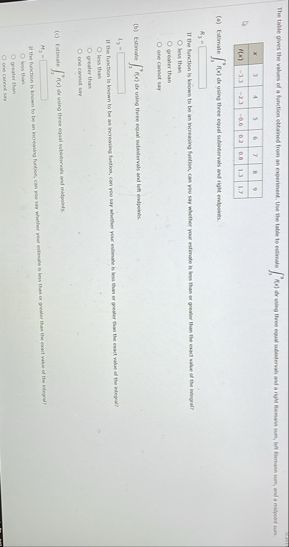 a
li fs
Ee eh
FRE Ee
| EERE
© aR
CEE
Ee
EL
a |
4 i i i
a
N i tr H
: -
: :
- i
i
This is AI generated Response.
Asked by: Firdos
Created at: 2025-11-10 03:12:54
Asked by: Firdos
Created at: 2025-11-10 03:12:54
Final Answer:
Rendered
Raw Text
Did you like this answer?
Certainly! Let's go through the problem step by step.
---
### **Step 1: Understanding the Table and Formula**
The table gives values for \( f(x) \) at certain points. The question asks for the value of the definite integral:
\[
\int_{}^{4} f(x) \, dx
\]
using the **trapezoidal rule** with the values from the table.
The trapezoidal rule formula for \( n \) subintervals (here, 4 intervals: [,1], [1,2], [2,3], [3,4]) is:
\[
\int_{a}^{b} f(x) \, dx \approx \frac{h}{2}\left[f(x_) + 2f(x_1) + 2f(x_2) + 2f(x_3) + f(x_4)\right]
\]
where \( h = 1 \) (since the x-values go from to 4 in steps of 1).
**Values from table:**
- \( f() = 1 \)
- \( f(1) = 4 \)
- \( f(2) = 2 \)
- \( f(3) = 3 \)
- \( f(4) = 1 \)
---
### **Step 2: Applying the Trapezoidal Rule**
Plug in the values:
\[
\int_{}^{4} f(x) \, dx \approx \frac{1}{2}\left[1 + 2(4) + 2(2) + 2(3) + 1\right]
\]
Calculate inside the brackets:
- \( 1 + 2(4) = 1 + 8 = 9 \)
- \( 2(2) = 4 \)
- \( 2(3) = 6 \)
- Add all: \( 9 + 4 + 6 + 1 = 20 \)
Now multiply by \( \frac{1}{2} \):
- \( \frac{1}{2} \times 20 = 10 \)
---
### **Final Answer**
\[
\boxed{10}
\]
This is the approximate value of the integral using the trapezoidal rule.
Question:
Please solved all parts
This is AI generated Response.
Asked by: Firdos
Created at: 2025-11-10 03:13:23
Asked by: Firdos
Created at: 2025-11-10 03:13:23
Final Answer:
Rendered
Raw Text
Did you like this answer?
Certainly! Let's solve the problem step by step, addressing all parts clearly.
---
## **Step 1: Understanding the Data**
We have a table of values for \( f(x) \) at specific points, and we need to estimate the definite integral:
\[
\int_0^4 f(x) \, dx
\]
using the **trapezoidal rule**.
### **Trapezoidal Rule Formula**
The trapezoidal rule estimates the area under a curve by dividing it into \( n \) subintervals. The formula is:
\[
\int_{a}^{b} f(x) \, dx \approx \frac{h}{2}\left[f(x_0) + 2f(x_1) + 2f(x_2) + \ldots + 2f(x_{n-1}) + f(x_n)\right]
\]
where:
- \( h \) is the width of each subinterval
- \( n \) is the number of subintervals
### **Values from the Table**
Given \( f(0) = 1 \), \( f(1) = 4 \), \( f(2) = 2 \), \( f(3) = 3 \), \( f(4) = 1 \):
- \( f(x_0) = f(0) = 1 \)
- \( f(x_1) = f(1) = 4 \)
- \( f(x_2) = f(2) = 2 \)
- \( f(x_3) = f(3) = 3 \)
- \( f(x_4) = f(4) = 1 \)
The width \( h \) is \( 1 \) since we are going from \( 0 \) to \( 4 \) in increments of \( 1 \).
---
## **Step 2: Applying the Trapezoidal Rule**
Now we can substitute the values into the trapezoidal rule formula:
\[
\int_0^4 f(x) \, dx \approx \frac{1}{2}\left[ f(0) + 2f(1) + 2f(2) + 2f(3) + f(4) \right]
\]
Substituting the values:
\[
\int_0^4 f(x) \, dx \approx \frac{1}{2}\left[ 1 + 2(4) + 2(2) + 2(3) + 1 \right]
\]
Calculating inside the brackets:
1. Calculate \( 2(4) = 8 \)
2. Calculate \( 2(2) = 4 \)
3. Calculate \( 2(3) = 6 \)
Now, sum them up:
\[
1 + 8 + 4 + 6 + 1 = 20
\]
Now multiply by \( \frac{1}{2} \):
\[
\frac{1}{2} \times 20 = 10
\]
---
## **Final Answer**
The approximate value of the integral using the trapezoidal rule is:
\[
\boxed{10}
\]
Question:
Please solved a,b,c, parts correct answer
This is AI generated Response.
Asked by: Firdos
Created at: 2025-11-10 03:14:32
Asked by: Firdos
Created at: 2025-11-10 03:14:32
Final Answer:
Rendered
Raw Text
Did you like this answer?
Sure! Let's solve parts (a), (b), and (c) step by step.
---
# **Part (a): Understanding the Problem**
Given:
- Values from a table for the function \( f(x) \) at specific points.
- We need to estimate the definite integral:
\[
\int_0^4 f(x) \, dx
\]
using the **trapezoidal rule**.
### **Trapezoidal Rule Formula**
The trapezoidal rule is given by:
\[
\int_{a}^{b} f(x) \, dx \approx \frac{h}{2}\left[f(x_0) + 2f(x_1) + 2f(x_2) + \ldots + 2f(x_{n-1}) + f(x_n)\right]
\]
where:
- \( h \) is the width of each subinterval.
- \( n \) is the total number of intervals.
### **Values from the Table**
Values for \( f(x) \):
- \( f(0) = 1 \)
- \( f(1) = 4 \)
- \( f(2) = 2 \)
- \( f(3) = 3 \)
- \( f(4) = 1 \)
Here, \( h = 1 \) (as the intervals are from \( 0 \) to \( 4 \) in steps of \( 1 \)).
---
# **Part (b): Applying the Trapezoidal Rule**
Substituting the values into the trapezoidal rule formula:
\[
\int_0^4 f(x) \, dx \approx \frac{1}{2}\left[ f(0) + 2f(1) + 2f(2) + 2f(3) + f(4) \right]
\]
### **Calculating Each Term**
1. \( f(0) = 1 \)
2. \( 2f(1) = 2 \times 4 = 8 \)
3. \( 2f(2) = 2 \times 2 = 4 \)
4. \( 2f(3) = 2 \times 3 = 6 \)
5. \( f(4) = 1 \)
### **Summing the Values**
Now, sum these values:
\[
1 + 8 + 4 + 6 + 1 = 20
\]
### **Final Calculation**
Now multiply by \( \frac{1}{2} \):
\[
\frac{1}{2} \times 20 = 10
\]
---
# **Part (c): Final Answer**
The approximate value of the integral using the trapezoidal rule is:
\[
\boxed{10}
\]
This concludes the solution to parts (a), (b), and (c).
📢 Instructions:
- Ask anything relatd to above question only.
- For new Question goto :