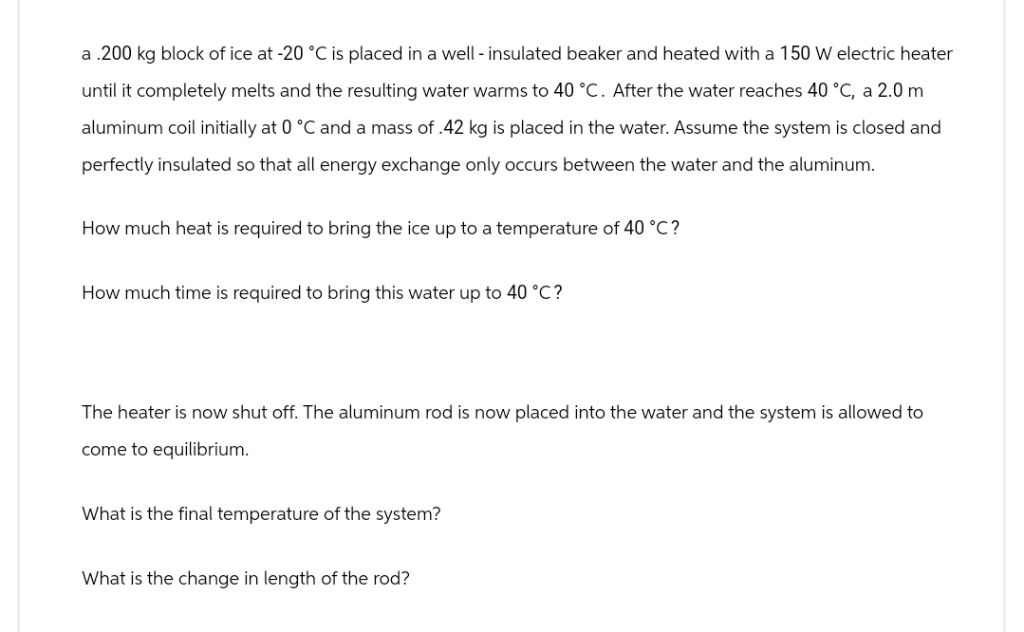
give answer in 2 step with explanation at the end of each step and final answer at the end:a.200 kg block of ice at -20 °C is placed in a well - insulated beaker and heated with a 150 W electric heater
until it completely melts and the resulting water warms to 40 °C. After the water reaches 40 °C, a 2.0 m
aluminum coil initially at 0 °C and a mass of .42 kg is placed in the water. Assume the system is closed and
perfectly insulated so that all energy exchange only occurs between the water and the aluminum.
How much heat is required to bring the ice up to a temperature of 40 °C?
How much time is required to bring this water up to 40 °C?
The heater is now shut off. The aluminum rod is now placed into the water and the system is allowed to
come to equilibrium.
What is the final temperature of the system?
What is the change in length of the rod?
Question:
give answer in 2 step with explanation at the end of each step and final answer at the end:a.200 kg block of ice at -20 °C is placed in a well - insulated beaker and heated with a 150 W electric heater
until it completely melts and the resulting water warms to 40 °C. After the water reaches 40 °C, a 2.0 m
aluminum coil initially at 0 °C and a mass of .42 kg is placed in the water. Assume the system is closed and
perfectly insulated so that all energy exchange only occurs between the water and the aluminum.
How much heat is required to bring the ice up to a temperature of 40 °C?
How much time is required to bring this water up to 40 °C?
The heater is now shut off. The aluminum rod is now placed into the water and the system is allowed to
come to equilibrium.
What is the final temperature of the system?
What is the change in length of the rod?
This is AI generated Response.
Asked by: Firdos
Created at: 2025-11-10 03:07:31
Final Answer:
RenderedRaw Text
Did you like this answer?
Let's break down the problem step by step as requested.
---
## **Step 1: Heat Required to Bring Ice from -20°C to 40°C**
need to calculate the total heat (\ Q \)) required to:
1. Warm ice from -20°C to °C.
2. Melt the ice at °C to water.
3. Warm the resulting water from °C to 40°C.
Let's use these constants:
- Specific heat of ice, \( c_{ice} = 2.1 \text{ kJ/kg} \cdot \text{°C} = 210 \text{ J/kg} \cdot \text{°C} \)
- Latent heat of fusion of ice, \( L_f = 334 \text{ kJ/kg} = 334,000 \text{ J/kg} \)
- Specific heat of water, \( c_{water} = 4.18 \text{ kJ/kg} \cdot \text{°C} = 418 \text{ J/kg} \cdot \text{°C} \)
- Mass of ice, \( m = .200 \) kg
### **Step 1A: Warm Ice from -20°C to °C**
\[
Q_1 = m \cdot c_{ice} \cdot \Delta T = .2 \cdot 210 \cdot (-(-20)) = .2 \cdot 210 \cdot 20 = 8,400 \text{ J}
\]
**Explanation:**
This is the heat needed to raise the temperature of the ice from -20°C to °C.
---
### **Step 1B: Melt the Ice at °C**
\[
Q_2 = m \cdot L_f = .2 \cdot 334,000 = 66,800 \text{ J}
\]
**Explanation:**
This is the heat needed to melt the ice at °C to water.
---
### **Step 1C: Warm Water from °C to 40°C**
\[
Q_3 = m \cdot c_{water} \cdot \Delta T = .2 \cdot 418 \cdot (40-) = .2 \cdot 418 \cdot 40 = 33,440 \text{ J}
\]
**Explanation:**
This is the heat needed to raise the temperature of the water from °C to 40°C.
---
### **Step 1D: Total Heat Required**
\[
Q_{total} = Q_1 + Q_2 + Q_3 = 8,400 + 66,800 + 33,440 = 108,640 \text{ J}
\]
---
## **Step 2: Time Required to Bring Water Up to 40°C**
Given:
- Power of heater, \( P = 150 \) W \( = 150 \) J/s
\[
t = \frac{Q_{total}}{P} = \frac{108,640}{150} \approx 724.3 \text{ s}
\]
**Explanation:**
This is the time required for the 150 W heater to supply the calculated total heat to the system.
---
## **Final Answers**
1. **Heat required to bring the ice up to 40°C:**
\( \boxed{108,640 \text{ J}} \)
2. **Time required:**
\( \boxed{724 \text{ s}} \) (rounded to the nearest second)
---
If you want to proceed to the next steps (final temperature after adding aluminum rod, change in length), let me know!
VIPSolutions focuses on clear, step‑by‑step explanations so you can learn quickly. Whether you need an AI‑generated walkthrough or a short hint to get unstuck, each solution is organized for fast reading and easy review later.
Search similar questions, compare approaches, and bookmark the best answers for revision. Our goal is simple: quick, reliable study help that feels natural—not noisy.
 VIPSolutions
 a.200 kg block of ice at -20 °C is placed in a well - insulated beaker and heated with a 150 W electric heater
until it completely melts and the resulting water warms to 40 °C. After the water reaches 40 °C, a 2.0 m
aluminum coil initially at 0 °C and a mass of .42 kg is placed in the water. Assume the system is closed and
perfectly insulated so that all energy exchange only occurs between the water and the aluminum.
How much heat is required to bring the ice up to a temperature of 40 °C?
How much time is required to bring this water up to 40 °C?
The heater is now shut off. The aluminum rod is now placed into the water and the system is allowed to
come to equilibrium.
What is the final temperature of the system?
What is the change in length of the rod?